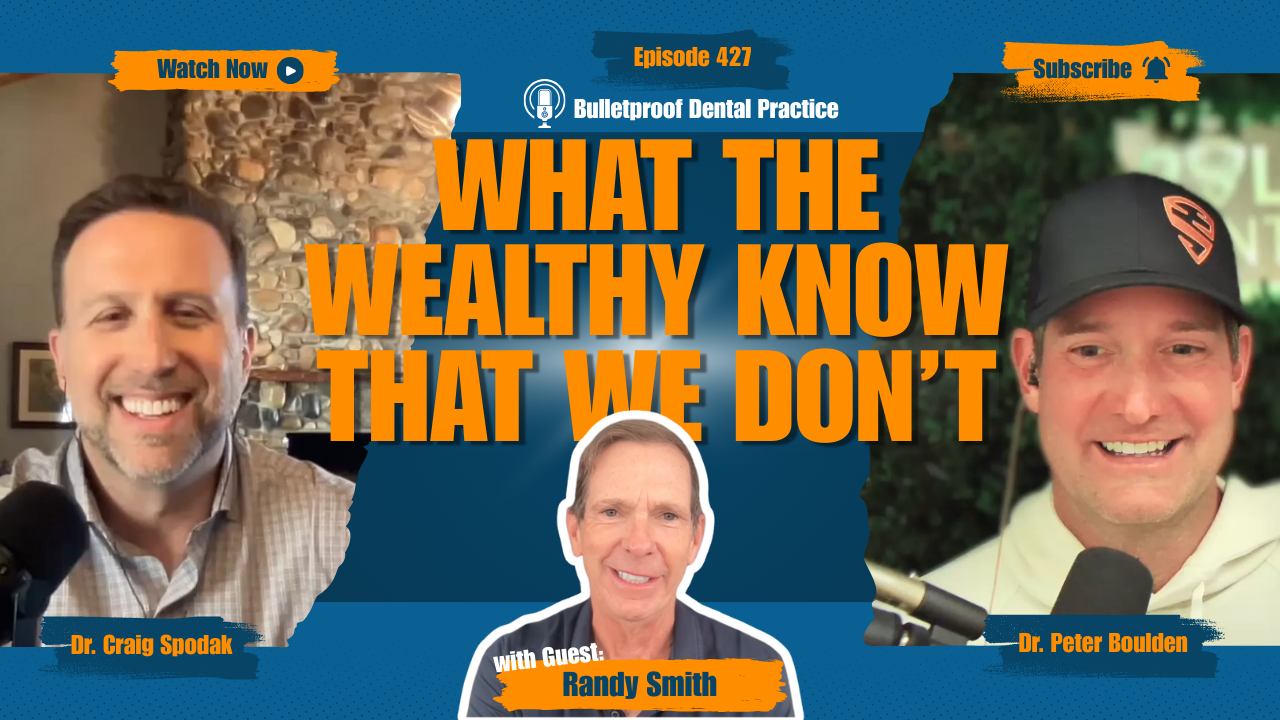
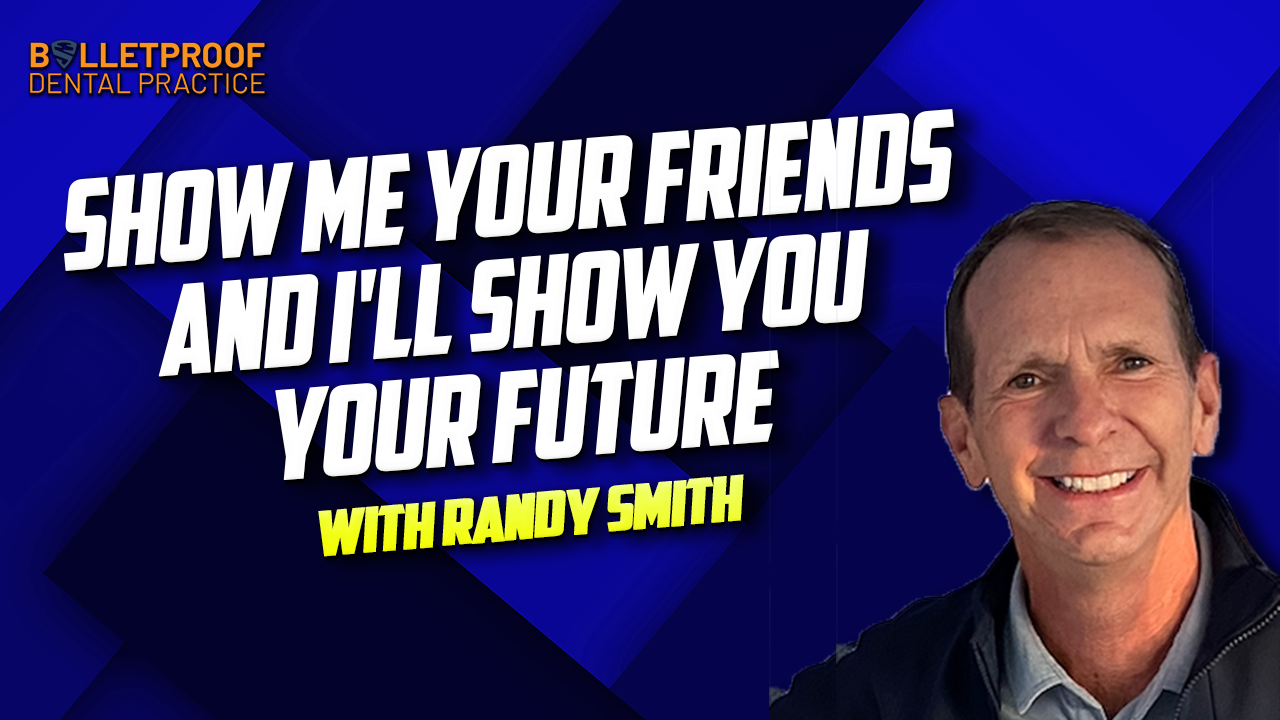
The Roadmap to Financial Success with Randy Smith
Bulletproof Dental Practice Podcast Episode 290
Host: Dr. Peter Boulden
Guest: Randy Smith
Key Takeaways:
Introduction
Updating Financial Statement
Habit of Saving
CPA Vs. Tax Advisors
Educate Yourself On Your Taxes
Mistakes Made
References:
Bulletproof Summit
Bulletproof Mastermind
Bulletproof ERC
Mighty Networks: Bulletproof Dental Practice
The Law of Success In Sixteen Lessons
Tweetables:
Some people don’t take time to educate themselves. -Randy Smith
Relationships matter. -Randy Smith
Full Episode Transcript
Below is the complete transcript of this episode of the Bulletproof Dental Practice podcast. Prefer to listen? Find us on Apple Podcasts, Spotify, and YouTube.
Read the full transcript
The following transcription was from the Bulletproof Youtube channel. Here is the https://www.youtube.com/watch?v=4TxPbWyRzc4
Randy Smith
0:00:00
when you're young and starting out in business and investing, it's like you're driving a car, but instead of the windshield being in front, it's like the rear view mirror's in front and the window is really small, right? And then as you move forward, you're looking back and everything's really clear to see. And it seems like life is always that way on this continuum of wake up, go to work, take care of the family, invest for the future. And as you get towards the end, suddenly the windshield is full-size big and you kind of see what's coming. And it's less having to turn around and see, you kind of know what's around the corner once you've been through 30 or 40 years of this. And that's one of the things that drives me because when I talk to a young entrepreneur in their 20s or 30s, I know that their windshield is really small and they don't see the big picture that I have seen, right? So that's where I try to come in and help them by giving them the vision of what they're missing.
Peter Boulden
0:01:10
♪ In that bulletproof room with you ♪
Peter Boulden
0:01:13
Everybody, welcome back to the Bulletproof Pod. I'm flying solo, but I'm actually flying solo with one of, I would say, Craig's financial proxy. So the guest today is Randy Smith, and it's, like I was saying earlier before I messed up on hitting the record button, that Randy is kind of like Craig's financial sage. And I'm using that term again. And Randy, you can say what you said the first time about the consigliere.
Randy Smith
0:01:51
Yeah.
Randy Smith
0:01:51
Craig calls me his financial consigliere. And I earned that title with him over the last 12 years. I call him my dentist. That's why I have these beautiful teeth right here. Craig and I met 12 years ago in Delray, we've been fast friends ever since and we help each other with advice. Craig is, he and I are wired differently. Our culture indexes are almost the same except for he's more emotion in his decision making and I'm more fact-based, data-driven in my decision-making. And that's just kind of what drives me is the numbers.
Peter Boulden
0:02:30
So yeah, I've heard about you all through the years. You know, I recently got to spend some time with you in person because you came in just spontaneously, was able to speak to our mastermind in Salt Lake. And I thought it was just very timely for us to hear the message of what you were saying. It's one of, you know, I guess first off, let's maybe give a little bit of background on why you are teaching kind of what you do and why you feel called to teach others on this based on having a successful construction company or flooring company, right?
Randy Smith
0:03:02
Mm-hmm.
Peter Boulden
0:03:03
You have a flooring company and then an exit and then really being disciplined with some of the foundations in which you teach kind of from a financial pathways, so to speak.
Randy Smith
0:03:13
Sure, so what gives me the experience, let's say, to be able to talk about this and be what some call a subject matter expert, everything I know, you can read on the internet. In fact, anything you ever want to learn about anything, you can learn on the internet, that's all it is, right? But I started in business when I was 19. My dad lent me some money to start a business because he thought I'd be a good entrepreneur. So I never had to go out and get a real job and deal with any of that. I started this business just on a shoestring and through trial and error, I was able to build it up over the years. After several near bankruptcies, literally, and some amazing saves that kept the company out of bankruptcy over all those years, growing to 13 locations in 11 states, shrinking back to three locations, up and down over this 35 years. And then I finally built the company big enough that I was able to sell it to a top tier private equity firm out of Houston. And that was three and a half years ago, and they're still really happy about the purchase. Since we sold, we've doubled the EBITDA, and the way financial engineering works, that means they're going to make a ton of money when they sell this company again. I'm still the president of the company, but we'll be retiring later this year. So right now I'm working part-time. And along the lines of building a business and going through all those school hard knocks. At the same time, when you finally get to the point where you have excess cash generated, then you usually start a side hustle and you work on your investing life. When you're an employee, it's really easy. You join the 401K, you do a Roth IRA and investing is relatively easy and automatic. When you're an entrepreneur, you have to decide every time you have a month where excess cash comes in, am I reinvesting in the business or am I reinvesting in my case, Randy Smith Incorporated outside of my business. During the years, you decide how to break that out because you want to keep the business healthy and successful going forward, but you also want to have your safety net for yourself outside of the business. And most entrepreneurs will end up in real estate because they'll buy their own building or whatever the normal pathway is to building wealth, wealth generation and security for yourself and your family. But then investing kind of takes on a life of its own. And I'm at the stage now where I sold the company and liquefied, so now I'm just a full-time investor, right? And along with that comes philanthropy, which I'm really excited about, and adventuring. You know, I'm a sailor, I have a catamaran, I've sailed 30,000 miles through the Panama Canal all over the world, and I'm building a new one right now to start some new adventures. So I've gone from the entrepreneurial journey to becoming the investor, philanthropist, and adventurer. And it's a pretty great place to be. And with that, I learned so much along the way that when people come to me and say, hey, Randy, I need your advice, I love to give it. So over the last three, four years, I kind of built this little tool that I've shared with you, which is Randy's Top 20, which is just kind of like my personal finance advice, along with I give business advice as well. I mentor a lot of companies and startups and things like that. So that's my story.
Peter Boulden
0:06:55
I love it. And it's, you know, I love that you're coming from a place of really, you're helping a lot of people, right? And you felt called to do that. And it's no different than I was kind of looking at, you've learned from all the ass kicking that you got in your career. And you're teaching people like, hey, here's some things I would maybe avoid, you know, if I could have, and you're teaching that. And that's kind of the, that was kind of the genesis of Bulletproof, right? Craig and I felt like we had a lot of scars and things and we had gone through the school of hard knocks and learned hard ways and ate a lot of glass. And we figured, you know what, let's maybe see if we can maybe help impact dentistry and help people avoid some landmines that we may have gone through and level up the whole industry from a dental ownership perspective, right? The business and marketing of dentistry, then that's probably what we should do. And so that was kind of, so you're kind of doing the same thing. It's something you feel called to do, talk about your financial acumen and people come to you for advice on this. And yes, going to Randy's 20, which I was able to kind of see it live in person at the Mastermind, a lot of it really resonated with me, Randy. I mean, a lot of the things that you talk about, yes, I was kind of already doing some things, but there were some eye-opening things that I was like, hmm, and it made me audit kind of like my pathway, if you will. Can you talk about some of the biggest mistakes that you've made or some things that you would have done in hindsight?
Randy Smith
0:08:14
Yeah, so first of all, I don't know if I hit on this earlier but I don't do any consulting or anything for money. I do this all for free. I lecture, I go to clubs and make presentations and it's just for the love of the game and to help people and I really enjoy doing that. So for me, what's interesting about being of my career, I'm 58 now, I started when I was 19. When you're young and starting out in business and investing, it's like you're driving a car but instead of the windshield being in front, it's like the rear view mirror is in front and the window is really small. As you move forward, you're looking back and everything is really clear to see and it seems like life is always that way on this continuum of wake up, go to work, take care of the family, invest for the future, wake up, go to work, take care of the family, invest for the future and as you get towards the end, suddenly the windshield is full size big and you kind of see what's coming and it's less having to turn around and see, you know, you kind of know what's around the corner once you've been through 30 or 40 years of this. And that's one of the things that drives me because when I talk to a young entrepreneur in their 20s or 30s, I know that their windshield is really small and they don't see the big picture that I have seen, right? So that's where I try to come in and help them by giving them the vision of what they're missing. When you talk about mistakes, the first one I focus on is the time. Most people are so busy running their business that they don't take time to work on their business or they're so busy in their personal life with kids and sports and maybe helping elder family members or whatever it is that they don't have time to focus on personal finance. And personal finance is a little bit of a science and Napoleon Hill wrote a great book called The Law of Success. And that was like a founding principle book for me. But people that have been there before you, there is a roadmap. And if you just listen to them and follow the steps, it will get you exactly where you wanna go. It's like my kids are in their 30s now and if they would just listen to me and do whatever I told them, it would be so easy for their lives, but they want to go out and make their own mistakes. But there are just steps that you can take. And it's like stepping onto a ladder. And if you see the steps in front of you and you know what they are, and you get on the ladder, it doesn't matter if you're on the first rung, doesn't matter if you're 23 and in credit card debt. If you get on the ladder of personal education and empowerment through financial decision making and knowledge, the first rung is just as valuable as the 99th rung because you're on the ladder and you're going one direction and that is up and to the right over time. I am not the get rich quick guy. I am the get rich slow guy. The get rich quick guy is another guy and you can go listen to him and he only makes his money selling books on tape, right? The get rich slow guys are the ones that get there and they don't lose their money, right? So anyway, so most people don't take the time to educate themselves. I recommend reading. I recommend joining peer to peer networks. People that joined your podcast, who listen to your podcast are doing it. People that do peer-to-peer learning or join a local organization like, what is the, why, what's the one you're in? YTO and like, yeah, YTO, things like that. People that take that five hours a month to work on their personal finance or work on their business because the truth is most people don't. I would encourage anybody listening to this to go out and talk to your friends and say, how much time do you spend dedicated per month on personal finance or ideas to grow your business? Some may do a lot, most have their head in the sand.
Peter Boulden
0:12:39
Yeah, I think that's probably a pretty pervasive problem in just our society as a whole. I think dentists may be a little bit better with things like that, although Craig always contends that like most dentists can't retire on time because of poor planning. So I would actually, yeah, I would like that to be a test for people to go out and how much time are you spending? Or ask your colleagues, how much time are you spending? Because I think one of the fatal flaws is that we are optimistic, meaning we are, I'm making good money and I've got a good business and I'm optimistic for the future. But without a plan, you're kind of planning to fail. And that's why I like what you were kind of speaking on in Salt Lake was really that this takes work like anything else that's worth a shit. You have to put in the work and get a hold around the spotlight of where you are right now in order to make progress for where you want to go. But without having that data point, it's almost like you're just hoping. Like, I hope and I wish and I think. And so you were very intentional about spending a lot of time in your PFS, which is short for your personal financial statement. Which so many of us, I think we actually took a poll that day, didn't we Randy? In the room of 20, right? Highly educated, high earners, very, you know, the cream of the crop in terms of like, yeah, people. And I think we, and you said, how many people here track their net worth? And I mean, it was like of the, let's call it the 20, I think there were maybe two, three hands. Would you agree?
Randy Smith
0:14:15
Most people, most people do a financial statement, Peter, when the bank asks them to. Asks them for it, exactly. If they don't borrow money for five years, they don't do another one. And I'm just like, are you kidding me? Because to me, that's like being on a boat in the ocean. You can't see land and you don't have a compass, right?
Peter Boulden
0:14:36
Right.
Randy Smith
0:14:37
Your financial statement is the compass. It tells you exactly where to go. And people bury their head in the sand. My favorite is, I'm in an investment group of 22 members, and in our January meeting, I asked everybody, did their net worth go up or down last year? Not one of these 22 accomplished individuals had tracked whether their net worth increased. And they did that because of a natural bias. The bias was the market was down 20%. So nobody wanted to look, right? Well, if you look and the market's down 20% and you impair your financial statement, it might affect your decision-making. It might affect you and your spouse's decision on how much to spend on travel this year, or education, or growing the business, or buying new equipment, or whatever, right? So, to me, not only do you have to have an up-to-date financial statement, but, and I will share with you and the group at some point in the future, at your leisure, I have a fairly detailed spreadsheet where it's the financial statement the bank wants to see and then it's the entity structure and everything that you own and then it's your credit lines, lines of credit, any of your debts and then it's annual governance, what do I want to accomplish every year, what are my investing goals for the year, what are my business goals for the year. It's kind of like a spreadsheet that my entire financial life is in this one document. And I open it up every Saturday morning with coffee. I look at everything. I update. Oh, I sold a car. I bought a car. Oh, my stocks are down. My stocks are up. My Bitcoin is down. My Bitcoin is down.
Peter Boulden
0:16:14
Oh, I see this building.
Peter Boulden
0:16:15
I can be in this building.
Randy Smith
0:16:16
Sorry, I got stuck on the Bitcoin.
Peter Boulden
0:16:18
Wait, did you say it went down three times?
Randy Smith
0:16:23
Maybe five. Anyway, so most people are not up to date on their financials and they don't update them monthly. Somebody like me does weekly because I get joy out of it. I enjoy being up to date and knowing where I'm at. But most of my friends have no idea and they know that they'd make better decisions if it was up to date. And to piggyback on that, if people are married or in a serious relationship, what have you, your spouse needs to be aligned on where you guys are at as well, so that he or she can make sure that they're making decisions along the lines of what you know based on what's in those financials, right? And often, husbands and wives are diverted. Husband either goes out and buys a new car every year, maybe not a great decision, or the wife goes out and buys something, or what have you. So really, couples need to be aligned on money matters and they'll have less strife between them about money matters.
Peter Boulden
0:17:20
That's a funny thing about the PFS. You know, it used to be, like you said, the bank will ask for it and they'll say, hey, here's a blank form. Can you fill out your personal financial statement? You know, which I jumped through the hoops for so long in my career. Then I started doing kind of what you're going to, the Randy logic and actually creating a document, gamifying the net worth and looking at it, you know, back then I was looking at it quarterly. And I would tell the bank, I was like, hey, I see your form, but is it cool if I just send you my form? And they're like, absolutely. Right, because it had way more data, it was way more, you know, the page they give you is like little tiny lines and you have to fill in all these little things and it doesn't give a complete view. I was like, this will make, this will A, be time savings for me, it'll give you a B, a more comprehensive look, and C, it'll be a lot more accurate than what I'm about to write on this PFS. And I think literally, there's a, when an underwriter sees this, and I could be wrong, Randy, and maybe we're, you know, this is just a hypothesis of mine that an underwriter sees something like that, and it's like, hmm, okay, loan is approved at this rate. Right, it's just, it's a little bit more impressive.
Randy Smith
0:18:31
It's, it shows that you're a sophisticated business person when you have proper documentation on a personal PFS. The only thing they'll ask you to do is sign the bottom of that other document because they need your signature certifying that the PFS is accurate. What I find amazing is you remember when you're young and you don't have assets, you can't borrow money, right? And you're like, what's the bank for? And then when you get older, you realize, oh, the bank doesn't take risk because they're only making two points on the spread. So they're not taking risk on your business. They're not taking risk on anything, right? They need to know that they have collateral. Your financial statement is what gives them the tools to validate your collateral and therefore lend you money. The better your financial statement is, the less you normally need to borrow and when you do borrow, you're going to borrow at attractive rates. The other thing that's amazing is when you're starting out, and I consider one of the things I like about Bulletproof and your podcast, Peter, is that you guys are dealing with sophisticated people. Yeah. Dentists have the fortitude to go to dental school, build a business, start a private, whether they're working in one or starting one or gonna start one, you know, this is a really good caliber of people. So I think my message plays really good to people that wanna learn, right? My message doesn't play for everybody because they'll go, another rich guy showing us, you know, how he got rich. I like my audience to be the guy that goes, I want to be that guy. You know what I mean?
Peter Boulden
0:20:03
Or that's cool.
Randy Smith
0:20:04
Right? And I want to learn from that. But one of the funny things, back to banks, is normally when you turn in their financial statement, they want you to include all of the side schedules and give copies of current statements and all that. Well, I do a lot of real estate investing. And I'm at a point now where when I send my financial statement, they approve the loan and wire the money. And they didn't even ask me for my current bank statements and brokerage statements. That's how much confidence they have in my document. Now I know that's breaking all their rules, but it goes to show you relationships matter. People's perception of you matters and how you present yourself to your banks, your vendors, you know, whatever, all that matters. friends with your accountant, making friends with your vendors. A successful entrepreneur, everybody is the customer. His employees are the customer, because how often do we have to really work for our employees? A lot, right? Customer is the customer, your banker is your customer, your accountant is your customer because you want them to pay more attention to you. So we're really using our relationship ability to network everybody. And a lot of people when they get into business, they go, finally, I'm the boss. I never had that experience as an entrepreneur. I always felt like the guy that had to spin all the play to make everybody happy and get them to want to do business with me. I was never the boss, right? So anyway, just a thought on that.
Peter Boulden
0:21:33
The other thing is you're talking and kind of, you know, as you're saying is the sophisticated crowd. Yes, I completely agree. And I also say the bulletproof crowd is is one seeking growth, where therefore you're coming to open mind about something right, as opposed to like, I don't know, figure it out. So that that was one caveat. The other thing is, I want to mention, and I don't think we brought this up and in Salt Lake, and I know, you know, kind of a lot about dentists, because you're friends with Craig. But we love technology, Randy, we love data, we love all the things, we are scientists, right? And so we study these things about our practice, right? KPIs of our new patients, KPIs of our collections, KPIs of our growth, all these things, cost of acquisition, and we drill into this. Yet we don't track the KPIs of our, a lot of times we don't track the KPI of our net worth, right? How am I tracking on these parameters? Is it being accretive or am I losing, you know, am I going in the wrong direction? And it's just a phenomenon that I see a lot. And I can't say that I've always been the most disciplined in this area, but like, but once you start getting the hang of it, you start looking forward to it, to your point of the coffee every Saturday morning. It's a highlight of one of your weekends is to see what is the hard work led to. Boom, look at that, it moved the needle. And that is encouraging of more of that behavior. Wouldn't you agree?
Peter Boulden
0:22:57
Absolutely.
Peter Boulden
0:22:58
You had a point that was like, this is an endorphin rush. I like this, let's do this every Saturday.
Randy Smith
0:23:03
Yeah.
Peter Boulden
0:23:04
Which got more and more and more of the activity that made you feel good at Saturday morning.
Randy Smith
0:23:08
Yeah, it's like winning, you know, and people love to win. And it doesn't matter, again, on your financial statement if your net worth is $50,000, you are way ahead of so many people in the world. You're no longer competing with them. You're competing with yourself to grow that for whatever it is that you want to do with that money, for your kids, your family, what have you. The other thing that when I look at people that aren't getting the outcomes they want is they haven't created the habit of savings, right? And the habit of savings, whether it's inside your business or in your personal life, is the most important habit that you can establish because without it, you will never get where you want to go financially. How many of us have friends that make $200,000, $300,000, $400,000, but they do not have a net worth because they pay their taxes and they spend. They have great cars, they have great travel, they have great weekends, but they haven't built net worth because they think that net worth is going to happen down the road someday when a magical bomb of money drops on them. When I sell my practice, when my bitcoin hits, when my in-laws, when we inherit that money or whatever, they're like waiting for this magical bomb of money to come down the road or they just assume that something will happen that will deliver it. But the only thing that really delivers that is diligence and the habit of savings. So every year, there's an old joke out of the book, The Psychology of Money. I don't know if it was Warren Buffet. it, it said you can never get rich by increasing your income. You can only get rich by controlling your expenses. Think about that. If you keep increasing your income, you don't get rich if you spend it all. You only get rich by controlling your expenses. You do this in your business and you do this in your personal. And once you finally hit that period where your business is generating more than the salary you're drawing or the draw you're taking or what have you, and when that magic moment happens, it's so easy to say, let me just elevate my lifestyle a little. Let me elevate it a little more. Let me just elevate it a little more. Or my favorite is, well, my lifestyle and my business is set for what I'm going to earn next year. But then a year later, they've raised their lifestyle once again, right? So without the habit of savings, and there's people, you know, you've heard stories of school teachers that died with a million five because they saved 10% of their money and put it in the S&P 500. And then the grandkids go, Aunt Claire had a million five. Where the heck did she get that? She was a secretary, you know. She saved and she invested in the market and then she had the magic of compound return, right? And anybody can do that on any income level, but most people, Peter, do not believe they can save enough money to have it be meaningful. And the truth is, anybody can, at any income level.
Randy Smith
0:26:22
So, Peter, it is shocking to me how many people, one, have not actually heard about ERC and two, have gotten the wrong information. And you and Trey being two of them, I mean, I consider you to be an epic business person. And when I talked about the insulator retention credit to you, you were really dismissive of me. Like, no, I went through that. I got it. You know, it's great.
Randy Smith
0:26:45
I got it.
Randy Smith
0:26:46
It was done. And even Trey just now, we were just talking to him on the last pod. He's like, yeah, I already, you know, my accounting firm, they got it very little. They only got like five or ten grand. So we know this is totally misunderstood.
Peter Boulden
0:26:54
I was told I didn't qualify until I went to a specialist and they're like, you absolutely qualify. And here's the number. And it almost startled me. Like my jaw was off on the ground.
Randy Smith
0:27:04
I'm like, yeah, you don't actually you don't believe it.
Peter Boulden
0:27:06
You don't believe it.
Peter Boulden
0:27:07
But don't don't ask your CPA. Ask someone who specializes, which is why we actually have this awesome arrangement and we created a link and the company is bulletproof ERC to help kind of implement this because from this pot of money that Congress has allocated we want the people listening from bulletproof to take advantage of it. So this is why this announcement is going on because it's don't ask your CPA, ask the people who this is the only thing they do all day every day.
Randy Smith
0:27:34
That's why we had to do this because initially of telling everybody, telling you, telling everybody, like, oh, I went, we don't qualify. So like, oh, this is not going the way it's supposed to. Like, you have to go to the people that do it. So I'm really proud of that. My buddy, Norm, works for the company. Norm, as you know, like the nicest guy in the world. He's literally like Ned Flanders. He's like, how do you do? He'll fill out your form. He'll walk you through the process. I'll do the zoom call with you. It's literally white glove services. You don't have to do anything. And this is for it. You can either pay up front or they can just take a percentage when they give you the money and it is awesome. You did one, I did the other. We won't tell which one, who did what, but it's a government program. It's going to run out. Do not delay. It's amazing how many people are like, I'll handle a couple of months. I don't have time. You don't need any time like this person right first come first serve and I mean I know the government's treated you well through the cares act and you're thinking to yourself well maybe I don't need this it is your money to have the cares act right it is part of the cares act but a lot I mean even when I thought about like now I'm good I don't want to take you know more money but this is a program that's allocated for people like you who have kept your employees kept your businesses open do not take it for granted. If your account told you, your friend who's a lawyer told you, do not leave that stone unturned. Go to bulletprooferc.com. Spend five minutes. It's worth the due diligence. Do not assume anything. And even if you filled it out, you got something, but it wasn't, you know, what you think is commensurate for your size business, go ahead and reopen the process. You can amend these things for different years. So do yourself a favor, take the five or 10 minutes, have a Zoom call, you may be leaving hundreds of thousands of dollars on the table, which is not prudent for you, your business, and the families that your business supports. Do it for them.
Peter Boulden
0:29:27
So is it more important to establish X percent and stay congruent with that throughout the years, or is it more important to just adopt the principle of savings, even though things feel hand-to-mouth at the time, and then just as later in life, as you check off the boxes of this, this, and this, and this, right, now you can maybe discretionarily save 40%, whereas you started at 5%, if that makes any sense, right? So, staying congruent or adjust along the way?
Randy Smith
0:29:57
Yeah, so, if you're an entrepreneur, you'll end up adjusting along the way, because at some point, everybody gets to that sweet spot where their business starts making them a lot of money. And so your savings rate could go from 10% to 35% that year or the year after.
Peter Boulden
0:30:16
So you're saying as an entrepreneur, you allow yourself the grace to change over time because there may be demands on the business that need less savings and more liquidity into the business. And later on in the life cycle, there may be an opportunity for you to the business is running fine, there's really nothing I can invest in. I now can pull 35% and save 35% of my adjusted gross income,
Randy Smith
0:30:39
or not even adjusted gross, my gross income.
Randy Smith
0:30:42
Correct, if you lock yourself in to 5% or 10%, your income is gonna end up swelling. You're gonna hit those 30s and 40s where you start making a lot of money and you don't want to be limiting yourself to 10% when you've doubled your income. I know that can happen to a lot of your listeners. The other thing is, as we're saving, it's important to do it monthly. A lot of people, many of my friends, just have this thing where they say, I'm going to do my investments at the end of the year. But if you follow the theory of dollar cost averaging, which is almost as magical as compound interest, you're better off if you were going to save 20 grand this year, you're better off putting $1,500 a month into whatever that vehicle is that you're investing in than waiting to the end of the year. There is no 10-year period, you can show me in the history of the US stock market where it would have been better to
Peter Boulden
0:31:40
wait 10 years and put the money in. Or try to time the market or do it at once, one tranche at a time like you're saying, right? The ideal thing to do would have been to do, if you could invest every day, meaning a small little micro fraction every day, that would probably be the ideal thing to do, right? So you're saying the frequency is going to let you capitalize more on the ups than any of that.
Randy Smith
0:32:02
Yeah, private equity firms that want your money and they don't want you to invest in the stock market, they like to tell everybody that if you put a million dollars in the S&P 500 in 2007, it took you 10 years to get back to a million dollars, meaning you made no money. But if you take that same million dollars and you had invested 5,000 a month, you would have 2 1⁄2 million at the end of 10 years because you would have been investing when the market cratered down and then recovering with compound interest as the market goes up. So nobody can outsmart the market and investing monthly rather than annually has dramatic change to your total return.
Peter Boulden
0:32:42
So like you said, there's nothing new. We've heard this philosophy of like pay yourself first and I believe that, I don't know the book, Profit First. Yeah, the book's called Profit. And I think it's just getting the philosophy of like, look, whatever it is, make it habitual, save, take something, right, and allow yourself the grace to adjust over time. I think that is a simple philosophy, but so many of us think we're too smart for that, I don't need to do that, I'll wait till I sell my business. I think it's a great, great thing to just kind of reiterate here, even though it's simplistic at its core.
Randy Smith
0:33:17
Well, one other little strategy that I used for years, again, after going through hard times and then finally making money, every month when we would do our revenue, we'd figure out what our profit was. And then I had a separate bank account at my bank. So instead of being in my checking account, which was my operating account to run the business, I had a separate account. And if the profit that month was $30,000, I wired $30,000 into the separate account and then my CFO and I were only able to spend, run the business, make decisions based on what's over here because the profit was non-negotiable. And then the next month the same thing and the next month the same thing. Now if you ever needed to borrow back because you had a bad month, you could do that. But I found when you left all the money in one account, you kind of get the feeling of being rich. You know, hey, I've got 200 grand in the bank, I can go on this trip, I can go on this, you know, whatever. It's having a lot of cash sitting in your checking account can be a little intoxicating and fun, especially when you struggled before, but I would highly recommend segregating.
Peter Boulden
0:34:19
Greg and I had this same conversation the other day about like, you know, we were basically saying we both get to a place of like this aggregate savings in X account
Peter Boulden
0:34:29
and then deploy it.
Peter Boulden
0:34:30
So we, I was like, dude, I constantly feel poor kind of thing. Cause I'm constantly getting rid of things into assets. And he's like, you know, that's probably a good way to be, you know, always thinking as opposed to if it was just sitting there in X account and you're looking at all the aggregation of, you know, operating plus savings plus this. You're like, I'm good. You know, and it gets complaint.
Randy Smith
0:34:47
You get very, you know, we're all the same, Peter. I have found, even in my personal life, when I have extra money in my checking account, I spend more frivolously.
Randy Smith
0:34:59
Yeah.
Randy Smith
0:35:00
You, right?
Randy Smith
0:35:01
Yeah.
Randy Smith
0:35:02
Just human nature.
Peter Boulden
0:35:04
Randy, I want to go to a different thing, something else that kind of resonated with me that you told to the group is the CPA versus the tax advisor. And it's not versus. They're on the same team. I'm just, so many of us, we talk about, I need a new CPA and dental CPA and this, that, and so few of us have tax advisors. Can you describe the difference in why someone would want to have both on their financial
Peter Boulden
0:35:30
team?
Randy Smith
0:35:31
So, yeah, so two part answer. So first, for the first 20 years I was in business, I didn't have the right accountant. I did not have a tax advisor. Let's just call them the same person for now. I didn't have the right attorney and I didn't have the right business advisor, like a mentor. By the time I figured out that I needed all those, I shopped and found the right attorney. I shopped and found the right tax advisor and then I found a business advisor, a mentor and those three people acted like my board of directors because when you run a private enterprise like this, it's kind of fun to be an entrepreneur because it's like starting a country and you're the king and you get to make all the rules. Think about it, when you run a business, Peter when you walk in the door to your business, you could paint it purple the next day, you could double it, you could shrink it, you could close the door and walk away. It is your domain for you to do whatever you want to do, right? And that's the really, really fun part about it. But you've got to have the team to help you make all those decisions because what do you know about finance and running a business when you start? What did I know? But over time, you get this board of directors on board. Now you guys do it with Bulletproof. I think you guys mentor a lot of your people, and I'm sure some of them are mentoring each other.
Peter Boulden
0:36:57
Correct.
Randy Smith
0:36:58
So you've got this network of people to talk to. But the attorney, that was relatively simple to find a good one. I found a good one, and what made him good is if somebody owed me $10,000 and it was going to cost me $15,000 to collect it, my attorney wouldn't tell me, Randy, don't bother, write it off. My attorney says, we're not gonna let that person steal $10,000 from you. So even if it costs 15 to get it, we're gonna go get it. That's the guy that I wanted on my team, okay? So when it comes to an accountant, right, an accountant's job is to take the data you give them and understand the tax code and fill out your 1040 and have you sign it and send it to the government. They're simply just doing what a spreadsheet like TurboTax can do for you, okay? They're following all the rules that are the framework, the easy rules, right? The tax code is 6,000 pages. Thirty pages of the tax code tell you what you owe. It's the schedules, right? 5,970 pages are the incentives, often called loopholes, where you can use the tax code to your advantage to minimize your tax. When you minimize your tax, you basically keep more money. Then you can invest money and have it be making infinite returns for 30 years on money that you would have otherwise sent to the government. And it's important to understand that I'm not talking about cheating the government. I'm talking about following the laws the government has established to pay the minimal amount of tax. And as a citizen, my duty isn't to overpay. My duty is to pay exactly what I owe and not a penny more, right? So, and it's a big accelerator on your net worth. Most accountants cannot do this for you. Number one, they could be, pardon me for saying this, they could be jealous of you, right? They could be jealous of the success of your practice and they kind of want you to pay the tax, right? And my favorite, and I fired accountants,
Peter Boulden
0:39:02
Why did the accountant want you to pay the tax?
Randy Smith
0:39:04
My favorite is when the accountant says, I say, this, something's wrong. This tax bill is too much. And they go, Hey, what are you complaining about? You're making money. That's not your tax advisor. That's the guy that literally wants you to pay the
Peter Boulden
0:39:17
most. So can I interject something real quick and then I don't want to derail you, but how much of that is them doing a, and I don't want to paint all CPAs in a bucket, but how much of it is a CYA, a cover your ass scenario? Because they're the ones signing the returns. They're like, dude, just pay the money. But it's my money. Like, yeah, just pay it, because I'm the one signing your returns. And so there's not a bunch of like, hey, we could do this or this strategy or look at this. It's just pay your taxes and move on.
Randy Smith
0:39:46
I would say not only do they want to protect themselves for sure, because it would be malpractice if they were doing really bad tax returns and costing their clients money, but they also want to protect you. What if you're too aggressive on your taxes, right? You don't want to end up in handcuffs, right? And there are people out there that once they start making money, they start lying on their revenue and trying to play a shell game with the money to minimize their tax bill. Or worse, they don't have the cash to pay the taxes, so instead of saying, I don't have the cash and telling the IRS I'll pay you when I can, they cook the books to show that they didn't have to pay it in the first place, right? And there's so many people, Peter, that fall into that trap. And trust me, when they got out of school, they didn't think they were going to be criminals, but they just fell into making some bad decisions. So what a tax advisor does, tax advisor reads the tax code, and they read the changes and updates that come out every year. They think about you and your business. Then they look at your situation. Do you own your building? Who owns your cars? Does your wife or spouse work at the practice? They look at all your situation and they take what they know about the tax code and they inject strategies that will reduce your total tax. If you reduce your tax, there's more money for you to invest, spend, save, give to your kids, reinvest in your business, or anything else you could do with that money, right? But a tax advisor is thinking in that respect. They actually are thinking of how you can pay the least amount of taxes. Accountants
Peter Boulden
0:41:33
just don't do that. It's not how they're wired. So, yeah, I think so few of us have kind of tax advisors and when you were talking about like look, I went out and assembled the team. I got, you know, this team around me and attorneys and tax advisors, CPA, and they were all kind of rowing to the same or, you know, marching to the same beat, so to speak. And I was thinking as you were saying that, like, you know, early in my career, I didn't have any money. So those people would not have talked to me possibly, you know, maybe that's it. And so, yes, you can sit here and say that you assembled that, but it's easier when you're like, hey, I'm Randy and I just exited my business for a lot of dollars and I need a team. They're like, yep, yes sir, yes sir. So how do you advise someone who's maybe listening to this that maybe has some student loan debt, maybe has some consumer debt, right? And now you're talking about a financial team for them. Like do you know what I'm trying to say?
Randy Smith
0:42:27
Like there's a dichotomy
Randy Smith
0:42:27
of those worlds? Sure, sure. So I assembled my team when I had less than a million dollar net worth, right? So they were actually part of the growth. But the day I started I wouldn't have been able to get any of them on the phone, right? So you got to get in business, you got to get your feet wet, you got to get the ball rolling, you got to use your network, talk to people, make friends and you got to make friends with your accountant. Your accountant can become your tax advisor and also everybody you deal with in business Peter when you go to Merrill Lynch and you open your account or your 401k and you put your first $5,000 in there, that person is looking at you going Peter you're a dentist, that $5,000 is going to be $4 million when I'm 60 and they're going to be earning money off you and that growth with their fees. The accountant looks at your business the same way. They'll give you a better deal the first couple years, but they know you've got potential. That's one of the great things about dentistry and you guys building these practices. The bankers, the attorneys, the accountants, they want you on their team and they want to be on your team because they know you have potential. So when you interview an accountant, you know there's a great book called Tax-Free Wealth by Tom Wheelwright that I highly recommend. And when you read that book, in the back, he tells you how to interview for a tax advisor. He basically gives you step-by-step instructions on how to walk in and sit down with your accountant and say, let's talk about these things. And you can easily see if that's the right fit for you. You want the person that's aggressive and willing not to bend the rules, to investigate the rules, to see what they can do to help you minimize your taxes. For example, I bought a building and I owned it for 10 years and when I finally got the right accountant on board, he walks into my office and he goes, did you do a cost segregation study on this building and figure out what you could depreciate faster than 39 years? And I said no. So, my previous accountant had taken the cost of the building and divided it over 39 years.
Peter Boulden
0:44:29
39 years.
Randy Smith
0:44:30
And that was my depreciation, 39 years. So this guy hires an engineer for a couple grand, comes in and basically figures out that my building's a POS and it's not going to last 39 years, it's not going to last seven, and he was able to get me a million dollar write-off in year one because the building had been depreciated so much. These are two accountants that both are in Boca Raton, Florida, that both charged me the same price to do my taxes, and one said, hey, Randy's old building, I wonder if he's fully depreciated that. You know, there's a law for that.
Peter Boulden
0:45:02
Yeah, bonus appreciation.
Randy Smith
0:45:03
Yeah, and he saved me all that money. That's the difference between an accountant and a tax advisor. And the accountant that I had before, when I switched to this guy, he would have told me, why do you want that now? You could just take that over 39 years and come every year. And I said, cause I'd always rather have money now, not later. So anyway, that's a little, that's a little.
Peter Boulden
0:45:26
Yeah, because back to your point, money now is able to redeploy into your business or invest and have the time value of money over time, not over 39 years. So I love it that you bring that up. And something you said in Salt Lake was, hey everybody, raise your hand. What's the biggest expense of our lives is? It's kind of a pause.
Randy Smith
0:45:46
Nobody gets this question right, Peter, nobody. Like it's taxes.
Peter Boulden
0:45:50
Taxes are the biggest expense. Therefore, isn't it incumbent upon you to learn how, to learn the code, to learn the laws, to be an advocate of paying less money by following the letter of the law. Yeah, yeah, because to your point, back to the business, right, back to the business, or back to the building, rather, I should say, which allowed then more cash flow to then be reinvested or redeployed in your business. So I love that that question was brought up, and actually I didn't even answer it.
Randy Smith
0:46:20
Number one answer, Peter, people say, my mortgage is my most expensive expense of the year. Some people say kids tuition. Some people, you know, it goes around the horn because people think about what they pay. People love to forget that their tax bill to the federal government is the biggest expense of their life over any period of time. So if you add the tax on sales tax and gas tax and alcohol tax and everything else, you realize that you really pay about 55% of your total dollars in tax, right? But just the federal income tax, if you're in a 20 to 40% bracket, is usually your biggest bill of the year. And I want people to understand their tax return. I want people to read every page of their tax return.
Peter Boulden
0:47:07
Yeah, they're probably not going to do that, Randy.
Randy Smith
0:47:09
And ask questions and understand, because they're going to find mistakes. You want everyone to read 6,000 pages of the tax code? No, no, no, no. I want them to read their tax return. Oh, sorry. No, no, no. I don't want anybody to read the tax code. You can hire somebody to do that for you. That's your tax advisor. I just want them to read their tax return because they're going to find mistakes on it and they're going to understand it better. And then something's going to happen in July and you're going to go, oh, this is actually a business expense. I didn't realize when I went to the conference that I could charge that against the business. I mean, there's some people that forget that stuff, right? So educating yourself on your taxes is important. Understanding your own tax bill is important. And in January, you should start your tax planning. Most people say they start their tax planning in December.
Peter Boulden
0:48:00
Yeah, I think one of the biggest takeaways too that you've kind of taught is, not to loop back to the PFS, but when we look at the KPIs in the business, we found this phenomenon, Randy, is that the things that we track usually increase or get better. The KPIs that we look at in our business, if we are systematic, we're looking at as a business owner, as a practice owner, they inherently kind of get better. Just as like your psychology goes to play on how to increase it, how to make it better. I think the same thing applies with the frequency on which you visit your personal financial statement. You do it weekly, I do it maybe monthly or quarterly, but those who never look at it, it's just like it's probably not, your psychology is not working towards anything other than just like, oh, I hope it works, I hope it works. So I love the systematic approach, saying like, just get the data in front of you so you can make decisions, so you can gamify this life, so to speak. Because ultimately, like, we just want to use dentistry to build independent wealth through cash flow and our creative kind of enterprise value of our practices and real estate, pay less tax, like, and live a happy life. That's kind of what all humans want to do, you know?
Randy Smith
0:49:10
And happy customers.
Peter Boulden
0:49:11
And happy customers, of course, of course. That's a given. That's a given, right? The experience of our patients. That's awesome. I know you're going to be speaking, you know, after I heard you speak in Salt Lake and I was kind of looking at some of the light bulb moments that were going on in people's faces. I was like, you know, our community needs more of Randy and you and I are, I think I told you in full disclosure, I was like, I want to kind of be the Randy version in dentistry down the way, right? And really helping, you know, kind of jumping in more of this financial acumen and helping people, people, teach people like you are doing. Like, you know, I focus more on the statistics and stuff and the marketing and the data. Craig always makes fun of me that I'm always like, hey, give people the steps. You just want to give people the steps, the five steps to doing it. And I'm like, yeah, you're right, I do. And I always say, and you always want to talk about how they're feeling and kumbaya and what's your vision? And I was like, so we're a good compliment. But I resonate more with your plan. So we're kind of collaborating, Randy, is what I'm telling the audience. Randy and I are kind of collaborating, creating kind of a bulletproof financial plan that we're going to kind of present in the summit of August. Because it's such a big factor. The dentists need to, we need, you know, as a community, we need to know this stuff so we're kind of working on this this financial plan because there are different phases of your life which require different attention right meaning that you're not ready for alternate investments and conservation easement stuff when you still have consumer debt and you're not you know like so there's different there's a pathway no different than our bulletproof pathway that people to help their net worth, essentially, right? Did I say that? Did that, did that, I feel like I went on a little bit of a rant there, but. No, no, you nailed it.
Randy Smith
0:50:59
And Peter, what's interesting is, if 30 to 50 people watch my presentation, right, where we're gonna talk about the pathway and my 20 main points. If a couple of those people adopt some of the techniques and embrace it, it's going to change their life and they're going to email me 20 years from now and they're going to say, that changed my life because I've had those aha moments. I've read those books. I took those notes. I've had that entrepreneur give me that piece of advice and I want to reach back out to all of them now and thank them for setting me on that path. I hope in some small part I can do that for your audience. I certainly put the time in for it. If the hours that I put into personal finance were a college course, I'd be a PhD. Well, it's like that 10,000 hours. And I don't know that much about economics. I just know personal finance.
Peter Boulden
0:52:07
You know, it's funny you say that. I think that was one of the classes I took economics in. It's funny, Craig says, you love macroeconomics and all this financial stuff. And I was like, I think I got a C minus in college in economics, because I just didn't. It didn't work. So I'm with you. But now I feel like I'm better at understanding all that stuff just because of going through the school of hard knocks. I just got my ass kicked a couple times and made a bunch of mistakes. I love listening to people who are 10 years ahead of me in terms of age and things like that. I love listening to the missteps that you took so that maybe I could avoid them as I'm going. Like you said, if one person reaches out and says, dude, you changed the trajectory of my life. I had no idea I should have been tracking my PFS. I had no idea I needed a tax advisor. I have no idea these people should be talking together. And that is the shit that makes it all worthwhile. You know what I mean? So I'm excited for you to be able to lean into our audience there. And I want to thank you for spending the time today kind of going over this. And you can get your daughter to come back in the room and tell her you're all done this pod and ready to go. But really in all sincerity I want to thank you again for helping.
Randy Smith
0:53:22
Alright, thank you Peter and thanks to all the listeners. It's my pleasure and I look forward to meeting many of you in Las Vegas.
Peter Boulden
0:53:36
Bang, bang, bang, bang, bang, bang Loaded cock and lamin' shoe Loaded cock and lamin' shoe Loaded cock and lamin' shoe We gon' die livin' like the crew We gon' die livin' like the crew Yeah, we bang, bang, bang, bang, bang
Transcribed with Cockatoo
Blog




















1+1=3 The Power Of Alignment and Delegation For You and Your OM with Erika Pusillo
, October 31, 2024


















, June 15, 2023

, June 8, 2023

, May 31, 2023








Look at These 3 Stats if You’re Thinking of Going Out of Network with Teresa Duncan
, January 11, 2023

, December 28, 2022



Knowing What You Don’t Want with Judy Kay Mausolf of Culture Camp and Erika Pusillo
, November 30, 2022



Cabo This Week, Immersion Learning, Biggest Breakthroughs, Your Personal KPI is Net Worth
, November 2, 2022
, October 19, 2022










Business is not Productivity, Productivity is not Profitability with Chris Salierno
, September 22, 2021



























3 Biggest Bottlenecks of an Entrepreneurial Dentist: PART 2 with Perrin DesPortes of TUSK Partners