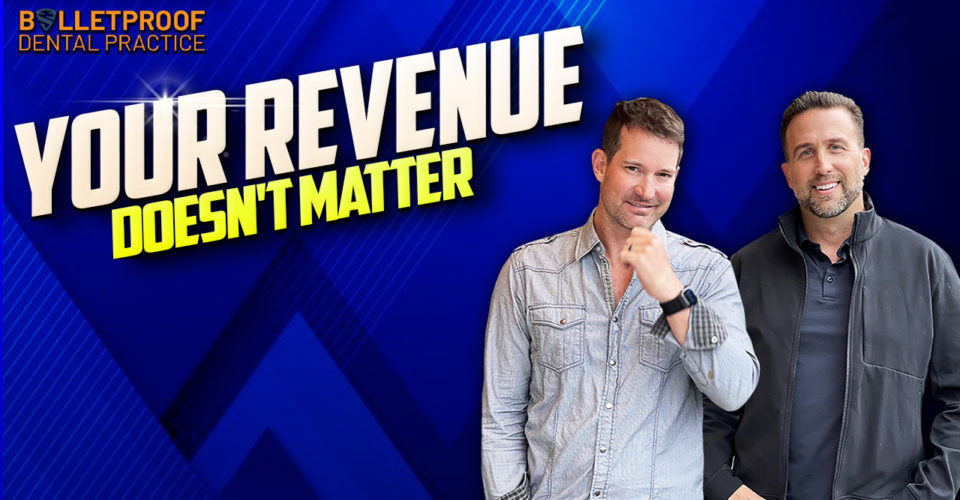
Your Revenue Doesn’t Matter
Join our network at www.Bulletproof.Dental to stay in the know on all things Bulletproof!
Bulletproof Dental Practice Podcast Episode 216
Hosts: Dr. Peter Boulden & Dr. Craig Spodak
Key Takeaways:
Intro
Take Action
Profitability
Own A Business Not Just A Practice
References:
Mighty network: Bulletproof Dental Practice
Tweetables:
Gross really doesn’t matter. -Dr. Peter Boulden
You cannot shrink your way to greatness. -Dr. Peter Boulden
Audit where you are with your expenses. -Dr. Peter Boulden
Assets are the best thing by far, ever. -Dr. Craig Spodak
Begin with the end in mind and start training yourself. -Dr. Peter Boulden
Don’t conflate a business valuation with an iconic producer. -Dr. Craig Spodak
It feels good when you know your strengths and weaknesses. -Dr. Craig Spodak
Full Episode Transcript
Below is the complete transcript of this episode of the Bulletproof Dental Practice podcast. Prefer to listen? Find us on Apple Podcasts, Spotify, and YouTube.
Read the full transcript
The following transcription was from the Bulletproof Youtube channel. Here is the https://www.youtube.com/watch?v=pb9LuYVw4Os
Peter Boulden
0:00:00
Hey everybody, welcome back to another episode of the Bulletproof Dental Practice Podcast.
Craig Spodak
0:00:08
I'm Peter Bolden. And I'm Craig Spodak. Dentistry can sometimes feel lonely. Having over 45 years of combined experience and the chops to run eight successful practices, our mission is simple. Pay it forward and share what we've learned. That's why we developed the Bulletproof Pathway to help you navigate your way to ultimate success in dentistry. And don't forget to join our community's conversation over at Bulletproof.Dental. Now let's get to it. Hey everybody and welcome back to another episode of the Bulletproof Dental Practice Podcast. Remember back in the you'd get so mad at me? Yes, I remember like it was yesterday. It was yesterday, actually. So it's just Peter and I today, and we're really excited to be rapping about something that we always talk about. And I feel like half the conversations that Peter and I have should just be recorded. And we'd have a lot more content because we have inadvertent podcasts all the time. And Peter, this was actually something that came up from you. You went and met with somebody that's like, hey man, my practice is worth, you know,
Craig Spodak
0:01:23
blah, blah, blah, blah, blah.
Craig Spodak
0:01:25
Like, well, based on what? Well, I got a mailer and that mailer said that we're gonna pay you whatever it was, three, five, 10, who cares? How many times are you gross? Like, ridiculous levels of money. And you peeled back and looked at the P&L, which they ultimately would have as well, and realized that there was really no net profit. And you're like, I'm out, thank you,
Peter Boulden
0:01:48
but no thank you, I can't compete with that. Yeah, that was, well, I've had two interesting ones. One was where I looked at the practice, and it was, you know, a couple million, actually it was about a $1.5 million practice. And I was like, well, you know, after looking at it and talking with him and,
Craig Spodak
0:02:04
you know, like, well, you know,
Peter Boulden
0:02:05
we think it's worth about three million. And I was like, hmm, interesting, why? And they was like, well, there's, you know, I got an email or a mailer saying that we'll pay 200% of top line revenue from someone.
Peter Boulden
0:02:16
Did you get an LOI?
Peter Boulden
0:02:17
No. So anyway, in this scenario, Greg, I said, look, your practice is netting about $125,000 a year, your practice is worth, at best, $600,000. What would have been the multiple?
Craig Spodak
0:02:29
Do the math, so do that math. Yeah, the multiple on that would have been, right,
Peter Boulden
0:02:35
so let's call it 20X almost. Yeah, 20X, yeah, that's wonderful.
Craig Spodak
0:02:40
He's trading it higher than like Disney does. So I guess my thing is, the reason that we talk
Peter Boulden
0:02:46
about this a lot, Craig, is because I think dentists are tracking the wrong thing and always have been. And especially if we get into this era where there is private equity sending out mailers and private equity is the buyer of certain resorts, that we need to also get, as dentists, we need to get our mind wrapped around the fact that it's not about 85% of top line revenue, like most banks will loan from, right? It's not the day of transferring to the doctor. One doctor is selling to another doctor. Oh, it's about 85%. You know, that's what I'm gonna sell to you. We need to wrap our minds and heads around the fact that we are running a business and true businesses sell for multiples of revenue, net, net revenue, not you. Not you as the dentist that work for free revenue, net, net revenue. And put a pin in that for a second,
Craig Spodak
0:03:40
that dentist working for free, we're gonna come back to that in just a minute.
Craig Spodak
0:03:44
That's important.
Craig Spodak
0:03:45
When you harp on that, right,
Peter Boulden
0:03:45
you always say that if dentists were to kind of back out what they did, they sometimes would be better off working as an associate because they're net profit after they take out what they would have paid themselves, you know.
Peter Boulden
0:03:57
So.
Craig Spodak
0:03:58
And I think, and the top line thing is such a luring, you know, it's like number of new patients without talking about net patient growth. And we always talk about that, but it's also the top line. I myself, like you and I are enamored by that. You know, we, we, when we first met, we became friends, you know, five years ago, it was like, you saw my top line. You're like, wow, that's cool. My top line at that point was larger than yours, but you know, it was interesting through our friendship and, and like, I guess, co-mentoring each other, I started realizing, okay, Bolden's got a smaller top line but a better net. Why do I even care what my top line is? But I think we're trained in the dental vernacular to talk top line. We're talking that full gross new patient number.
Peter Boulden
0:04:42
It's an easy way to give someone scope of what you do, but it doesn't give intel onto what kind of business person you are. So you can have $10 million revenue and $100,000 net, just like this example I gave. But really where the rubber meets the road, where things become more interesting, more valuable, is when you start thinking about it in terms of a dollar percentage of EBITDA, or an EBITDA dollar, right? And after a net net dollar versus something that's just gross because gross really doesn't matter. At the end of the day, like if your business is doing $10 million top line revenue and spending $10 million to get there, it's essentially a business that just runs, it's worthless at that point, right? Because like who wants to go through all those operations for zero benefit?
Craig Spodak
0:05:31
So at the end of the day-
Craig Spodak
0:05:32
Your net profit is your reward for work and your top line is how much work you're doing. So you wanna get reward for work and not just do more work. It's kind of like it can translate into an insurance conversation as well. Are you seeing 500 patients in a given period of time making $5,000? Would you rather see 100 patients and make that $5,000? You know, it's just gonna be better for you. And I think that we conflate the idea of busy and top line revenue with feeling good. And really, like you said, with the rubber meets the road, that's the only thing that should matter to you, only. That's all that should matter is your net.
Peter Boulden
0:06:09
If your CPA is not giving you that kind of intel, and I don't really care how big your practice is, it's always good to get in that habit because eventually someone's gonna have that conversation with you. But ask your CPA, hey, calculate my EBITDA. Tell me, what would this be? What is my true EBITDA on, you know, because lots of times they'll give you a net, but it's an owner's net, and so I say,
Craig Spodak
0:06:31
give me a true business EBITDA. I call it entrepreneurial profit. So it's like basically take your, all your expenses, if you're a solo doctor, add on your, above the line, above the line of net profit, add a associate percentage to your expenses. Whatever it is, 28, 32%, doesn't really matter. Put 30% in. If you have profit left over, you have a business. If you run negative, you don't have a business, you bought yourself a job, and you really have to take action. Either A, make it better, or B, work for somebody else, because you're running into a deficit, because if something happens to you, all the people that depend on you
Peter Boulden
0:07:10
won't be able to sustain themselves either. The good news is, is typically in some P&Ls or most P&Ls, the EBITDA is actually more than what the net P&L is showing you because there are so many add backs and owner benefits that we, as business owners, take advantage of, right? Life insurance, cars, meals and entertainment, all the things that benefit you are actually add backs. So if you're looking at your P&L right now saying like, man, it's only $200,000. Well, there's probably a lot of owner benefit in there that gets added back into the equation. And just like Craig and I have had that conversation, maybe we haven't had this publicly, but I remember we were talking about the free food at your house, the lunches at your house, at your dine house, that we talked about that and you're like, well, you know, it's $75,000 a year. And I was like, well, actually, Craig, it's whatever we were going for the time, is actually on open market, it's about nine times that. At your size, it's about nine times that. So it's gonna cost you one day about a million bucks to have provided lunch.
Craig Spodak
0:08:15
Isn't that freaking crazy? So when you think of your business valuation, I just wanna unpack what you just said. It's not a dollar of net profit or 50,000 or $10,000. It's the multiple of what your business would be worth, that's the true cost. So 77, even conservatively speaking, a six multiple, I mean, that's huge, it's half a million dollars.
Peter Boulden
0:08:36
So here's, I love, let's harp on that for a second, because sometimes people will say, even in the summits we'll talk, well maybe, you know, I wanna work on getting my supplies from like five down to four and a half, or six down to whatever, and it's like, well it's only gonna save me, you know, maybe $20,000 a year. And I'm like, correction, right? It's gonna save you a multiple of that. So a dollar saved.
Craig Spodak
0:08:58
Is seven earned.
Craig Spodak
0:08:59
Is seven or six or five or whatever,
Peter Boulden
0:09:01
but it's a multiple of earned, not just what you get. And also, even if you're not willing to sell, you also get that every year until you decide to do that.
Craig Spodak
0:09:09
Right? Meaning you just run a cleaner operation.
Peter Boulden
0:09:12
You just run a cleaner operation.
Craig Spodak
0:09:13
It's like you and me and the credit cards. We thought we had beaten the hell out of credit card merchant processing fees. You had said you had beaten them so good, you had really, oh Peter, there's no way. I am so good at this, and I'm saying I'm so good at this. I mean, how many thousands of dollars between you and me, and just in fees, have we saved? 5,000?
Peter Boulden
0:09:34
Through MCC? Yeah. Yeah, it's crazy. I mean, on the order of, yeah. And that was free money. Really, we did nothing. So, yeah. So probably you and I both saved $10,000 a year in credit card
Craig Spodak
0:09:45
processing at least. And so, um, but it's just crazy that this thing like y'all there's little things like that or like refinancing debt, you know, like I've, those are things that like you've made money by signing papers. We made money. We made that money by signing papers with MCC, for example. I refinanced my building.
Peter Boulden
0:10:05
Now, Craig, I want to push in on this, though, too, because this is where I think you cannot shrink your way to greatness, meaning that this is not the place to cut cotton rolls and do things and all of a sudden just only be focused on profitability.
Craig Spodak
0:10:18
Yeah, because a scared money don't make none. It's really, that is gonna be a problem for you, because it creates an environment of scarcity. You can't, it's true, you can't trim your way to that. Be efficient where you can trim, but really it's better to grow through it.
Peter Boulden
0:10:33
Grow through it. Yeah, take all, look, take your P&L, take all your expenses, even look at your Amex if you've consolidated that. Look at the areas in which you're saying, look, this is fixed expenses. I can't negotiate my rent. I can't negotiate the mortgage. I can't negotiate the light bills. Can't negotiate the cable. Well, actually you probably could negotiate the cable, things like that.
Craig Spodak
0:10:51
So maybe look at- Negotiate the mortgage, that's for sure.
Peter Boulden
0:10:53
Yeah, that's true too. But look at where you can, look, most things are fixed and you're just gonna leave those alone. But there are some variable expenses that you can negotiate with. And it's a good time to kind of revisit some of those with vendors, with all those things and saying, hey, I might go to X, Y, and Z software. I might go to X, Y, and Z vendor. I might go here, unless you can incentivize me to stay. It's always good to audit where you are in your expenses, is my point. It's worth your time. And one more thing, I know we're jumping around a little bit,
Craig Spodak
0:11:22
but I want to circle back to a point that you made a moment ago. You told me, you had said like, oh, look at what you're making, and have all the ad backs of your car or whatever else you run through your corporation on what you made, 200 grand or whatever you said. That means another point to make, and I help a lot of dentists just by saying this to them, so I'm happy we're talking about this in the podcast at scale, but the other day we had a guy in our mastermind who was really kind of upset, he was like, hey, I'm only making this amount of money. You know, I'm only making blank. And you know, I've opened this practice and I expected to be doing better, and now I'm actually making blank. I'm not making enough money. I said, well, what I want you to do at the end of every year is I want you to add two things to your salary. Number one, I wanna add the amount of principal you paid down on your building because he actually owns his own building. So I want you to add that and any business growth that you've achieved. So if your business is worth more money, I want you to add that as well because the most important thing is, Dennis, as we get longer into our career, if we transition to entrepreneurship, you're not gonna have the cash that you used to have as a paid employee. You'll have assets, you're growing assets. And assets are by far the best thing ever. Like Scott Galloway says he's only never made more than 200 grand in any given year, but he has these events that he always says in his podcast. Think about it. Assets and equities are the only thing that is a hedge against inflationary environment. Right, but you can't spend it, it's illiquid. Oh yeah, of course you can't. Well, I'm just saying, no, I'm saying in a good way, it's less liquid. Cash is a problem. If you have a lot of cash in your bank account, it's going to take an extreme amount of discipline to actually do something smart with it. You feel richer. You feel better. It's like having the larger plate at the buffet. You'll eat the size of your plate. You'll eat more. You'll spend more if you have a bigger bank account. What I'm trying to say is that for those of you who are running your own business or maybe bought your own building or paying down an asset, don't just look at what you make, add to it the amount of principal reduction, you'll feel a lot better. And that's the actual truth. For guys like Peter and I who actually do personal financial statements and net worth analysis, it is amazing to see that stuff grow. You don't feel it, you can't spend it, but you start seeing your assets growing. I think that's really important for people that are beating themselves up right now about that.
Peter Boulden
0:13:41
Yeah, but look, you won't know that unless you track it. And that goes again to kind of net worth trackers and things like this, is that you got, my cash flow doesn't seem the same, but, and that may be the scenario, but your equity, right? Your net worth is growing because you're paying down assets or your assets are increasing in value over time. Right? Exactly. So I think Greg, and we'll put a pin in this one and kind of wrap it, is that I think it's just nice to dance the way that people are dancing in the financial markets. And where I mean by that, that wasn't a very good analogy, but like, why is we as dentists, unless you know 100% that you're only gonna sell to another dentist one day, perfect. Turn this off and then you can probably get that 85% model. But if you know that one day the person that you're buying from or going to exchange from is going to start using vernacular like this and evaluating business like this and having the conversation, then why not start shifting the way you think about your evaluation of where you are or the value of your practice, not from a mailer, not from this, but from true facts of true profitability. What is this business worth and how did how do true business people value it? Are you getting the most out of your practice? Well find out exactly what type of dentist you are and understand exactly how to get impactful results by zeroing in on your superpowers and mitigating your weakness. Want to find out? Head over to DentistQuiz.com now to get your results. So I think it's that built to sell model. Do begin with the end in mind and start training yourself and let's get away from that percentage of top line revenue, which never made sense.
Craig Spodak
0:15:27
A hundred percent. And one other thing I want to just touch on as well is when you have, I think doctors conflate their personal reputation and who they are and their business. So you may find a practice if you're looking to acquire a practice, you may find this practice where the doctor is a rock star producer. Just charming and they're great at what they do. He or she just cranks it out. They know all sorts of expanded types of dental procedures and you may look at it and be like, oh my god that's amazing. That doctor does two and a half million, three and a half million. This is a goldmine. The practice is not a goldmine. He or she is a goldmine producer. Do not conflate the two. Because if you wind up saying, I'm, you know, I know thyself, like we would say, if you're not that person, if you're an introvert, you're not that type of dentist, you've only done eight or 900 grand your maximum year, and you're buying a guy or gal that's been established and they're doing two and a half, three and a half million dollars, the location is not doing that for them. They are doing it for them. So you're going to buy their potential of them and have to pay for it with the potential of you. I actually had a doctor that left my practice, and a good guy, I'm still friends, a little while ago, a really good guy. He's like, look, there's a practice down there. It's doing 3 million. I'm going to go there. It's going to be amazing. Rah, rah, rah. And I'm like, well, you could do $3 million here. Well, now it's amazing down there. And it just wound up being really bad for this guy. But it was the guy's personal potential. So don't conflate a business valuation with an iconic producer. The Lakers are worth more because the superstars that the Lakers have. If the team left, the Lakers have nothing else but brand and that's very common. Honestly, very common
Peter Boulden
0:17:16
You probably didn't happen with you and some of your past. No, I mean a close. Yes He wasn't like a unicorn I acquired a practice and it was he wasn't a unicorn producer but it was a unicorn it was a subset of a genre of town that I just didn't pay attention to and and you know, so I'm being cryptic with that, but it was basically, his practice was geared towards a certain type of religious. And I didn't even pick up on that.
Craig Spodak
0:17:45
Right, but exactly the point, exactly the point. Doesn't matter if it's religion, but that style, that unique style of that doctor, he or she may just really be an iconic producer. And you can pay handsomely for it. You're gonna pay way above what you should. Yeah, that's a great, that is a great. Or you're looking at something from just just oh look at the numbers They're doing as opposed to look at and like can you do the specialized procedures that that's doing? Can you do plans? Can you do all on force whatever they're ever they're making their service code look in their codes And if you're not equally as a unicorn You know you could be massively overpaying like I kind of like we kind of did in our scenario. So that's a great, that's a great scenario.
Peter Boulden
0:18:29
That's a great point.
Craig Spodak
0:18:31
It's amazing that people don't see that. They don't see it.
Peter Boulden
0:18:34
So as a goal, I want to talk about this because I think, and then as a goal, if you're looking at net profitability, what would you say, Craig, is a good EBITDA percentage that you keep hearing the people on the other side of the table throw around is an excellent one to be at. Well, I think.
Peter Boulden
0:18:53
Give people a goal.
Craig Spodak
0:18:54
Right, so here's the way I explain it, and it's probably a softener for my own psychology, make myself feel better about myself. I hear, like you do, 25 or 30% of net. I like my little Spodek branded chapstick and the sunglasses and all that stuff. So in my mind, I always soften that. But then again, you know, when you're competing with the DSOs, it can get to 25 or 30%. Their Invisalign costs less than mine does.
Peter Boulden
0:19:26
Well, I'm just saying from our, from like the people listening, you're probably like, where do you, okay, so let's say-
Craig Spodak
0:19:31
25, I'd say 25 is a really good score.
Peter Boulden
0:19:35
26%.
Craig Spodak
0:19:36
So you're crushing it, that's gold to me.
Peter Boulden
0:19:39
Okay, so I had a conversation with someone about these mailers and I know someone who's very high up with the offers and it was at a brokerage that was sending out the mailers that you're talking about. And it was actually a 200%, he actually called and said it's a 200% of top line revenue. Said interesting, tell me more. He said well that only applies if you're running at a 26% EBITDA or more. And I was like hmm, interesting. So at that level, right, that's where things kick in.
Craig Spodak
0:20:06
But this doesn't apply.
Craig Spodak
0:20:07
There's a math equation to make that work.
Peter Boulden
0:20:08
Of course there is.
Craig Spodak
0:20:09
What is there though? Help me with it. So 25% EBITDA, yeah, you know what I'm saying? 200 times top of the million dollar practice.
Peter Boulden
0:20:17
That's an eight.
Craig Spodak
0:20:18
Yes.
Craig Spodak
0:20:19
That's an eight.
Craig Spodak
0:20:19
That's a six, actually. I knew I'd make myself look like an idiot. You sure? Two, yeah, I won't. My numbers are not my strong suit. But still, you backed it into a valuation.
Craig Spodak
0:20:29
Right, look, people are not,
Peter Boulden
0:20:31
you know, it's like you and I always talk about, that private equity or some giant that's buying your practice isn't doing it, and isn't giving you an amazing valuation because they think you're a really good guy, Craig. They're buying you with your own money over time, like we talked about in the last podcast, and they're doing it because they see upside in what their investment is gonna be.
Peter Boulden
0:20:52
That's it.
Peter Boulden
0:20:53
And they like the cash flow of the resist of the- They're gonna make a lot of money. Right, and there's the arbitrage of the rolling up.
Craig Spodak
0:21:00
It's those three things, and that is it in a nutshell.
Peter Boulden
0:21:02
And I'm not trying to get into this. This pod started as really just like, let's stop valuing things as top line and using that as the way we beat our chest and as opposed to go to say, Hey, yeah, you know what? I have a million dollar net. Beat your chest on that. Right? I have a $2 million practice. I have a million dollar net. Like that's a chest beater as opposed to have a $10 million practice with $500,000 net. Not such a, not such a chest beater.
Craig Spodak
0:21:30
Well, I had a guy once talked to me, a really good guy, um, came to me. He's like, he's like, I'm like, what do you want to do? He's like, I want to build a practice like yours. I'm like, well, why? He's like, I want to make money when I'm not there. I was like, well, tell me the metrics of your practice. Like, I see patients three days a week, you know, we're probably doing like one, and he's like, it was one eight at the time. And it was like a 60% net profit. Like meaning like he was-
Peter Boulden
0:21:51
Was he an endodontist?
Craig Spodak
0:21:53
No, but implants, you know, maybe even more. Like he was making a million dollars a year net net on like two and a half or three days a week. And literally not going into the office the other days of the week for anything. I was like, that's a pretty good lifestyle. Like, you know, it's like, you know, so it's just, and then he wound up, I'm sorry.
Peter Boulden
0:22:12
Yeah, I would have told him like, don't change a thing. All you can do is, all you can do is screw this up.
Craig Spodak
0:22:17
He did, he changed it, he hated it, and he sold it. So that was like four years ago. I told him not to do it. He's probably listening to this. If you are, just text me. But he did it, he changed it, he hated it, he sold it. And now he's out completely. You know, live and learn, live and learn.
Craig Spodak
0:22:35
Live and learn.
Craig Spodak
0:22:36
Anything else on this, bud?
Peter Boulden
0:22:37
And we'll wrap.
Craig Spodak
0:22:39
No, I think we hit it. I think it's important. And you might need to hear this a couple more times before it starts making sense. I know I did.
Peter Boulden
0:22:46
Well, look, awareness is the first step, like anything, right? And this may be foreign concept to some people listening, like, whoa, never really thought about it like that. And so I think awareness is the first key, especially if you're owning a practice or looking to acquire a practice. Because sometimes, I have to say, sometimes you can get a screaming deal if you know how to calculate EBITDA, because practices are still valued from brokers at around 80%. So you may be able to look at that practice and say, holy shit, there's a ton of business cashflow coming off of this and they're still paying it. So you could buy as cheap as two times earnings, but sometimes you can pay as much as 12 or 15 times earnings if you don't know what you're doing.
Craig Spodak
0:23:26
Of course, and also I think it's, if you want to own a business and not just a practice, look at a business or a group practice or a group of practices that are actually making money. You know, and I wanna point this out, like everything that you buy is going to be the most expensive it ever was. Peter Malouf says it, like a burger at Burger King is the most expensive as it's ever been. Your house is the most expensive it's ever been. The Ford Explorer is the most expensive it's ever been. If you have a good business, like one that actually runs and makes profit beyond what the dentists get paid, that could be a really exciting thing to buy into as well. Like, if you live in a location, you wanna live in a location, doesn't have one of those businesses, start one. But if you find a practice that actually has entrepreneurial profit and you can add to it, I'm a big fan of buying into that. You know, partnerships are always key, especially as you explore culture index, it's created a lot of awareness around me. Like I created that little flossing device, Peter, the envy device. I literally had the idea. I went to a bunch of partners that were sophisticated in the space. And they're like, great, we love your idea. You'll get like 10% equity. I'm like, what? 10% equity is fricking my idea. So what does a guy like me do with a lot of ideas and low execution power? It sits on my shelf for like three or four months and nothing happens with it. I decided to link up with good partners, took the fraction of ownership, I got diluted, and now it's in stores and making money. And it was more fun for me. So don't get caught up on, you know, oh, I'm only going to own 5% or 10% or 20% or 30%.
Peter Boulden
0:25:01
And it's only 30 bucks, I saw that. That's a pretty good deal.
Craig Spodak
0:25:05
Right, but it's like, it's a beautiful box, a beautiful packaging, it's awesome. You have to design the whole thing. And the point I'm trying to make is not about the flossing device, it's about like knowing your limitations and you know, I think dentists are like Oh, well if I don't own 51% or 80% like bullshit own a piece I own like 10 or 15 percent of the flosser what percent is like we always say what percentage of Amazon do I own Peter? You know even that is you know It's I and I think that that's another sticking point too because the practice brokers are used to appear. Single doctors exiting, new doctors coming in. It has changed a lot since your crusty 70-year-old broker has advised you.
Peter Boulden
0:25:48
Like you know, I just had a buy-in last week. I got a new partner last week. Bought in for a single-ditch 7% the practice. Yeah, single-ditch, right, 7%.
Craig Spodak
0:25:59
But what a great thing, because Chip on the table feels good, he's gonna be there even if you didn't offer him the buy-in, he's probably gonna stick around and be an awesome doctor there. But now he gets to be paid as an associate, and all the entrepreneurial things that he brings to the table are gonna come into his pocket.
Peter Boulden
0:26:19
And it's gonna be a good deal for him, long term.
Peter Boulden
0:26:21
I mean, of course, right?
Craig Spodak
0:26:21
Of course, 100% it will be. 100% it will be.
Craig Spodak
0:26:25
I'm excited.
Craig Spodak
0:26:25
I mean, that's the way you and I talk, like, hey, don't give me, you know, I don't care about that. I want a piece of something. If I'm going to work on something, I'm going to make it better. And my own idea with the Flosser was just above single digit percentage. It was like 12%. It was my idea, every part of it. But I'm happy. I'm getting mailbox money now from a device that I've never had to expend any money and do it. So, know yourself. And you're the ops of it, which is a pain in the ass, right? Right. I don't get calls. This is the only call I ever got, you know, besides the design, I spent a lot of time in design, but for guys like you and me, Peter, we love design. You know, speaking with product engineers and stuff like that, that's not work for you and I. But being on a meeting with like sales and trying to get into Walmart, like just shoot me, no way. And it's actually, you know, it just feels good when you know your strengths and weaknesses. So I think there's a lot of frustration for the younger doctors and maybe established doctors that say like, well, I'm really not good at everything. I know in my own practice, I need to be good at everything. Bullshit, you don't. Partner with people, get people to cover your weaknesses. And that's the end of my side of the rant.
Peter Boulden
0:27:23
Well, as the rant, this is just how many tributaries our conversations take. This pod started as, hey, let's talk about the, I don't know, the wrong evaluation.
Craig Spodak
0:27:35
But it's true. The problem is, is we're all clouded thinkers in our space. We're very clouded. It's immediately apparent to me and you. When we talk to a dentist, they have one simple question to pick our brain, just one question. And then we ask a question and all of a sudden like, oh, geez, this person doesn't even understand anything. They're asking a question for me to help this person on, but they don't even understand what they're asking. So, I mean, that's why we have to unpack these things. We'll get people to listen to this, like, oh, I want to learn about valuation. And by the end of that, like, you know what? I don't pay myself an associate. I don't have a 40% net profit. I don't, I've been saying that, but I don't.
Peter Boulden
0:28:14
Or I think my practice is worth this, and it's clearly not. Or I think it's worth, or maybe it's a better case scenario than you thought, right, now that this acumen. Or start running it, start getting it delivered to you from a KPI perspective now that you know all of these things that we've been talking about.
Peter Boulden
0:28:31
So that's what I would do.
Craig Spodak
0:28:32
And those that measure their businesses, if you know your numbers, if you're measuring, if you're reporting your net profit on a daily basis, it will improve. It's Pearson's log count.
Craig Spodak
0:28:41
Pearson's, exactly.
Peter Boulden
0:28:42
All right, let's wrap up on this one. Thanks everybody. Craig, any announcements? Do we have anything to tell?
Craig Spodak
0:28:47
Well, we got our summit coming up in Nash, Vegas. That's pretty damn cool. Also, you can check right now,
Peter Boulden
0:28:52
is the landing page up for registration even? Yeah, I believe it is. This one's going to sell because everyone loves. Everyone loves them. This will sell out very quickly. I guess the past two have already sold out, but you can sign up to be notified, it looks like. But I know that they're putting up a cool landing page. We're obviously going to have the team components like we did, but we will announce it as soon as we, if you're on the mailing list, you will get notified first. But, and this isn't a scarcity tactic. This one will sell out really quickly because everyone wants to go to Nashville.
Craig Spodak
0:29:20
I was thankful, by the way, that we snuck in that one. Like, it was such a lulls where COVID wasn't making the news and all that. I'm sorry, I didn't mean to say that word. Speaking of that, smash the like button on YouTube.
Peter Boulden
0:29:47
Smash it.
Craig Spodak
0:29:47
Because YouTube loves the C word, by the way. The C and the ending in the word.
Peter Boulden
0:29:53
If you can't get spayed or they'll crush you.
Craig Spodak
0:29:56
But we did get in, sold out, no one was wearing their mask. It was like such a free time. And then as the world would have it a couple of weeks later, it makes the news again. Everybody's all panicked about it all over again.
Craig Spodak
0:30:07
But yeah.
Peter Boulden
0:30:07
And then the, actually the MCC deal we talked about, I think there's a, isn't there a website we can,
Peter Boulden
0:30:12
I've even forgotten.
Peter Boulden
0:30:13
Yeah, we'll put it in the show notes
Craig Spodak
0:30:14
because we got a link for that, but that's huge. I can't believe it's still saving me the money it is. But like we talked about before, that if you've beaten up your credit card fees and like, I'm gonna give a shout out to Tish Nahat and I, one of our docs in the mastermind. He's like one of the only people that they weren't able to save him money, so kudos to you bud, you beat the crap out of your credit card company.
Peter Boulden
0:30:37
I bet Tish's EBITDA is above 26% for that matter alone, that thing alone. Exactly, exactly, exactly.
Craig Spodak
0:30:45
But it's funny, Peter, I won't go tangential on it, but my accountant actually said, they were trying to figure out in my P&L year over year, like your business is not using credit cards as much. And I'm like, well, how do you figure that? Like, well, your fees have gone down in such a proportion. We think you're taking like 20% less credit cards. I'm like, and I actually went down the rabbit hole with them like, okay, let's pull out the mastercard and the visa, let's reconcile. I'm like, no, we're taking more. And then it dawned on me after the fact, I'm like, oh shit, that's MCC. Like, that's literally how it happened. I forgot, because instead I didn't forget it. And they keep negotiating on your behalf as well. So credit card companies will, you'll feel really good, you'll beat up your fees, and six months later, it'll creep right back up, which is total crap, but that's what happens.
Peter Boulden
0:31:32
Anyway.
Peter Boulden
0:31:33
Hold on, I'm making sure that, maybe it's a bulletproof savings, right? How can we just so like, we just don't.
Craig Spodak
0:31:41
Yeah, well, the funny thing, can I out us for a second? So Peter and I have both recently completed for like the 13th time our culture index, which we'll get into later on another podcast, but it kind of ranks like your level of like how you want to win, your social skills, your details, your pace. So Peter and I both want to win. We have an extremely fast pace and an extremely low detail. So we are thankful to our teams for getting us to have some traction. I think I have lower details.
Peter Boulden
0:32:09
I give that one the landing page now that we've made much to do, much to do. It's Bulletproof Discounts. We had it set up.
Craig Spodak
0:32:16
Bulletproofdiscounts.com
Peter Boulden
0:32:18
Bulletproofdiscounts.com But we just set up, we got so much people saying, hey, what was that deal? So we just set up a quick little landing page for everyone.
Craig Spodak
0:32:25
So then of course, someone texts me like, hey, what's that deal again? I forgot and then they come back to you.
Peter Boulden
0:32:30
We forgot live, like literally sitting here doing a podcast.
Craig Spodak
0:32:35
Most podcasts are looking forward.
Craig Spodak
0:32:35
We could edit this by the way, make it seem very together, but we don't wanna do that. It's just who we are, but that's a huge, huge thing for us. I'm so happy about those things.
Peter Boulden
0:32:43
Most pods are out there looking for sponsorships and doing this and that.
Peter Boulden
0:32:46
Yeah, we can't even help our viewers.
Craig Spodak
0:32:49
We can't even remember to them.
Craig Spodak
0:32:50
Yeah, what's that thing that you and I saved a lot of money? We should help people save money.
Craig Spodak
0:32:53
Yeah, we should do that for people.
Peter Boulden
0:32:54
We should.
Peter Boulden
0:32:55
Yeah, we'll figure it out.
Craig Spodak
0:32:56
All right, buddy.
Peter Boulden
0:32:57
Good one. We'll chat. Everyone, we're signing out for now. We'll see you on the next podcast. We'll see you on the next podcast.
Craig Spodak
0:33:01
Take care, everybody.
Transcribed with Cockatoo
Blog





























1+1=3 The Power Of Alignment and Delegation For You and Your OM with Erika Pusillo
, October 31, 2024

























, June 15, 2023

, June 8, 2023

, May 31, 2023












Look at These 3 Stats if You’re Thinking of Going Out of Network with Teresa Duncan
, January 11, 2023


, December 28, 2022



Knowing What You Don’t Want with Judy Kay Mausolf of Culture Camp and Erika Pusillo
, November 30, 2022



Cabo This Week, Immersion Learning, Biggest Breakthroughs, Your Personal KPI is Net Worth
, November 2, 2022
, October 19, 2022















Business is not Productivity, Productivity is not Profitability with Chris Salierno
, September 22, 2021

































3 Biggest Bottlenecks of an Entrepreneurial Dentist: PART 2 with Perrin DesPortes of TUSK Partners