ALWAYS BE RECRUITING
Bulletproof Dental Practice Podcast Episode 272
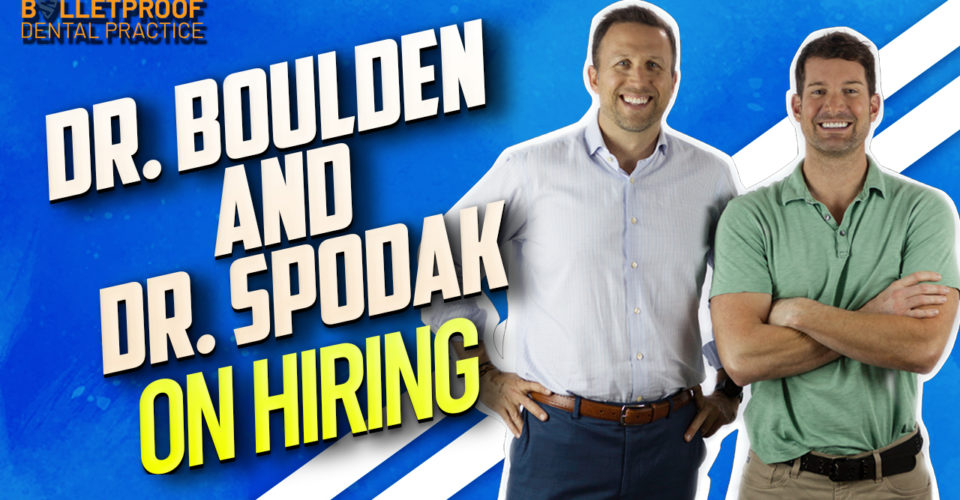
Hosts: Dr. Peter Boulden & Dr. Craig Spodak
Guests: Dr. Trey Tippit & Dr. Dwight Peccora
Key Takeaways:
Introduction
Hiring
Tracking Hiring And Retention
Burns Of The Practice
Examine Where You Want To Go
Recruiting Methodology and Tips
References:
Bulletproof Mastermind
Bulletproof Summit
Mighty Networks: Bulletproof Dental Practice
Tweetables:
This isn’t hocus pocus, it’s the methodology. -Dr. Peter Boulden
Everybody has their pain point. -Dr. Craig Spodak
Full Episode Transcript
Below is the complete transcript of this episode of the Bulletproof Dental Practice podcast. Prefer to listen? Find us on Apple Podcasts, Spotify, and YouTube.
Read the full transcript
The following transcription was from the Bulletproof Youtube channel. Here is the https://www.youtube.com/watch?v=mZZu5DB5VDA
Dwight Peccora
0:00:00
Welcome back. I'm glad that everybody was able to get to the link from Pete. One thing we almost took away from him. That's
Craig Spodak
0:00:17
right. Link. You guys will not ever make the link mistake again
Peter Boulden
0:00:22
because as Craig says, I will overbear you with my you my aggressive relation for no appropriate reason you know that's how the energy right now yeah you guys seem like you're low-ass energy right now no you're gonna have to carry this shit like I always good stuff look you're wagging the vine I got you guys hey there's enough there's enough room in the back get behind me you're cool you can get on. Jump on I'll drag you through this. Typical Pete.
Dwight Peccora
0:00:53
I'm good as long as I'm in first place and I see y'all back there second. Hey, you know what Dwight? Second place is a first place loser buddy. That's exactly what he said during the mastermind. I mean you're not first you're worst.
Peter Boulden
0:01:08
Well isn't that from the Will Ferrell movie, what do they say about that? Oh god, what's the racing movie?
Peter Boulden
0:01:19
Talladega Nights.
Peter Boulden
0:01:20
Talladega Nights, thank you, gosh. On air and I'm making a fool of myself. What do they say about that? What do they say about being first in Talladega Nights?
Craig Spodak
0:01:27
If you're not first, you're last. Yeah, okay. I thought it was more profound than that.
Trey Tippit
0:01:31
Nope.
Craig Spodak
0:01:32
I think that could place us first place for losers. No fear. Let's go all the way back to the early 90s.
Peter Boulden
0:01:38
Well, let's roll back, man.
Dwight Peccora
0:01:39
Let's bring it, I think that one of the biggest topics that we've been wanting to hash out is relating to this hiring process. And I think everyone who all here is dealing with some hiring issues right now.
Trey Tippit
0:01:51
It's getting better.
Trey Tippit
0:01:52
Yeah, it's getting better for us too.
Craig Spodak
0:01:53
We just recently had a big shift.
Dwight Peccora
0:01:55
Hey, by the way, I know we don't have the power
Craig Spodak
0:01:58
because I can't tell the editor to go do something because we don't have an editor. But does anyone here, Craig, just no jokes for a second, does anyone here remember me saying this six months ago? Yeah, I'd love to pull up things like that.
Peter Boulden
0:02:13
I said, I was like, the pendulum is going to swing. And because everyone was playing in this well as me, hiring is so hard. And I remember telling that at the summit. I remember sitting on stage being like, hold on. You're about to have the most empowered. You're about to have the best opportunity at the best team you've ever had And the pendulum is gonna swing back, and I know I said it multiple times So I'd love to you know I don't say I'm right all the time even though Dwight would say that I do and Craig was there that I think I'm right All the time, but I think you you believe you're right all the time Well look the beauty of being recorded is that it's a problem. You're either right or wrong and you can't fudge it.
Craig Spodak
0:02:55
Yeah, so we should just do a best of Bitcoin clip montage.
Peter Boulden
0:02:58
Yeah, hey, hey, hey, hey, okay.
Peter Boulden
0:03:01
Again, the timeline.
Craig Spodak
0:03:03
Go at a million, go at a million.
Dwight Peccora
0:03:04
Hey, we're the Peter reality.
Peter Boulden
0:03:05
The timeline just needs to be extracted.
Craig Spodak
0:03:07
My timeline is just being extended a little bit, Craig. I know, you never told us, hey, I'm prognosticating for 2124. I thought you were prognosticating for 2024.
Dwight Peccora
0:03:17
His favorite thing is to prognosticate, but we are on his time stamp, so it may be 40
Peter Boulden
0:03:24
years from now.
Craig Spodak
0:03:25
Yeah, yeah. If I'm ever wrong, we just need to extend the timeline, okay?
Trey Tippit
0:03:27
Right.
Dwight Peccora
0:03:28
Maybe beyond our own depth, but this is recorded. All right.
Dwight Peccora
0:03:30
I'm not picking on Pete.
Craig Spodak
0:03:31
I'm sensitive. Pick it on Pete time. It's coming back. No, but it's true, though. I mean, as you have these big companies laying off, it's getting a lot better for us, and if you choose to look at the oncoming recession as something to kind of trim the fat and start laying off your own people, you're going to have them picked up by the entrepreneurial people like us that feel a little bit better about the future. So, support.
Dwight Peccora
0:03:49
Well, no doubt. I mean, the economy does clean itself up. And one of the main methods, unfortunately, is as it's cleaning itself up, a correction to inflation is always increased unemployment. And increased unemployment then turns out to being a solution for a lot of individuals who've been looking for better quality individuals. It also solves a lot of wage inflation and things to that nature. So we all, if you've held the line, and yes, I would say, and I'm going to speak this out loud because maybe I can be the only one, but all of us have maybe had to hire to, to hold a position, to fill in a spot, knowing that everyone did for the past. Yeah. And knowing that in many, many ways, there's no way we're going to be able to maintain that person at that pay. That's just not going to be okay. And that's okay to say it.
Peter Boulden
0:04:33
Check the box. It's a warm, it's someone I needed. I hear it all the time. Well,
Craig Spodak
0:04:38
I just needed somebody is what I hear. And so you're right, Dwight. We all did that.
Dwight Peccora
0:04:43
We all did that. Because sometimes people are like, oh, I can't believe you hired him for that. The times are what sometimes describe what it is we need to hire. But the only I think the only failure in this is that if you then just say well you know then you keep it that way forever because in reality you do live in an economy and it's not just your own economy and the truth is is yes there's very likely that you can trade people out but if you get stuck just saying well this is my team you should always be recruiting and that's why I think we should talk about this right now.
Peter Boulden
0:05:14
ABR, baby. I'm going to get a hat that says ABR.
Dwight Peccora
0:05:16
ABR. Always be recruiting. In every position. And I think that's one of those things you really have to be prepared for because there will be change. And I will say that, and this could be another pot in itself, but prepare your business to be able to onboard people well. And then this won't be as stressful.
Peter Boulden
0:05:36
That would be an after this one, Dwight.
Dwight Peccora
0:05:38
Yeah, that's something really, really we're going to need to talk about because that's after the fact.
Trey Tippit
0:05:42
That's after the success.
Peter Boulden
0:05:43
That's not today.
Craig Spodak
0:05:44
That'll wipe us out. And by the way, too, when you're talking about being vigilant and not hiring the wrong people and trying to fill spots and that we've all had to do it, we have had a stretched team here unfortunately for quite a while. And we had some during the weight inflation, there was a lot of assistance that were lured out of my practice for like, oh, don't worry, we'll pay you more, you know, a dollar or two more per hour, unbeknownst to those assistants, and even though you break it out sometimes, it's like, hey, you get this per hour, this in bonus, this in benefit, this in 401k, this and that. And still, oftentimes people will make bad decisions because they say, well, I can't count on the bonus, or I can't count on this, you know, and they'll leave for a dollar more per hour. Some of those people now are coming back around and be like, that was not the opportunity it was cracked up to be. I'm really thankful that the leaders in the practice are not allowing some of those subpar people to come back in because they know you're going to get stuck with them and it's going to be hard on your team for a little while, but it's better to stretch and make it through as a team and divide up whatever resources you have between the existing team than pull I think that's really important. Do you bring people back that you felt were talented? I would, yeah. I do, too. I just had to put that recently. They left on good terms, but they left, right? And that never feels good to be the one broken up with, so to speak. But if they're good, I'll drop the ego and be like, you were good. Yeah, and I think, as Peter would oftentimes say to me, you know, I'm not a good person. I'm not a good person.
Peter Boulden
0:07:02
I'm not a good person. I'm not a good person. I'm not a good person. I'm not a good person. I'm not a good person. I'm not a good person. I'm not a good person. I'm not a good person. I'm not a good person. I'm not a good person. I'm not a good person. I'm not a good person. I'm not a good person.
Craig Spodak
0:07:15
I'm not a good person. I'm not a good person. I'm not a good person. I'm not a good person. I'm not a good person. But if they're good, I'll drop it. You're gonna be like, you were good. Yeah, and I think, as Peter would oftentimes say too,
Dwight Peccora
0:07:27
it's a great, from an optics standpoint of your existing team, they went out to go somewhere else. They bring the news from outside. They did, hey, the grass isn't greener, guys.
Craig Spodak
0:07:36
Let's make it work here. How many of you track this?
Dwight Peccora
0:07:39
We track 43% of people who leave our practice ask for a job back within a year.
Trey Tippit
0:07:39
Holy smokes.
Craig Spodak
0:07:40
We're 43%.
Dwight Peccora
0:07:41
I thought that was a big number. Hey, good, that's awesome.
Peter Boulden
0:07:43
The fact that you have data to it is amazing because I can't give you statistics like that.
Craig Spodak
0:07:48
All I can tell you is-
Dwight Peccora
0:07:49
Well, don't give me an emotional answer.
Dwight Peccora
0:07:51
Give me data, bro.
Peter Boulden
0:07:52
All right, you know what?
Craig Spodak
0:07:53
I'll shut my mouth. Yeah, so three people that recently left all asked within days, like one of them called Eric and Eric was actually giving her advice, like, listen, it's only been three days, give it a chance. So now everybody in my ecosystem, I mean, outside of people moving out of the area.
Peter Boulden
0:08:10
Of course.
Dwight Peccora
0:08:11
Well, it's critical. And one of the biggies that I think that we have to understand is that if you're tracking it, you're realizing it, you're making that impact. We talked about on the last pod about how we are not the hires and the fires on our team. But I think there's a culture, and we just touched on it, a culture to recruitment. And that's what you just said. Sometimes some people leave, and it's not this compassionate, oh, be compassionate that they left us and they're coming back. No, they have the skillset that's good for the business. And you have to be watchful because director of operations, office managers, individuals out there that are running your ops, they may just be so sour that somebody left. They'd be like, ah, not even taking that application. And we as leaders need to stop and have these conversations with our implementers and our operators to say, hey, by the way, we actually have a culture that says, if this person's great for the team, get yourself out of the way. Get your personal emotions out of the way. And it's not about you. Bring them in. And now let's tell them as to why, which is what you just said. They come in saying, oh no, no, no, grass is not greener, stay, right? So I think it's important, don't forget to explain that to the operator.
Peter Boulden
0:09:23
The hesitancy with that, Dwight, is that if this person has done it once, they will do it again, right? And which is, which is tiresome. I mean, that's all I can say is it's tiresome to the team. It's taxing on the team, it's taxing emotionally, inbound, you know, having to give someone an exit interview, having to give them a new onboard interview, pay them off payroll, it's taxing. So I think that is probably where some of that is coming from, I don't know if it's so much ego as it is just this is a lot of work and please don't do this again, right? But everyone's entitled to make a mistake, I feel like.
Craig Spodak
0:09:55
Oh, for sure. Take that a little bit further, because yes, that person may leave again, but what it also can send a message you have to be very careful about is that, hey, if you leave, we'll take you back.
Peter Boulden
0:10:05
Right.
Craig Spodak
0:10:06
So then people feel good about, hey, well, let me go try it out over here. She did, and they took her back. So you have to be careful about that.
Peter Boulden
0:10:13
You have to make it very clear. So you don't want your success ratio to be, you know, Dwight says it's 43%. Maybe that's a good mix. Maybe it's like, hey, yeah, if you're a badass, we'll take you back. But if you were probably an underperformer and left because you were job hopping, like, don't count on a job getting come back here or
Craig Spodak
0:10:29
It's as simple as like look a doctor loses an assistant the assistant goes and takes another job You get a really qualified assistant to take that person's position. It is not fair to the new person. You just hired Yeah, so like your position may not be here and that's also reality of it as well Like hey, you were a great hygienist. We would take you back, but we filled your opportunity.
Dwight Peccora
0:10:51
Yeah, but rarely are those people ever, if they are brought back in, right? So we're at 43% of that, 43% of the people who come back asking for their job. That's what you're saying. 43% doesn't mean that they're hired.
Craig Spodak
0:11:03
Right, that's what I was understanding.
Dwight Peccora
0:11:04
43% means they've asked for their job back within that year of leaving. And I think it's an important statistic, really not even so much for us, but for everybody on the team. Now, if they come back in, I assure you-
Craig Spodak
0:11:18
Here's the problem, Dwight. Here's the problem. Do you- so one of the problems we ran into is we always want to take the high road. So if someone resigns and they call back and want their job, it's not really our position in the organization to be like, hey, you know, Jeanette called back and wanted her job back. Like, it just doesn't feel right. We want to protect their privacy. So how do you balance the, how do you report that statistic back to your team without feeling like you've violated their privacy and or made them look bad?
Dwight Peccora
0:11:50
I mean, just claiming the percentage is not, I mean, we have a- But you say it like in a morning huddle,
Craig Spodak
0:11:55
like, hey, FYI, 43% of the people that leave want their job back.
Dwight Peccora
0:11:59
No, I think it's a known discussion amongst our leadership team where they can expect some people to also ask for the job back. And I think they spread that information based on the necessity of knowing, Hey, some people start considering job down the road is going to pay me $5 more per hour. Well, guess what? If they're that much high above market, what do you think that job is all about? Are they just trying to kind of recruit anybody? They're throwing anybody in there.
Craig Spodak
0:12:26
And well that's what people have been doing.
Dwight Peccora
0:12:28
And does that mean that nobody else, and so therefore, knowing that statistic is because a lot of people try out that other side. I'll be honest with you, back in the day when we weren't such a big practice with a better established culture, with better leadership and more accountability and onboarding, which took a lot of work to get here, there weren't a lot of people coming back. Once they left us, they did, they could have found a better place. Let me be blunt and honest. But once we worked really hard to find something, people who get attracted by the dollar bill sometimes do want to come back. Now, I think that's the point. It's a result of the culture we've created. I think that's something that- But people get accustomed to it, though,
Craig Spodak
0:13:06
Dwight. I had a hygienist that recently was temping another office to help out a friend, and she came back. She's like, holy smokes, what we have here is so special. Holy smokes. Oh my God. So I almost wish, like it would be great for my own culture if we made people do mandatory externships.
Trey Tippit
0:13:24
Yes.
Craig Spodak
0:13:25
Hey, you got a two week externship.
Peter Boulden
0:13:26
Interesting practices.
Craig Spodak
0:13:27
Yeah, it would be great because once you see what is normal, you're like, holy shit. And by the way, I want to qualify the 100% of people want their job back. We have had people that make career changes. That's a different story. I don't know if those people come back as frequently as moving to another dental office.
Peter Boulden
0:13:46
Yeah, yeah, I agree. I think what people get worn out, and we talked about this actually in the retreat, and I gave some tips on what I did to circumvent this problem, was people comparing what was an apples to oranges scenario, right? And what Craig was saying when we started this pod was that people remember what they were hired up. I make $22 base, I make $30 base, whatever it is. And when they hear someone makes 31, all of a sudden it's, well, damn, I don't get paid that. But in actuality, they more than likely do in all of your ecosystems and probably the people listening to this. So it's not a fair comparison. And I gave, again, the tactics of what to do and what we have instituted quarterly to kind of circumvent that problem and make people feel better about what they're getting because it's far more than what they were hired with. Because, right, when you ride with a good kick-ass team, the team does better, right?
Peter Boulden
0:14:37
The business does better.
Dwight Peccora
0:14:38
And I love the simplicity of your pie chart. We implemented it at your clinic. Yeah, it's a graphic.
Trey Tippit
0:14:41
At the dental.
Dwight Peccora
0:14:42
That graphic where it's literally like, if I'm working on your team, I've got my name at the top and then there's a pie chart and it's all the benefits components, and at the bottom is the dollar per hour total, and that includes benefits, bonuses, all that, and it's accurately calculated and put out after the end of every quarter. That keeps these conversations managed, and honestly, I didn't come to appreciate that quite as much as I have over the last year. It made a tremendous difference for the team.
Peter Boulden
0:15:09
So I think, too, one of the frustrations, so we talked, we ended the last podcast with talking about how there's a burnout problem in dentistry, right? There's lack of implementation, which then causes it's like this cycle with lack of implementation, which then makes the dentist more frustrated, which then I'm the nucleus of everything. Yeah. I think one of the employee then causes you to have to go back into hiring, which is daunting, as we know, if you don't have tools and systems around how to make that less daunting and getting the right person on the bus. So everyone just rolls their head. You talk about hiring and it makes all the… We're in the mastermind, it beats people's skin crawl because they know the 10 steps that are gonna take to potentially putting someone back on the bus and that might be the wrong person, but they're gonna spend weeks and months trying to see if that person is right. Right. And ultimately decide, or that person, either they will decide or that person might decide that they don't like this seat and they then leave and the process starts over again. And that is just too much sometimes for people to poop with so
Dwight Peccora
0:16:28
This is this is key cog for me that it changed with culture and it's key cog
Peter Boulden
0:16:34
Period remember I was talking about the entrepreneur This is this is the hardest part of advancing your business and Craig it goes back to you We talked about vision so much is predicated on getting this right will make the vision of what you're trying to do happen so much faster, with so much less, you know, that's why we go through it on the Bulletproof pathway. It's not that we stuck a bunch of shit up on the board, it's like, go through this pathway, it works. It's get your head right, get your vision right, get it planned, then start implementing. Build your team. Implementation, then start learning how to hire, right, building it. And so, this isn't hocus pocus. It's a methodology, as Dwight likes to say. Yeah, the problem is, though,
Craig Spodak
0:17:16
is like we talked about before, it's like the work, it's just the five easy steps. You know, people don't want to do the work, and even with my own physical fitness, I would-
Peter Boulden
0:17:25
I don't feel like that's true, Craig.
Craig Spodak
0:17:26
I think that there is a, at the very first level of decision of what type of practice you want, there's so much that people don't even look at.
Peter Boulden
0:17:37
When you say people don't want to do the work unpack that a little bit. So because look let's be honest High school was hard college was hard to get a dental school was hard people are willing to do work Yeah, it's letter said they want a shortcut
Craig Spodak
0:17:49
Yeah, so what I think is that they didn't have a shortcut getting so where they are So look I went like I went to Dwight's practice. I went to another practice all in one Monday, I saw five locations, right guys? And each one was so-
Peter Boulden
0:18:06
Wait, break down which.
Craig Spodak
0:18:07
So you saw two of Dwight's? So I saw two of Dwight's, two of Trey's, which are, you know, both of Dwight's were different, both of Trey's were different, and then I saw an entirely different model, an entirely different owner, an entirely different model. Outside of people being treated for their teeth, there was absolutely nothing similar about their businesses whatsoever. And I think that people that are listening are like dental practice, that's it. It's a dental practice and it is not. Think of it as a restaurant. All restaurants will get you full. But look at the disparity in business models. Some people need to get Chick-fil-A because they have four minutes. Some people want, they're celebrating their anniversary, both restaurants, and people are not willing to do the work to describe the new restaurant they wish to create that makes them feel. This is my favorite analogy you've ever done, by the way. That makes them, it's like we're all chefs.
Dwight Peccora
0:19:04
A lot of appreciation from Pete.
Craig Spodak
0:19:06
Yeah, I didn't go and notice, but I don't want to lose my train of thought. As dentists, we're all chefs, we're all artists, and they say, how did you build your restaurant? Well, you know, I wanted blah, blah, blah. What, what, what, what, how many square feet was it? Well, what are you serving? Are you hot chicken sandwiches? Are you filet mignon? What are you doing? And we all don't want to do that work because someone along the way, maybe it was, you know, our supply house or something like that, but they told you dental office should be four operatories and you need 1.3 of this and 1.4 of that. It's not a formula. What's the formula for a restaurant? If you go to your restaurant tour buddies, and I have several, and say, how many square feet did you decide upon for your restaurant? Well, I'm a coffee shop. Oh, I didn't know you were a coffee shop. I thought you were an empanada store. No. So they're totally different. They're totally, completely different. And what we get is we get Dennis just saying, I've never been to your restaurant never in your food I've never experienced anything about it, but I've heard it's kind of cool. I saw the pictures on Google How'd you build that and that's the work that people don't want to do and we're doing them a disservice Any of the four of us are doing them a disservice. We say it should be 13,000 square feet 18 operatories one rural surgeon one parent. We're gonna lead that person right into failure Yeah, good point, but you know what there's nothing more frustrating, and I think that's why I crush you so much, is that someone will ask a question, you'll be like, well, and you'll ask the more questions. In my gut, Craig, is always just like, this is what you should do. And so I'm not saying I'm right and you're wrong or vice versa. I'm just saying it's so frustrating sometimes when someone is desperately in need of answers
Peter Boulden
0:20:44
for them to answer the question with a question.
Craig Spodak
0:20:48
Right, but if you really want to help people, you want to get clarity because everybody has their pain point. People have a tendency to diagnose themselves and by the time they get to the question, they already have a diagnosis. I do not have a good team. How do you hire a good team? Well, what is a good team? Someone that shows up on time and works for $14 an hour. Okay, well that's not a good team to me. It's the Alice in Wonderland quote. If you don't know where you're going, any road will do. And it's just, in our profession, it's really, really at like epidemic levels of that. So every question forces another question, if I'm really trying to get.
Peter Boulden
0:21:26
What, epidemic levels of what? Of people wanting the five easy steps?
Craig Spodak
0:21:30
Of not examining where you want to go, because let's face it, we all got into dentistry, we wanted to help people. We learned a recipe and a scientific form of how to help people. If this, then that, if that, then this. And then we're thrust out and we're like, oh shit, I'm a small business person. Wait, what is this all about? What is withholding? What is that? What is marketing? And it's frenetic now. It's like, and there's so many voices in the industry. Like, here's the five easy steps. We'll build your office for you. You know, I can name names, we don't have to, but like, we'll get you off the ground and you're built you're they're building these cookie cutter offices when Everybody's different this type of dentistry if a patient goes into any of our four offices They will have a different treatment plan from all four of us and all of them are right So even like you know, it's like you go in a chick-fil-a They're gonna give a chick-fil-a chicken sandwich you go in a mortgage. You're gonna get a steak You're gonna get whatever they have but you can't want to be a Morton's and build a Chick-fil-A. It's very frustrating. The first question is, what type of dentistry do you want to practice? That's a really important question. Trey, as you joked about in the intros, he is a bread and butter or basic restorative quadrant dentist. If he meets people that need all-in-four, FMR, they're probably going to get referred out or be pushed along down the road. They meet Dwight, they're going to get an FMR. They meet one of my guys, so is one right or wrong? By the way, that patient will be super pissed off. If they go to Dwight, they get a $40,000, $50,000 FMR. They go to Trey and be like, ìYeah, I'm going to do some crowns and make some partials.î Iím like, ìWho's right? Why did that guy want to charge me 40? I'm going to get it done with Trey for 15. And they're pissed.
Trey Tippit
0:23:18
Yep.
Craig Spodak
0:23:18
Is one wrong or right? No. So we're not talking about the nuances of, did I lose all you guys? No, no, no, we're hearing you.
Dwight Peccora
0:23:26
No, you're on a pod.
Trey Tippit
0:23:28
But let's, let me be the process controller
Peter Boulden
0:23:30
and let's pull it back to the topic. But that was a good, I did love that analogy though, just for the record. I think that was really good.
Craig Spodak
0:23:38
It's very real and it's very correct and most people operate without that. That's the hard part. As in you're speaking to a select few that wanna actually sit down and plan out, hey, this is where I wanna go, or even figure it out. But I mean, kudos to you, Trey, like doing, you know, your model, you can take any dentist that has a degree and a nice personality and good hands and they will be successful You take that same dentist that works in your facility really successfully drop them in here. They might freak out I have dentists that are 12 year tenured and they come in in this organization. They feel like they're not good Very intimidating and I have to tell them no, you're actually really good Well, they're doing that, you know all on X and FM on like you don't have to we don't know every patient that shows up here is not an FMR All on X right, you know, so it's like every you know You have a dental office has to have its service offering like what it's gonna do what type of dentistry gonna do paired with a retail Avatar of what consumer you wish to attract because if you're an FMR trained dentist But your office looks like you're selling, you know, single tooth dentistry or doesn't function well, you won't be able to do your craft and you'll be burnt out.
Dwight Peccora
0:24:57
And I think that no better way to connect that to the components of recruitment is when we even got to the point where we were saying, Hey guys, let's talk about recruiting an operator, for example, in the mastermind in Cabo. And the consensus in so many ways was do not, an implementer, do not bring in somebody in dentistry. Right? And well, a lot of those I don't think that was an option meaning and they didn't even think that was an option. It was so straightforward and expected to be the answer. I need a hygiene an RDH, an RDA, an office manager, a front desk person, like that was and that's how standardized a lot of people see recruitment and dentistry and it links back to kind of what he's saying. I don't have a vision, I don't really know what I want, but at the end of the day, don't get stuck on the title, don't get focused on all these other items, but more importantly realize you've got other options out there. And I think in recruitment, so much of us get stuck on creating such a small funnel because this is all we do.
Peter Boulden
0:25:57
We think that dentistry is just this magical business that you need to have experience in and it's just a different widget. Yes, I understand we provide clinical care, but at the end of the day, the stuff that leads up to that is the same as all business. It's just a different widget. And so, your advice was, Dwight, is, well, should I, I need to hire someone with dental experience, right? And the answer was no. As a matter of fact, it's probably preferential to get a fresh set of eyes for implementation, because the stuff you need to implementating implement. Yeah implementing. Yeah implementing Thank you is not the stuff that is clinical So like why are you looking for someone who has quote-unquote dental experience for? Implementation of X Y & Z and it was like oh shit And I was like and here's the beauty of that is that now you just opened up You know millions of more people to the application pool so to speak Yeah, yeah, right and I'm not someone quite better and probably someone who's not coming with a preconceived set of notions of the way that Dr Nose and hairs did it ten years ago with the practice they worked in right
Dwight Peccora
0:26:59
Yeah, that's exactly it. And I think we get so stuck on saying well, there's no other office managers available in my area
Peter Boulden
0:27:06
By my area, I mean
Craig Spodak
0:27:08
Southwestern United States, that's right.
Dwight Peccora
0:27:13
It's like, it's kind of crazy, but it's true. And I think that's part of what Craig is saying too and bringing that together. Now, what is your number one recruiting methodology across the board? I know that we use Culture Index a lot to try and then bring them in and establish who it is that we're recruiting. I mean, does your, I know all of you have now implemented some Culture Index into your process, but are you all actually having your teams build the profiles or are you all still rolling down that road?
Craig Spodak
0:27:43
One thing, just a small bit of housekeeping by the way, Dwight, we keep mentioning culture index and I want to make sure that people know how to get to culture index. So we'll put the link in the show notes below because it's a very specific way and culture index is great for all business, but it's very specific when we talk about using Culture Index for dentistry, and that's why I want.
Peter Boulden
0:28:06
Do they hook up Bulletproof listeners, Dwight, by the way?
Craig Spodak
0:28:08
Yeah, yeah.
Peter Boulden
0:28:09
Yeah, yeah.
Craig Spodak
0:28:10
All right. Yeah, so that's important to go through the channel that we have so that we can give them more security.
Dwight Peccora
0:28:14
Yeah, we'll definitely put it in there. And the reason I even bring it up is because I feel like we've used it to get us a more accurate and consistent method on how to recruit, and it actually puts a system in your team. Right now, your team is just like, whoever walks in that door, we're gonna interview them, we're gonna throw them through a working interview and we're gonna use Indeed to get those who are not in the door and then we'll just see what happens, right? And I think that's the biggest mistake right now is because not only are we trying to create a larger funnel, but we're also trying to make sure the right people are applying for the right jobs.
Peter Boulden
0:28:48
Yes, this goes back to, I know we were about to go with this, the way you use it, but the thing that is most daunting about hiring is whittling down that applicant pool. And I'm not speaking from a place of me doing it all the time, I'm just speaking from a place of me spending a lot of time with the people who do do it and getting their pain points. So it is hard. You have to, it's a lot of tire kickers, and a lot of people, and indeed, just sending it out, and you have hundreds of applicants sometimes for one job. And so how do you, how do you as the person who has the power to hire in the organization, pick the diamond in the rough, right? Or at least start the process without having some sort of data, data. And I think that data starts, guys, honestly, people say like, here's your recruiting tips. I think it starts too on you filming videos and getting the culture of the practice. People who are not a performers will sometimes weed themselves out of that application pool.
Craig Spodak
0:29:49
For sure they will.
Peter Boulden
0:29:50
Meaning if they see, well, that's what the office looks like.
Dwight Peccora
0:29:52
It's too intimidating to go apply there.
Peter Boulden
0:29:54
Yeah. If you're not a major league player, please, please stay in the farm league.
Craig Spodak
0:29:59
They'll know though. They will know.
Peter Boulden
0:30:02
So that self-selection is sometimes off. So that is one tip for the hiring is allowing people that it's not open for everyone. It's only open for here. I think video portrays that. I think good social media portrays that. If you don't fit this kind of culture, because, right, we're not going to, you have to protect the house. If you're not, you know, not going to let someone come in.
Dwight Peccora
0:30:22
I would argue one particular item on that is, I know, but it's not just that. It's not just the fact that they're weeding themselves out. It's that you're making sure that those who are inflexible and don't want to grow, that are stuck in their ways, do not show up in your environments. That's the bigger thing that you're avoiding. You're attracting people who are excited to be a part of your environment, not just…
Peter Boulden
0:30:44
I'm not talking about that's down the way and I hear you on the problem, like that's going to be a problem. I'm saying I'm giving tips and tactics.
Peter Boulden
0:30:51
Yeah.
Trey Tippit
0:30:52
Or hiring.
Craig Spodak
0:30:54
Recruitment of top talent.
Peter Boulden
0:30:55
Yeah, yeah, down the way, we'll get to that down the way, Dwight, I think you're right, that you need that because what you just said.
Craig Spodak
0:31:02
So all those things weed out those people, I agree with that.
Trey Tippit
0:31:05
So step one is.
Craig Spodak
0:31:06
I think a more important thing to say is it attracts the top talent as well. So A players bring in A players.
Trey Tippit
0:31:11
Yeah, that's my.
Craig Spodak
0:31:11
B players bring in B players. That's my ace, is my team recruitment strategy. So in our office, we have, number one, we have a pipeline program. So if you have no dental experience whatsoever and want a clinical job, you can come in as a sterilization assistant and we will train you to do that job. And then the hygiene team will train you to become a hygiene assistant, train you to do x-rays and perio chart. And then from there, the assistant team will move that person up. Whenever anybody starts as a line level employee here, and full disclosure, Erica started in sterilization, you go there but you don't have to stay there. There are people that have stayed there for seven years and there are people that have to stay there for seven weeks or seven months, but it's this idea that you can move through. The idea of paying people and encouraging our team to refer, so we have a bonus system. And I really like what Dwight said, the mastermind, we pay a bonus system, but you don't want to pay it all up front. It should be staged. So as Dwight, you were saying at the mastermind, maybe pay half of the bonus at 30 or 90 days or maybe six months and the other half of the year. Because anybody can kind of drudge through it and make it, you know, six months.
Peter Boulden
0:32:21
Anybody can make it.
Peter Boulden
0:32:22
Yeah. But Dwight has systems in place that, you know, through his culture and some things that basically that person's not going to even get an interview.
Peter Boulden
0:32:29
Oh yeah.
Peter Boulden
0:32:30
But unless they have checked the box with 80% of what the job they're looking for is right. So that's the data. That's the, I have said this a hundred times. I'm going to say it again. It's the money ball. If you haven't watched that movie, it's the money ball for dentistry, meaning putting the right players on the field is sometimes very analytical and, and in a space where we didn't have data, like Craig, we talked about in the last one. Now having data is a superpower and it can propel your business. Way beyond what you think, I think. So the right team. And I let go ahead.
Dwight Peccora
0:32:59
Um, I was going to touch on that for sure.
Trey Tippit
0:33:02
Go ahead then.
Trey Tippit
0:33:02
Yeah, go ahead.
Dwight Peccora
0:33:03
It's not just the fact that obviously you get the right person. And so what he's alluding to is that we use culture indexes platform to not only we each, everybody has their own profile. It gives us our strengths or weaknesses. We balance our teams based on what those teams need. What are some weaknesses in the teams that we need strengthened up? And so we build a profile specific to the position we are hiring for, not just in the traits that make them good at that job, but also in making them fit the team so that the whole team gets stronger. Then we let people take the culture index before we even interview them. If they don't hit at least 80% of that profile, we're not even interviewing them, much less are we putting them through a working interview. So if you have 40 people apply to a job, you may only have eight or seven that are actually within that. Yeah, you may have four. Well, guess what? After using this for so long, the one thing that surprises me to this day and just is the one, I guess, side effect that I did not realize is that my team does not hate recruiting anyone. Yeah. Because they're not interviewing 50 people for one job.
Peter Boulden
0:34:12
So I was talking about the burnout thing earlier.
Dwight Peccora
0:34:14
Yes. That's what I'm talking about.
Peter Boulden
0:34:15
And so it's not just your burnout because you are a – you can vicariously feel burnout from other people, which then you carry it with you as the owner operator. Yeah. Right? And so when someone is excited, potentially, let's change the change the narrative. Oh, hiring is the worst to I'm excited because I need to architect and meet someone who could potentially could be a thoroughbred. The narrative changes as opposed to I have to put someone on the bus versus I get to now maybe hire a thoroughbred. And so you're saying it's not so daunting because now you have four people that are technically qualified from a data standpoint of who they are to possibly be there. And now they're the only ones who the HR or your hiring department needs to kind of deal with. And that, my God, is reducing so much friction in this process that it's just a game changer.
Dwight Peccora
0:35:08
And they literally look at it as, I get to recruit a person that's going to make this team better. What a totally different world, right? Let's bring in somebody and try them out. So I think that's why.
Peter Boulden
0:35:20
Trey, do you offer a internal referral bonus for hiring teams and friends of team members?
Craig Spodak
0:35:28
We have in the past, I've gotten away from it, and I will tell you after that mastermind, we're putting that right back in place.
Peter Boulden
0:35:33
Yeah, so Dwight, you obviously have it because Craig did his, or Craig, what is the dollar amount that you give?
Craig Spodak
0:35:39
So we have historically it was done $250 when we had a major pinch and our difficulty hiring people just recently a couple months ago we amped it up for like a I think a three-month period to a thousand dollars so that my rationale was I was looking at my idea.
Peter Boulden
0:36:01
Have you reduced it?
Peter Boulden
0:36:02
Yeah.
Craig Spodak
0:36:03
Oh, yeah. Why? Well, no, no, no. I'm sorry. We've hired the people, so we have not reduced it. It goes all the way through until those jobs are all filled.
Peter Boulden
0:36:12
So you've kept the incentive the same?
Craig Spodak
0:36:15
Just until we fill those positions.
Peter Boulden
0:36:17
I'm not busting on you.
Peter Boulden
0:36:18
I'm not asking you to do that.
Craig Spodak
0:36:19
No, no, no. I know. I didn't tell people. I put an end to it. I'm like, we're a lightning round, so to speak.
22
0:36:24
I think it's good.
Peter Boulden
0:36:25
I would actually say, I mean, this is just me, I don't know what ours is actually, I think it's $500. But I would actually, I love that the $1,000, I think four digits gets someone's attention. I think three does not. And if someone's like, damn, I can make a thousand bucks by hustling and side hustling to get this thoroughbred that I know is my friend that's unhappy at X office, I'm going to actually go to work. $250 might not get me off the start line, but $1,000 is real money to anyone.
Craig Spodak
0:36:55
Let me tell you where I got it from, though. I was looking at my Indeed bills, and I was spending every week $3,000, $4,000 every week and a half, two weeks, major money. So what I always think of, and I talk about this with my team a lot, I say if there's any service that we're using that you could perform better and save us money, I would rather pay you to do it than pay some stranger. So it's the same thing as that. So if you see we're paying X dollars for insurance verification, you can do that plus your job and you can save us money, that's great. The only difference is just like any other vendor, if I don't like that particular service that you're doing, I have the opportunity to withdraw that service from you. So you don't lose your job, but you lose that upside. So if you want to clean the office, go for it. Clean the office. How much does it take to clean the office? I'll pay you. Save us money and we'll do it. But if at any given moment you don't do a good job cleaning the office, you don't lose your day job. You just lose that side job. I think it's important to talk about that.
Peter Boulden
0:37:58
I think it's the smartest money you've spent, meaning the delta from 250 to 1,000.
Peter Boulden
0:38:03
On your people.
Peter Boulden
0:38:04
Yeah, I think that difference is probably some of the best marketing slash operational money you've probably ever spent. And I'd love to hear –
Craig Spodak
0:38:12
Yeah, but you do have to put the – so in full disclosure –
Peter Boulden
0:38:15
Of course, it's titrated out over time.
Craig Spodak
0:38:16
Right, I made a mistake. Everybody – you get it at 90 days. So during the mastermind, I realized don't give it at 90 days. You can give half at 90 and half at maybe six or seven months.
Dwight Peccora
0:38:26
Well, even for us, I just want to be very blunt, Mike, it's not for us, not a recruitment bonus, it's a recruitment and retention bonus. There's your key. If I'm going to give you $1,000, I'm still going to say it's $1,000, but you're going to get $500 at six months and $500 at one year. Why? Because your job is not just to recruit, it's to make sure they feel good in this environment and that they're learning and that they're speaking.
Craig Spodak
0:38:49
And by the way, having a buddy inside the office is massive to your integration. I mean, all of our hygienists have been brought in by friends. So they tell you the good. It's not all roses and sunshine here. There's difficult things too. You're going to work your ass off. It's going to be hectic. It's going to be, we have high level patients. These patients that we have are not normal people. They're high net worth, they're demanding, and it's not all easy. So, you know, when I recruit someone, I'm going to tell them all the greatest parts about it. And in some ways it's a disservice because I look at the organization through rose colored glasses, but they'll keep it real with them and they will actually keep that retention high. To your point, Dwight.
Dwight Peccora
0:39:26
Yeah. I mean, you commented at Morning Huddle the other day, I have to say this. I even came up and I said, Hey, I want to hand this check to this person. I was like, Hey, and I pointed out, Justice, I want you to know you're a rock star on our team. I want to thank you. And on top of that, I want to thank Sadie who recruited you and brought you over. Sadie, here's your check. In front of everybody, everybody needs to know we appreciate what it is that's going on here and that this is the best way to recruit people.
Peter Boulden
0:39:50
I love that I've had this idea.
Craig Spodak
0:39:51
Yeah, we do the same thing.
Peter Boulden
0:39:52
I've loved that I've had this R&R idea, Dwight, that you reminded me that I had, the ADS R&R program.
Trey Tippit
0:39:57
ADS, yeah, yeah, yeah.
Peter Boulden
0:39:58
Just established October 31st.
Peter Boulden
0:40:01
It's coming in, right?
Trey Tippit
0:40:02
You're going to hold on to it forever.
Craig Spodak
0:40:03
It's the ADS referral and recruitment, the R&R program.
Dwight Peccora
0:40:04
I love it, Dwight.
Peter Boulden
0:40:05
Recruitment and retention. By the way, I think we touched on something that I think is like a whole… It's my idea, Dwight.
Peter Boulden
0:40:08
Of course.
Craig Spodak
0:40:09
We touched on something that I think is… Rebrand it.
Peter Boulden
0:40:11
I'm right.
Craig Spodak
0:40:12
I'm right.
Trey Tippit
0:40:13
Dwight, did you actually get it from me or you were doing it before me?
Craig Spodak
0:40:14
No, just the nomenclature of R&R.
Peter Boulden
0:40:15
Nomenclature of calling it recruitment and retention.
Craig Spodak
0:40:16
No matter what we come up with, it's going to be Peters anyway. Of course, yes. The most important thing though is-
Dwight Peccora
0:40:29
That's why we're here is to give them ideas.
Craig Spodak
0:40:31
You said, I give the checks to the public, right? And I think it's really important. Bonus checks, same thing. So we don't just drop your bonus direct deposit into your account with your paycheck. We pay the $25 to run a separate run and get those separate checks and I hand them each out because it just slips into your direct deposit. It doesn't really feel very much, but our bonus checks, you have to deposit them. You actually have to take a picture and deposit them. Do you always hand them out in a public meeting? Or do you hand them out? No, I go to them personally, or I'll give them to the doctors to give it to the people that they work directly with.
Peter Boulden
0:41:05
Yeah, so we're not gonna talk about any more culture index acts, because people who don't use them,
Craig Spodak
0:41:12
which is most of our audience, by the way.
Peter Boulden
0:41:15
Yeah, you guys have been beating this horse. So let's not talk about that anymore. Let's actually give tactical advice in the absence of that. Because I think it's getting sweaty back for me. Honestly, we've talked about it too much.
Dwight Peccora
0:41:25
Yeah, I'll give an example of something that we love to do and has turned out to be really successful in that we do kind of a job fair day type thing, but on a Saturday morning when other people are not working at their jobs, because a lot of them are too scared to take away from their practices or from their jobs. And we just kind of put it out there on social media and get out there. And honestly, we usually, it's crazy because I originally thought we would attract some assistants, maybe some hygienists and things like that. And things to that degree. We attracted doctors, lab technicians. I mean, people were coming in that had nothing to do with dentistry and they were walking in. And they're like, this place looks awesome to work. The fact that you're doing this, I just showed up. I mean, they would come in and they'd go through the process, get a tour, and go through it. And we recruited a ton of people from that. And honestly, we did. We made a video, we put it out there. We wanted to say, hey, you're welcome to just come in, get a tour of the facility, get a tour, get to know who we are. And we attracted, and I would say about 50% of the people came from outside of dentistry that were then hired. And then the other 50% were within dentistry But they didn't want to take away time from their job because it was just it's very catty. It's like oh I where were you and all that so I think it was kind of an interesting thing that worked for us So you did on a weekend? Yeah, we did on a Saturday morning
Peter Boulden
0:42:39
And this was like dental assisting hygiene appreciation stuff
Dwight Peccora
0:42:43
It was no this was just quite literally having an open forum of kind of a fair day and just kind of promoting and bringing everybody. A job fair, yeah. And we had everybody come on out. And honestly, we had a lot of people came in and were like, oh, not for me. But most of them were like, wow, this is incredible. I'd love to work here. I have no dental experience.
Craig Spodak
0:43:02
I think it's a testament to what you've built, Dwight, that you have people self-selecting, well, not for me, like you just said. So like bringing back to the food analogy again, there's certain people that would never work at McDonald's, but they would work at Chick-fil-A. Because there's values at Chick-fil-A. There's certain things that they resonate with. And you can go into a Chick-fil-A and just feel a different type of employee than at McDonald's. It's a totally different experience. And I just think that getting back full circle, it's just we don't, it's like what are the three easy hacks to get your team? Holy smokes, was your facility or mine easy to build? Holy smokes, but isn't your team, your culture, your facility, your brand all a hack to create employment?
Dwight Peccora
0:43:47
I'm with you, I couldn't have done that five years ago and been successful, that's a good point. Which takes time.
Peter Boulden
0:43:52
Let's do a hot take. It takes time and a lot of small.
Peter Boulden
0:43:55
Let's go hot, let's do a hot take.
Peter Boulden
0:43:56
Small daily wins. What is, what's your number one tip? Let's just summarize it and end on this. What's your number one tip or hiring tips or ideas or things that you feel like you've made a breakthrough in My number one still gonna be cold train index my number two is still gonna be
Dwight Peccora
0:44:12
Letting the team recruit their people love it Craig so yeah
Craig Spodak
0:44:17
around my mind very specific in terms of doctors and hygienists but I hire new new graduates the vast majority of times for our positions and then we train them and one of the biggest things we've done in terms of success is we just started have thrown happy hours at the school so you're getting we do we're started last year we're starting to do it every every quarter and we're gonna alternate doctors and then hygienists but if you think back to when you were a fourth year dental student or even a third and fourth year dental student, you don't get a lot of that. You get a lot of stuff that is very geared towards very specific things. So even the recruitment ones can be the way, as we've kind of asked them in our events, it's, they're very intentional in terms of, hey, what do you have? Oh, you have something already? I'm not talking to you, let me focus over here. It's, they're not just out there to have a good time, have a few drinks, have some food, enjoy themselves, and get to know us. And when you offer that, we've had a huge turnout and we've had a really good success rate of being able to hire people from each one of those individual events.
Trey Tippit
0:45:25
That's awesome.
Craig Spodak
0:45:25
But only doctors and hygienists. So, yeah, it's more specific and geared to those.
Trey Tippit
0:45:31
Yeah, man, that's awesome.
Dwight Peccora
0:45:33
I love that idea. Trippin' with Tippit.
Craig Spodak
0:45:35
There you go.
Dwight Peccora
0:45:36
No, Tipsy with Tippit.
Peter Boulden
0:45:37
Tipsy with Tippit.
Trey Tippit
0:45:38
There's no trippin' going on.
Peter Boulden
0:45:39
We're not dropping LSD.
Trey Tippit
0:45:41
Yeah, there you go.
Trey Tippit
0:45:42
Tipsy with Tippett.
Craig Spodak
0:45:43
He's so protective of this conversation, yet he knows the language all too well.
Craig Spodak
0:45:44
I'd be quite screwed if I ever quit drinking.
Trey Tippit
0:45:45
He doesn't even know what to say.
Craig Spodak
0:45:46
I won't, bro.
Dwight Peccora
0:45:47
Unfortunately, you're right.
Trey Tippit
0:45:48
Some of those things got augmented, but in reality, they're not that way.
Trey Tippit
0:45:49
Craig. And I can't say it.
Craig Spodak
0:45:51
I mean, I was drinking with you, man.
Craig Spodak
0:45:52
Craig, what is your, as we close this.
Dwight Peccora
0:45:53
Number one. Yeah, what is your, as we close this,
Peter Boulden
0:46:05
yeah, what would be your advice to me?
Craig Spodak
0:46:06
Yeah, the number one by far is having the team recruit their friends and associates. So whether that's doctors, whether it's like Dr. Estrada or like Pauline and Bart or the hygiene team, it's always been that. That's our number one by far and large. But the only reason I was able to utilize that hack was the 22 years or 24 years now of Grinding every day building what I think is the most iconic dental organization in my area So I could exploit that tactic because I built what I had built if you don't have something great No one's gonna recruit for you. So the hacks that we're all using we're speaking from the apex of our own mountains, so it's hard to you know just boil that down. Does that make sense? Yeah, yeah, it speaks to branding everything
Peter Boulden
0:46:57
Which which is I know no one's asking me, but with my number one would actually be that marketing is Just as important meaning the presence that you have from a website From it from an office experience all the things from a social media, from video presence, whatever it is, the same things that attract a patient to come in and pick up the phone in your office are gonna be the same things that attract a team member to want to embody that.
Dwight Peccora
0:47:25
I want to work there.
Trey Tippit
0:47:27
Yeah, exactly.
Craig Spodak
0:47:28
So all of it's dual purpose.
Peter Boulden
0:47:30
So right, so sometimes we think of market, where I'm going, Craig, is that so many of us, self included, we think that the marketing is just for new patients, just for revenues. But it actually has this halo or this side benefit of just being really attracting. I can't tell you how many people, honestly, y'all have hired, is like, I followed you guys on social media long before I wanted to work there, right? And then they get to see the patient, I'm sorry, the team experiences that we have. They get exposed to that. My other last thing I would say is that be active on LinkedIn. A lot of times people who are unhappy in their job are perusing around on LinkedIn, but they're too afraid to say, I'm open for hire, but they're willing to say like, hey, they're willing to engage. And so LinkedIn is a different psychology. Yeah, obviously Instagram, we're looking on Instagram to be entertained, Facebook entertained or connect. Someone who's on LinkedIn is there for a different purpose, right? So the context matters of what you do.
Dwight Peccora
0:48:28
That's right. That's exactly it. I love that. I would say that at the end of the day, I think if I was vulnerable enough and I'm sure all of us could be. You don't get to go again. No, I'm going to end us. I'm going to close it brother. Is that early on, and that's what a lot of people are listening or realizing is early on when you're building a practice, you're you got your C people attracting C people, then you get to the point where your B people attracting B people and then A, your culture attracts A people because you got A people and that it's all part of building a practice. You don't recruit people and they don't just show up because you're amazing. It takes more than just us to do it and it takes incredible facilities and marketing and branding and getting out there. We all know why we go shop places or go to places or eat at places because of their brand, because we want to be a part of that. Well, we've got to create the same thing if that's what we're going to do for recruitment. And it's no different in any other business as it is in dentistry.
Craig Spodak
0:49:27
And also too, sorry, Peter, one more thing. It's also, we're sitting here and it was really hard at first. I had a lot of really great people leave me early on in my career, just because I wasn't the type of boss or leader that people wanted to be around. So it wasn't like poof, this all just happened. It's a lot of failure along the way. And if you're failing currently, it's not your final failure. This is a time for you to take inventory, realize where you need to improve your skills and get that help. We got no training in dental school, none, for any of this. So this may be your first lesson as a new dentist or even as a seasoned dentist in how to do this. And in our mastermind, we have people that are my age. You know, one of the guys graduated school with me, Stephan, and you know, we've been out for 24 years. We never had, he's getting his information right now. Like, so it's no wonder we need help and no wonder that it just doesn't happen through osmosis.
Peter Boulden
0:50:23
I totally agree. I completely agree is what I was trying to say right there. What I would recommend everyone is, if you're evaluating, as you're listening to this pod, evaluate your own process. It's not gonna be Dwight's method or Craig's method or my method or Trace. Evaluate it, where are the pain points, what sucks in your process and start there. Sometimes hearing all these things, oh, they just said five things. Start somewhere, start with the pain point in your process. Evaluate that, fix that first. And we're gonna end with some good music here.
Craig Spodak
0:50:57
Oh yeah, this is Quiet Storm.
Dwight Peccora
0:50:59
I wish I had some drums.
Peter Boulden
0:51:01
You don't need them, you got them.
Trey Tippit
0:51:03
Dwight's gonna do some beatboxing.
Craig Spodak
0:51:05
All right, everybody. Bye guys, nice to see y'all.
Craig Spodak
0:51:07
Thanks everybody for tuning in,
Peter Boulden
0:51:09
we'll catch you guys next time on Bulletproof Pod. we'll catch you guys next time on Bulletproof Pod. time on Bulletproof Pods.
Transcribed with Cockatoo
Blog
































1+1=3 The Power Of Alignment and Delegation For You and Your OM with Erika Pusillo
, October 31, 2024





























, June 15, 2023

, June 8, 2023
, May 31, 2023













Look at These 3 Stats if You’re Thinking of Going Out of Network with Teresa Duncan
, January 11, 2023
, December 28, 2022



Knowing What You Don’t Want with Judy Kay Mausolf of Culture Camp and Erika Pusillo
, November 30, 2022



Cabo This Week, Immersion Learning, Biggest Breakthroughs, Your Personal KPI is Net Worth
, November 2, 2022
, October 19, 2022


















Business is not Productivity, Productivity is not Profitability with Chris Salierno
, September 22, 2021



































3 Biggest Bottlenecks of an Entrepreneurial Dentist: PART 2 with Perrin DesPortes of TUSK Partners