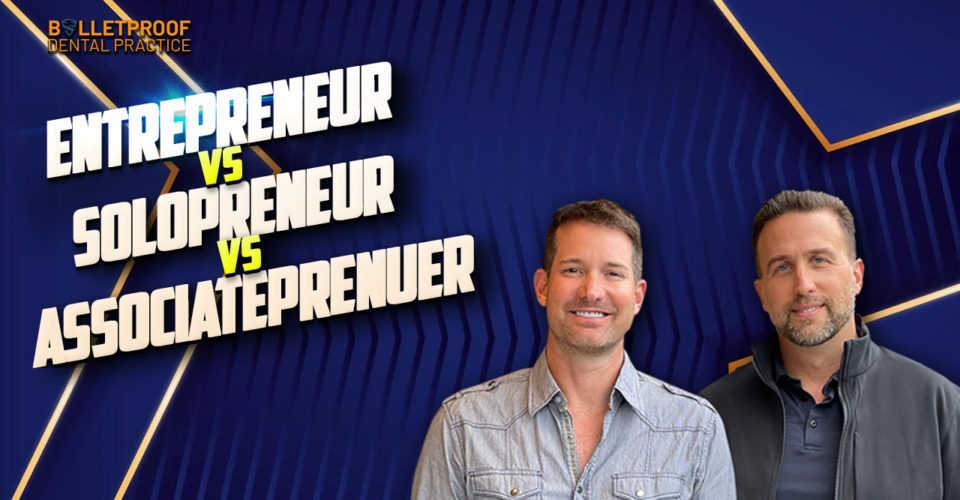
Entrepreneur vs Solopreneur vs Associateprenuer
Join our network at www.Bulletproof.Dental to stay in the know on all things Bulletproof!
Bulletproof Dental Practice Podcast Episode 215
Hosts: Dr. Peter Boulden & Dr. Craig Spodak
Key Takeaways:
Intro
Advantages Of Being An Entrepreneur
Symmetric Vs. Asymmetric Risk
Creating Wealth
References:
Mighty network: Bulletproof Dental Practice
Tweetables:
Keep your money in specification. Make your money in diversification. -Dr. Peter Boulden
Full Episode Transcript
Below is the complete transcript of this episode of the Bulletproof Dental Practice podcast. Prefer to listen? Find us on Apple Podcasts, Spotify, and YouTube.
Read the full transcript
The following transcription was from the Bulletproof Youtube channel. Here is the https://www.youtube.com/watch?v=NZwtP0c7B94
Craig Spodak
0:00:00
Hey everybody, welcome back to another episode of the Bulletproof Dental Practice Podcast.
Peter Boulden
0:00:08
I'm Peter Bolden. And I'm Craig Spodak. Dentistry can sometimes feel lonely. Having over 45 years of combined experience and the chops to run eight successful practices, our mission is simple. Pay it forward and share what we've learned. That's why we developed the Bulletproof Pathway to help you navigate your way to ultimate success in dentistry. And don't forget to join our community's conversation over at Bulletproof.Dental. Now let's get to it. Hey everybody and welcome back to another episode of the Bulletproof Dental Got a lot of guest hosts and you know if I if I wasn't so secure about myself I think I'd be I'm being asked to depart. Yeah. Well. Yeah, you didn't get that certified letter Oh, no, you know what it didn't I have a country so I should shouldn't spoke to you soon But I invited my way into this thing. I guess it's only a matter of time. Well, make it count considering this is your last. Make today count. Today will count actually because it's an important subject that I'm really excited to dive into. And I wonder, you know, there's a lot of shame in dentistry. I oftentimes say that. I don't know if I said in the podcast or not, you know, I'm just an associate, I'm just a GP, I'm just this, I'm just that, I don't have my own practice. There's so many qualifying verbiage that comes out of most dentist mouths and it's usually coming from a place of shame. And there's a narrative, and we can probably have a separate podcast of where it's coming from, but a narrative that you should own your own practice. And whether that's from your supply house or the people that make all the technology or the people that are trying to sell you the dental chairs, but they want you to run and open your own practice. And I think it's from a business standpoint, big business, big dental business, that wants you to go out and buy all that stuff. But an actual out-
Craig Spodak
0:02:07
So you're coming, so today you're discussing kind of the difference between entrepreneur, entrepreneur, and then the pains and the-
Peter Boulden
0:02:16
And the solopreneur. And the solopreneur, and then the stresses on all of them. Thank you, Peter, thank you. So yeah-
Craig Spodak
0:02:23
I'm just making sure, that's what we're…
Peter Boulden
0:02:26
Yeah, yeah, today is about entrepreneur versus solopreneur versus intrapreneur. And I don't think those are widely understood and it's just good to identify who you are. Give a quick definition, Craig, in your mind of those three. Okay, so Peter, you're an entrepreneur, right? You're a dentist by trade. You don't practice clinically, but you grow practices and you have a business mind that allows you to grow businesses that are productive, whether or not you actually work in them directly as a dentist or provider in those practices. That's an entrepreneur. A solopreneur is what most of our listeners is. It's a single operating professional, an architect or a dentist, doesn't have any of their dentists working with them, but your business would essentially stop if you decided to not practice in it anymore. That's the majority of people, so entrepreneur. And then an intrapreneur is an associate, a person who works for a guy like you or maybe me and they create their own business within the framework of an entrepreneur. And what's great about being an intrapreneur and what I love about intrapreneurs is that their income, their salary, their wages, is decoupled from their retirement asset, their retirement account. So for guys like you and me.
Peter Boulden
0:03:45
Wait, what do you mean?
Peter Boulden
0:03:47
Well, you and I have our retirement and our wealth strategy intimately locked with our businesses.
Craig Spodak
0:03:55
With our equity.
Peter Boulden
0:03:56
With our equity, yeah. Our equity and our businesses. Yeah. So imagine an entrepreneur, you know, an associate that works in a practice and is doing well, successful, making a couple hundred grand a year, and that practice doesn't do well. That practice, that area doesn't do well. Something happens, a hurricane or a flood or just the demographics change. He's going, he or she is going to take his skills or her skills and go find another entrepreneur working because they're always going to be protected. They'll always have their skill. And when they invest in themselves, like you and I have to invest in bricks and mortar and build stuff, they only have to invest in their skill. So if they go out and they take COIS or all these different courses and learn a new skill or new craft, that stays with them for the entirety of their career. And what I love about the entrepreneur is that their salary and the retirement strategies are decoupled. What does that mean? That means that they're making a couple hundred grand a year, maybe more, and they get to diversify their retirement account. In other words, they're not building a practice, they're not building brick and mortar or chairs. And if something were to go wrong, it doesn't collapse their whole retirement strategy. So they can invest in S&P or maybe cryptocurrency or have real diversified portfolio real estate. And I love that because now you have your income and your wealth as two separate silos. And I think from a protection standpoint, you're going to be more protected than the average person because we've all been fed this narrative that, yes, build a practice and run it well. Oh, it's going to be worth so much money. Oh, yeah, they're paying 50 times multiples now. It's just not true. I mean, Peter, how many people have you talked to that come to you and say, hey, I heard my practice is worth double digit, you know, or X number of millions of dollars. Well, I got a letter in the mail saying that they do 300% top line revenues. That must be what it's worth, right?
Craig Spodak
0:05:48
Yeah.
Peter Boulden
0:05:49
Not me. I'm saying a hypothetical. I hear this. Right. And in actuality, when you go to sell as a solopreneur and you go to sell your business, they're really going to pay you with your own money. So the DSO is going to buy you, or the ownership company is going to buy you and pay you out over, you know, maybe the clawback over three to five years. And it's really going to be like, you might do the math and it might look real sexy, and then at the end of the day, you're like, I should just work here for seven or eight years and then throw it away. Well, that's a good, I want you to pause there. So when we, we always talk about EBITDA and earnings. So think about it, right? So whatever multiple you get, that's essentially the year. It's equivalent to the year and how long they're paying you back with your own money, right? So if you get an 8X, they're saying, hey, that's a good valuation. We don't mind making our money back until about eight years from now, essentially, right? And they're planning on growing the practice, right? But if it's a 3X, it's a three-year, right? So that's a funny way that you just kind of, you said that and a light bulb kind of went off. You're like, yes, it is paying you their money and you can actually find out how long they're paying you their money based on how much money they're giving you up front based on the multiples of an EBITDA if you're in that scenario. And I don't want to go too deep down this rabbit hole.
Craig Spodak
0:07:09
I know, I know. I can't help it sometimes.
Peter Boulden
0:07:11
No, no. This is a great conversation. But what the point I was trying to make is that the idea that grow your own practice because it'll be very sellable in the future is not something that is predictable or guaranteed. And if you, like look at your career, my career, let's say if you wanted to practice dentistry and love practicing dentistry and love doing what you do, I could argue, and it'll just be, it's a financial calculation, that if you make a certain amount of money and you invest it and you diversify that asset, I think you'd be better off doing that than opening up more dental practices. Because even though the narrative is like, open up these dental practices and they'll be worth a lot of money, chances are you're not going to have the entrepreneurial gifts to do what you think you're going to be able to do. You get to one or two, like our friend Tim always says, you open up the first one because you're also not at the second one and you're running in between two and, you know, two different locations and you open up the third and you're like, oh shit, nothing's really making sense here. So I just think that that narrative that's been sold to us and that that narrative also creates shame because, you know, I'll just have one practice or I'm just, I'm not, I'm just an associate because there's, there's a narrative that says you're supposed to own multiple practices or, you know, be an entrepreneur in dentistry. And I don't think that always fits. And what made me think of this topic was like, you don't hear medical doctors saying, I've just been associated at the Cleveland Clinic. You know, I don't own the Cleveland Clinic. You know, I just worked there. Right. That's fricking awesome. Like it's an amazing organization and you do not care that you have no ownership in the Cleveland Clinic. But in dentistry, it's so readily, you know, the medical profession doesn't have that.
Craig Spodak
0:08:53
But that's a recognized badge of honor, meaning, meaning yet you're right. Dentistry doesn't have that analog in dentistry. There's no there's no Cleveland Clinic style dental thing that people have this status
Peter Boulden
0:09:05
signal this badge of honor to say, yeah, I'm one of those dentists.
Craig Spodak
0:09:08
Well, there are.
Peter Boulden
0:09:09
There are those. There are some iconic practices that people are really proud to work at and you know, they're gonna, you know, maybe there's some level of pride around certain iconic dental offices to work at. And those dentists that work there may have to work harder and make less money. As you're talking about this and you're going through the three types and have you gone over the solopreneur? Did you go for all three types? Yeah, solopreneur is the typical dentist.
Craig Spodak
0:09:33
So the thing that popped in my head when you're talking about this is risk. And so with a, there's symmetric risk and asymmetric risk. Right? And there's asymmetric risk, you get symmetric returns. Meaning here's my time, here's my money. Right? And honestly, we know of several people who, dentists who their time is very valuable. They're associate dentists, and they're probably making a million dollars, close to a million dollars a year. Right?
Craig Spodak
0:10:03
It's doable.
Craig Spodak
0:10:04
Right?
Craig Spodak
0:10:05
So, and I know lots of practice owners who make nowhere near that. So it's not that, you know, if the end game is, well I want to do it because I want to make more money, right, right, because that's what we're talking about in the risk. But usually, asymmetric risk is a scenario where it, if that resonates with you, and I mean asymmetric meaning minimal downside and unlimited upside. And that usually resonates with entrepreneurs and people who really need to take more more risks, because, like you said, in the in the instance where there's a business owner versus the the let's say the associate or the dentist who doesn't have equity, you're right, they can carry their skill down the way. If the practice doesn't work and they work in the practice, cool, they're still getting paid regardless, right? They're upping their skills, getting paid regardless, and they can hop and take those skills to the next and next and next. You are totally right. When in the owner scenario, there's a lot of risk going on in terms of taking on debt to then going with this thesis that I'm gonna open up these practices or practice. And if you're wrong,
Craig Spodak
0:11:09
you're real wrong. You're real wrong.
Craig Spodak
0:11:12
You're wrong for a long time, especially if that goes into a situation where you're in a chapter seven situation where you're having banks reclaim stuff. And I've known several dentists that's happened to. So you have to be, it's a risk tolerance that you need to know about, right? Symmetric risk versus asymmetric risk. I, Craig, you opened this pod with me kind of knowing, like I knew that I was unfit to work for someone, right? I knew early on in my life that I was an entrepreneur. I didn't know what that word was, but at age 12, I was buying and selling dirt bikes. At age 15, I was able to be a waiter for one day, my dad said, go get a job, I got fired in one day. One day, I was horrible, horrible. You know, I sold car parts.
Peter Boulden
0:11:52
But hold on, so hold on.
Craig Spodak
0:11:53
And so I pivoted and said, all right, well I'm gonna open up my own pressure washing business. Which I did. In college, I put myself through a lot of dental, I paid off a lot of dental school by buying and selling domains. I've told you this before. So it's just in my DNA. And when I found out that dentistry, irregardless of what my professor said, that I was capped in earnings and this and that, I was just gonna be a general dentist, regardless of what they said, when I finally got out and saw that there was no ceiling, I was like, holy shit, this is an entrepreneur's paradise. If you want. If you don't want, it's still just a, you know, it's still a great profession. So, and honestly, this has been backed up by the stuff that Dwight has been working with us on, Craig, with it, with the culture index, right? That culture index defined and basically said like, look, you love this stuff. You love a risk. You love an entrepreneur. You love the visionary stuff. You love, love, love this stuff. So Back to what you always say. You always say this, Greg, know thyself. Know thyself, do not cut and paste people's narratives.
Peter Boulden
0:12:55
And I know I kind of hijacked your thread on the differences, so to speak, of entrepreneur, solopreneur. I know I've kind of hijacked it into something else right now, but I think it boils down to that again. Yeah, but it is also, and I agree with everything you said, in addition to that though, Peter, it's like you and I are hyper-invested in dentistry. So Peter Malouk has a very famous saying, he said to me once, he's like, the number one reason why people get on the Fortune 100 list is consolidation in one area. And he said the number one reason why they fall off the Fortune 100 list, consolidation in one area. Yeah. So, you know, as you make your money in specification and you keep your money in diversification Exactly my point
Craig Spodak
0:13:44
Are you getting the most out of your practice? we'll find out exactly what type of dentist you are and understand exactly how to get impactful results by zeroing in on your Superpowers and mitigating your weakness want to find out head over to Dennis quiz comm now to get your results
Peter Boulden
0:13:59
So you make your money in specific knowledge, but you grow your money in diverse assets, portfolios. So you and I have everything works out fantastic and the timing and everything's perfect. It'll be great. It'll be fantastic for all of us. But for the associate dentist that's working for an entrepreneur, for the intrapreneur, the person that's refining their skills, constantly investing, going to all the courses, learning a wide variety of skills, that person, as long as they have the financial discipline and they start early, they could dwarf the best dental entrepreneurs.
Peter Boulden
0:14:39
Oh, well.
Peter Boulden
0:14:41
In return on investment, low stress, and diversification. I agree, I agree. Because the business is you. You are the business. Meaning when you're in that scenario, you are the business and you get to focus on the micro, meaning just me, just my skills, just my case presentation, just my speed, just my efficiency, all the things of me. And you need to take that to the next.
Craig Spodak
0:15:04
So you're saying that's investing in yourself
Peter Boulden
0:15:07
is what it is.
Peter Boulden
0:15:08
Right, and what you'll oftentimes hear is, yes, I would do that, but I don't own a practice. So you know how many times I've heard someone, I'd love to go to the Bulletproof Summit, I just, I don't know my own practice. I'm like, okay, do you own your own result? Because I have associate dentists that work with me, some make 220 and some make 790, same thing. What's the difference? It's their results and the efforts they put in. So there's a narrative that says, I cannot, I am not gonna bother learning right now because I don't own my own practice. And I've seen associates that work for friends that were really kind of bare minimum associates. They weren't really doing very much. They went out, they opened up their own practice, they started investing in their skills, and they started taking VOD. But imagine if they just would have done it while they were an entrepreneur. So it's just, there's a very interesting thing, and I hope we're making ourselves clear about this idea that I won't do it because I don't own it. But just do it, even because you do own your result.
Craig Spodak
0:16:08
Yeah, and you can own your result, and you can also brand yourself in today's day and age for free. 100%. Right? Like we talk about this at Summit, the Instagram and all the branding stuff you can do. Like Jenny Pernan does a ton of that. She's an associate or was an associate, and she built her own brand, right?
Craig Spodak
0:16:26
Yeah.
Peter Boulden
0:16:27
And there's a guy that shares space with one of our masterminders, nameless, but he's a very influential dentist. He lectures about direct bonding procedures. He gets tons of patients from Instagram and he shares space out of one of our mastermind doctors.
Craig Spodak
0:16:40
Yeah.
Peter Boulden
0:16:41
Doesn't own anything. Right. So, I mean, it's just, it's really cool that idea. And I just think that the idea of an associateship has, I should clarify it, like the idea of a career-long associateship has a degree of shame to it and I really don't think it should. And if I had the opportunity to go work in an amazing practice that looked the part, functioned the part, I would have signed up in a second. I only did what I did because there's nothing like it around.
Craig Spodak
0:17:11
Okay, well, but let's, okay, so let's go back to something. We talked about equity. I'm not going to get into equity of dentistry, right? But you cannot make your way to riches by just aggregating dollars and putting it into account, especially in today's day and age. Where does the super associate that you're talking about, where does the, well, I guess you've defined the solopreneur and the entrepreneur usually have equity. So where does that associate dentist, where would you advise them to go create
Peter Boulden
0:17:40
wealth? Well, so easy. The best place ever. Where? Real estate. The best place ever. The best place ever. You and I have access to a lot of very wealthy friends and know wealthy people and the one commonality amongst many of them is real estate. So, you know, the pain of any well-producing craftsperson like a dentist is that our income comes as ordinary income. We get taxed to high hell. The ultra-rich actually don't. They have assets. They don't make money. They have assets so they don't pay the same level of taxation. So the true hedge and the true way for a dentist to turn their income into true wealth is just real estate. It's living below your means.
Craig Spodak
0:18:26
And it's just that again, this is that's a sweeping generalization and it's dangerous because a lot of people got real hurt, Greg, in 2008. If you had taken this advice and heard this podcast in 2007 and went all in, you got really hurt, right? Meaning 10 years of your quote unquote associate money could have been wiped out in three or four months if you had been playing long in the real estate market. Now, granted, it would have recovered by now, right? If you zoom out, it would have recovered.
Peter Boulden
0:18:52
Had you not panicked and sold it.
Craig Spodak
0:18:53
Had you not panicked and sold it. But sometimes a lot of people didn't have the choice whether to not panic and sold because they were being foreclosed on. So I guess what I'm trying to say is I don't want to make it seem so easy. It takes, especially if, look, if you hate real estate, if you hate managing properties, if you hate looking at that stuff, then again, know thyself and know that that's probably not where you're going to make, it's not gonna be fun.
Peter Boulden
0:19:16
It's not gonna be a fun thing. Well, you asked a specific question about like,
Craig Spodak
0:19:18
I did, you're right, you're right.
Peter Boulden
0:19:19
Risk and reward, the way to do that is commercial real estate but it's also a higher stakes game. But, you know, investing in the S&P. Why is it higher stakes? Well, because it's leveraged and you can get yourself in trouble and if you get some vacancies and stuff like that, it's also specific knowledge required to enter the real estate market. You need capital. But I mean, investing in any tangible asset, even the S&P. Had you taken 20% of your… If we had taken our careers and taken 20 to 30% of what we had earned and just dumped it in the S&P, the S&P 500, just the stock portfolio, we'd have a significant amount
Craig Spodak
0:19:58
of money.
Craig Spodak
0:19:59
Totally. Here's why I like, when you're talking about the S&P, you have to own all those funds to go deploy, meaning you have to, with real estate, you can have leverage. And so leverage can either wipe you out
Peter Boulden
0:20:13
or create a lot more wealth for you, right? Yeah, but you won't get a capital call if it's not leveraged.
Craig Spodak
0:20:18
Well, right, right, right. If you're in the S&P, it's all your dollars that you deployed, right? With the real estate situation, it's typically you put in one and the bank puts in the remaining four if we're talking about getting to $5. And so there's leverage created, which can work out. So if you buy it right and you're going to hold it a long time, then yes, that is a good way to wealth. And so you and I are of the same mindset because we like, you talked about it, the tax advantages, blah, blah, blah, all the things. So I don't know why I'm going down this trail of wealth, but because it's really not applicable so much to what you're talking about, but I think that's that.
Peter Boulden
0:21:02
Well, it is, it was like part of the fundamental idea of that a well-disciplined entrepreneur can kick ass. Can kick ass, and let's talk, like, listen, it's not just money, but emotion and time like when you're an Entrepreneur and it's 515 and you just hung up the handpiece you've written your last note You should leave outside of your dentistry You shouldn't think about a thing and I can speak for myself And I'm sure I can speak for you to the dentistry towards the end of our clinical towards the end your clinical career I'm sure was the easiest thing you had to do. After 15 years of doing dentistry, it's pretty frickin' easy. You don't lose sleep over dentistry. You lose sleep over regulation and what you're gonna do and the advertising and how you do it. I mean, it's just, it's another thing. So maybe you'd be trading off a couple dollars, not owning, if you're that entrepreneurial dentist, but what you pick up in emotion and time could be huge for you. And I just see so many people being pressured by the narrative to go into a position that doesn't naturally suit what they want. They don't know themselves and they go in because everybody's, you know, on the soapbox are saying, you know, three and five practices and Dennis is CEO and blah, blah, blah. So I think that's just an important distinction for people to hear.
Craig Spodak
0:22:18
I like, I like how you're bringing this up, honestly, because it's, it's, I would say disproportionately our listeners are more in the entrepreneur mindset. Right? I mean, that's kind of that was kind of the thesis of the pod in the beginning was that. I think it gravitated more. So I like that we're talking to a different class because to your point,
Peter Boulden
0:22:43
Craig, you can still apply the same methodology, but you become the business. Of course. Same social media tactics we talk about, same exact stuff, same exact stuff. But just to grow your own portion of the business.
Craig Spodak
0:23:03
And look, when you have that, right, when you have that built up and you can redeploy that, you become more valuable,
Peter Boulden
0:23:11
meaning from a negotiation standpoint, right? 100%.
Craig Spodak
0:23:15
Right, versus like, I just want to get a job. Right, well okay, well the job is going to pay just what the job pays. But if you come in and say, hey, I've got 15,000 followers, I know these skills, I'm going to add this value to the business, I'm going to bring blah, blah, blah, blah.
Peter Boulden
0:23:28
I get three requests per week to have that compensation.
Craig Spodak
0:23:30
Yeah, everyone's going to follow me, I'm going to rise this whole business. That's a different conversation in terms of compensation.
Craig Spodak
0:23:37
Of course.
Craig Spodak
0:23:38
Right, and so that is the one thing to think about. And if you can modify that over time, you're right, Craig, maybe you become the one that wins. Maybe you become almost like, we bellyache about specialists demanding more or specialists demanding less. Maybe you become, you are kind of a quasi specialist at that point, meaning you branded and you have a skillset that probably only one, less than 1% of dentists on the planet have. And so you essentially did specialize this post-gradually you did. And from a market standpoint, you are a specialist. You've specialized, just not in the context of.
Peter Boulden
0:24:13
No, yeah, you're a specialist, not endo-perio.
Peter Boulden
0:24:16
I like this.
Peter Boulden
0:24:17
Yeah, but you know what I'm saying? And there's before this ever happens, there's like, well, I can't do that because I don't own my own practice. In other words, they believe that the outcome of their future is predicated on the entrepreneur or the ownership structure of the practice. You'll find a practice that can support your skill. So, you know, if you're gonna take on all these courses and you're gonna learn more techniques and FMR and rebuilding vertical and stuff like that, and you wanna practice in some shitty ass practice, it's not gonna meet, it doesn't fit your skills. It's hard to sell 40 and 50, $60,000 cases when you're literally in the crappiest location, the crappiest practice. But you and I have the unique purview of seeing the same building and seeing massively different results between different providers. And it just makes me go like, hmm, that's interesting. Why is it that doctor one can do $2 million of production and Dr. Two can't even get $500,000 of production. It's really interesting. And also something to compound is that the sale of that practice may not be all it's cracked up to be unless you're a true entrepreneur and you're producing EBITDA revenue without you being there. That's the key. If you're not producing revenue without being there, you're just kind of fooling yourself. You really are. You don't have a business. And even though the offers will come in, the mailers will come in, when you really distill down the numbers and you really, really look at it, they're gonna pay you with their own money, with your own money rather. That you're gonna be paid with your own money.
Craig Spodak
0:25:54
Yeah, it's not charity. Meaning no one's there to say, hey, you did such a good job with your career. We really respect the hustle you did for 20 years. Here's a lot more money than you're worth." They're going to give you, right? They're business people. They're going to make money in the long
Peter Boulden
0:26:09
term off you. And that's just how business works. I don't blame them. Otherwise, they'd be jerry. It's a paycheck advance.
Craig Spodak
0:26:15
It's a three to eight-year paycheck advance.
Peter Boulden
0:26:19
Right. And if you're going to want to work more than three to eight years, you might as well work for the eighth, ninth, and tenth year, and then literally throw it away. If you take the taxation and all that into it as well. Because you've got to remember with long-term capital gains tax going up now as well, you get that money, which is whatever, three to eight years, then you pay tax on it, it's really two to six years, and you want it to work seven anyway, so the seventh year on the taxation, you might as well just chuck it and throw it away. So I think know thyself goes into know thyself as a business as well. And I think that dentistry and dentists just don't understand that. They're proud that they're owners. They're proud that they're solopreneurs. But in actuality, it's really not that sexy. You got to wait till it's all, everything's done. If you get sick, if something happens to you and your plan is that you wanted to sell your practice at 65, but you're 53 and you get sick, your practice is worth zero.
Craig Spodak
0:27:11
All right. So like, I want to just, um, bear with me as I impact.
Peter Boulden
0:27:15
Or maybe not zero, but it's.
Craig Spodak
0:27:17
So let's take the solopreneur and then we'll end it on this. So you just said doing dentistry sometimes becomes the easiest part of dentistry, right? Yes.
11
0:27:27
All right, so let's take the solopreneur.
Peter Boulden
0:27:28
Of your career, yeah.
Craig Spodak
0:27:29
Of your career, I agree. So let's take the solopreneur versus the associate, okay? So I would say the solopreneur is probably spending
Peter Boulden
0:27:40
half time doing dentistry physically,
Craig Spodak
0:27:43
and then half the time probably running the business. Maybe, maybe that's off. Maybe it's, maybe it's 70, 30, 60, 40, whatever. Right. Okay. The associate is converting a hundred percent of the time. And we just talked about how you can super power that a hundred percent of the time. So in an apples to apples, what if that solopreneur took that 40% that they're quote unquote just running the business in a mediocre standpoint, easy for me to say, and took that hourly that they're being, and put it into the, so. I like where you're going with it, keep going, Peter.
Peter Boulden
0:28:20
Yeah. Exactly, you're helping me, like this is exactly what I'm trying to say.
Craig Spodak
0:28:28
So it's like, are you being, are you being-
Peter Boulden
0:28:28
Sometimes it's the bellyaching,
Craig Spodak
0:28:29
it's the stuff we hate the most, the 40%, we hate the most, and if we just take that 40% of time that we kind of gobbled up doing payroll and HR and compliance and OSHA and all the systems and all the stuff we hated, and said, hey, I convert $20,000 cases all day long, and I couldn't, you could have done that with that 40% of your time in a different vehicle. And now you're happier, you're wealthier, you're healthier, you have less worry.
Peter Boulden
0:28:56
You're time. Well, it's also like figuring out what your hourly rate is worth.
Craig Spodak
0:28:59
Right, right.
Peter Boulden
0:28:59
So like if you're, if, if.
Craig Spodak
0:29:01
As a solopreneur, meaning the business net, net, yes.
Peter Boulden
0:29:04
Right, right. And as a solopreneur, it'll be easy to conflate. This is quite easy to run the business because it's just you. You know, the trickiest person to manage is usually the most highly compensated, that's you in a solo brand. So like you don't have, you're the racehorse, you're the tough, you're the hard one to manage. If you have, you know, if you're an entrepreneur and you have, you know, 150 team and you have 20 docs, I'm telling you, the doctor's gonna be the hardest thing to manage, most likely, or the highest paid company, you know, the highest paid people are gonna be the hardest thing to manage. And you'll say, oh, it's so easy, just calling in payroll is so easy, it's because you have a team of five. You don't understand it. And then you think about what are you being paid for that? Imagine if you took that same amount of time, you're an entrepreneur or you're an associate, and that 40% of your week, that 10 hours a week, you just started taking real estate classes or met with an advisor or hired, even hired, you know, there's real estate firms out there that will actually manage properties for you. Your return won't be as sexy, but your downside will be a lot more highly mitigated. Yeah, you're in a reed. And most dentists at that point are accredited investors. There are a lot of deals open to accredited investors, right? And I won't go into what defines that, but you are right. There's access to deals that can give you decent, solid returns, 8%,
Craig Spodak
0:30:18
9% returns in perpetuity.
Peter Boulden
0:30:20
Right. And I'm just saying, if you took that amount of time that you managed the business and you really compared it to managing another business or investing or managing your investments, I just don't know who would win. I think in a solopreneur situation, I think the entrepreneur will win. Entrepreneur will win all day long typically because there's high risk, high reward, but I'm just talking about solopreneur, single owner versus entrepreneur, associate dentist, that's discipline.
Peter Boulden
0:30:46
Yeah, and that's the only metric
Craig Spodak
0:30:47
you're looking at in this scenario, right? Who's winning? But if we talk about the burden of stress, the burden of doing shit you don't like, makes life miserable, which makes you think that you hate, I hate being, you know, miserable being a dentist, right? We have this discontent in our profession. You know, why is it? It's not because, it's probably not because you're doing a bunch of awesome life-changing dentistry. It's probably because you're doing the shit that you don't want to do. Like I said, the HR, the OSHA, you know, all the stuff that you're like my god
Peter Boulden
0:31:16
and I got a
Peter Boulden
0:31:18
compounds because you know you're trying to see two columns of patients a column or two a hygiene and Then Sally the hygienist wants to talk to you because she you know is really upset and you have to comfort Him or her or whatever whatever is going on so it's just it's a workload. It's compounding a workload I found when my clinical schedule slowed down or I slowed it down. I had more time to be a good leader. So I was booking so hard with the clinical dentistry, so much, four days a week, running 10 different docs, 40 team members, and doing four days of dentistry. I was not a great leader. I was short with people, it was not good. Wasn't good for my team. So you have to actually figure out what you wanna be
Peter Boulden
0:31:57
and what you're gonna do.
Craig Spodak
0:31:58
You had no bandwidth, yeah.
Peter Boulden
0:31:59
I had none.
Craig Spodak
0:32:00
I like it, I like it. I like it Let's wrap on that. I think that's good. Let's you got anything else to add. I think I think we know at home
Craig Spodak
0:32:06
No, I appreciate
Peter Boulden
0:32:08
You helping with that because I think it's an important subject to discuss and for this is an important topic for you Meaning you you really want this message to be delivered because because you've brought this up several times I think this is important to you because and you probably have more conversations. Let me try and people know that you're, you're the more, you have the empathy and you want to talk about things that of the two of us, right? So I think you get hit up a lot more on like, hey, my life and my happiness and you know, these kind of things. And I think you have more context for people, conversations and see people saying, really not happy. Yeah, it's like the first step of true suffering is a narrative that makes you suffer. We have a guy in our mastermind, he's like, yeah, I got this building and the payment. I had that breakthrough with him on one of our Tuesday calls. He's like, I'm like, look, he says, I'm only making this amount of money. I'm like, that's not true. You have to take the amount of money you're making because you decided to be an entrepreneur and you own this building and blah, blah, blah, and then take that amount of money and take the amount of business growth that you did in that year. So if your business went up in value by 200 grand or 300 grand, I want to add that to your salary too. And then I want you to take the amount of principal you paid down, the 70, the 90 grand of principal, because it's a big, you know, like a four and a half million dollar building. I want you to add that, because you're bullshitting yourself if you tell me you're only making one percent.
Craig Spodak
0:33:37
And then take a recent valuation of that building.
Peter Boulden
0:33:40
Right, exactly.
Peter Boulden
0:33:41
And then add the capital.
Craig Spodak
0:33:42
And then add that back on. And then look at the tax savings of doing a cost that, you know, all the things.
Peter Boulden
0:33:48
Right, but that's the truth, Peter. That's not just an exercise of mental masturbation. That's the God's honest truth. So if you do, if you are that entrepreneur. Well, that's a net worth statement versus a what did I make statement. Right, and the entrepreneur should not be really overly concerned with their salary. You know, Scott Galloway, when he was on our podcast, he said very clearly, I've never made more than $150,000 in salary in any given year. The guy's probably worth like 80 million or something, double digit millions. But he never made more than X dollars in a year.
Craig Spodak
0:34:22
I literally, and this is no bullshit, I literally just updated, because I track net worth every month, because I think, you know, back to Pearson's law, and I have all the things listed, buildings, all the buildings, all the debts, you know, so it's assets minus liabilities and tracking all the things, okay? And so I update, I log into my bank accounts, I look at what I owe in buildings and I put it in. And so to your point, Craig, sometimes I'm like, man, you know, it doesn't feel, I don't feel like I'm growing here. And then you look at the abatement of what you're doing over time, of the abatement of the principle that you just forget about sometimes on buildings or the loans on your practice. And so you're building the net, the network.
Peter Boulden
0:35:06
You wake up overnight, or what seems like overnight, but it's really 10 or 15 years, like, oh shit, I paid down that much money in real estate. I have that much less. So for those that chose to be the entrepreneur, don't give me that what are you making. If you're gonna wind up being an entrepreneur, you can't think as a salaried worker any longer. You've decided to invest, and investments need to be accounted for, not just the amount of money coming in the door. But like everything else, though, you get to a certain point, you're like, ah shit, I'm not satisfied anymore. I remember thinking, I've told you this before. Well, it's a growth thing, and that's what we preach, right? If you're just in homeostasis and you're stagnant, then like, okay, everything's good. Like, that's kind of a boring way to live,
Craig Spodak
0:35:51
and I think idle minds, I think bad shit creeps in.
Peter Boulden
0:35:56
Yeah, that conversation, by the way, where I tell people, like, look at your principal reduction and your business valuation before you tell me what you make. That is like an instant game changer for the psychology and well-being of the person that hears that. There was a guy that one of my associates had me call, this guy named Arvind, and he was really upset, blah, blah, blah, blah, blah. And I had the same conversation. I was like, what'd you pay down in principal exactly? And what did you do this? What did you do that? What did blah, blah, blah? And he wrote it all down. And what he thought he was making like 150 grand a year, and he's pissed off because as an associate he was making 250. He was really, you know, if you look at the balance sheet and his net worth, he made like 400 grand that year. And then instantly felt great about himself. So, you know, and same thing with our masterminder. He's like, that was instant. My girlfriend was so happy and it's just so funny how we just, we tend to F ourselves up with the dialogue. And that's the reason for this podcast and that's the reason why I'm always harping on it. Because it's just not true. You know, so if you're, to close, if you're that entrepreneur and you're happy and you don't have that entrepreneurial zest and that desire to do it, just invest. And take the same amount of time that your colleague, the entrepreneur, is taking on managing the practice and manage your assets and your wealth, and you will kick ass. And you will also decouple your salary and your retirement strategy, which is really, really financially secure. which is really, really financially secure.
Craig Spodak
0:37:12
I agree, I agree with you. All right everybody, thanks for tuning in. We'll get you next time. See ya.
Transcribed with Cockatoo
Blog


























1+1=3 The Power Of Alignment and Delegation For You and Your OM with Erika Pusillo
, October 31, 2024























, June 15, 2023
, June 8, 2023
, May 31, 2023






Look at These 3 Stats if You’re Thinking of Going Out of Network with Teresa Duncan
, January 11, 2023

, December 28, 2022

Knowing What You Don’t Want with Judy Kay Mausolf of Culture Camp and Erika Pusillo
, November 30, 2022


Cabo This Week, Immersion Learning, Biggest Breakthroughs, Your Personal KPI is Net Worth
, November 2, 2022
, October 19, 2022












Business is not Productivity, Productivity is not Profitability with Chris Salierno
, September 22, 2021






















3 Biggest Bottlenecks of an Entrepreneurial Dentist: PART 2 with Perrin DesPortes of TUSK Partners
, June 25, 2020
3 Biggest Bottlenecks of Being an Entrepreneurial Dentist: Part 1 with Perrin DesPortes