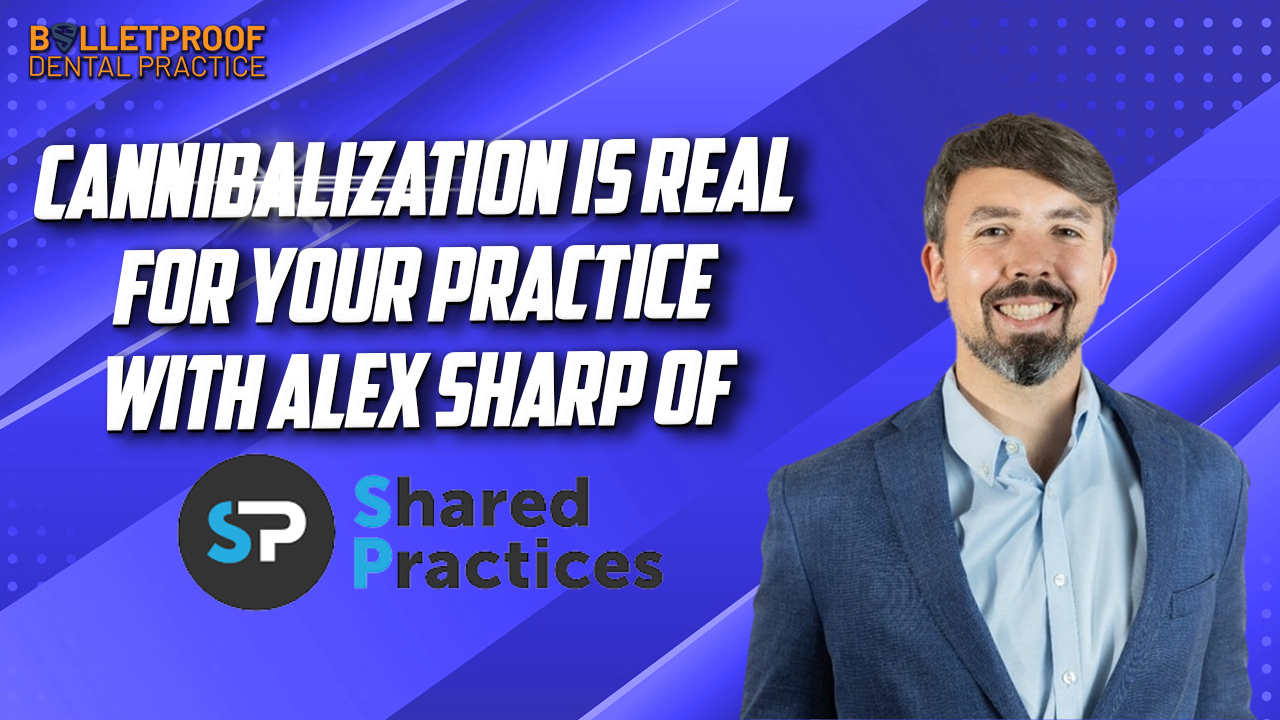
Cannibalization is REAL for Your Practice with Alex Sharp of Shared Practices
Bulletproof Dental Practice Podcast Episode 270
Hosts: Dr. Peter Boulden & Dr. Craig Spodak
Guest: Alex Sharp
Key Takeaways:
Introduction
Merging All Practices
Different Positions Of Equity
Evolution Of The Practice
Cannibalization
References:
Bulletproof Mastermind
Bulletproof Summit
Mighty Networks: Bulletproof Dental Practice
Tweetables:
There’s room for everybody. -Dr. Alex Sharp
Dentistry is the darling of equity. -Dr. Peter Boulden
Full Episode Transcript
Below is the complete transcript of this episode of the Bulletproof Dental Practice podcast. Prefer to listen? Find us on Apple Podcasts, Spotify, and YouTube.
Read the full transcript
The following transcription was from the Bulletproof Youtube channel. Here is the https://www.youtube.com/watch?v=eWsozzZkDIg
Peter Boulden
0:00:00
So today we have Alex from Shared Practices. Alex, how tall are you?
Alex Sharp
0:00:14
6'7".
Peter Boulden
0:00:15
Yeah, taller than Craig.
Peter Boulden
0:00:16
So he's taller than Craig by a long shot. But not better looking though.
Alex Sharp
0:00:20
No, I find you more prettier than I am. Also I'm older, but by the time you're my age, you probably won't look as good. But you look good now.
Peter Boulden
0:00:30
And you look good even in those fluorescent lights that are beaming. Yeah, that's the most unflattering background,
Alex Sharp
0:00:35
so I'm gonna add five points to you.
Alex Sharp
0:00:37
I know.
Alex Sharp
0:00:38
Well, I know that I can shine, you know, in spite of the visible surroundings.
Peter Boulden
0:00:42
So bring the energy, buddy.
Peter Boulden
0:00:43
Confidence.
Peter Boulden
0:00:44
All right, so talk to us. You've been, let's get a little background on you, just for people who don't know you. I know you've been to a couple, actually I think you were at the first Bulletproof Summit, by the way, right? Yeah, I was at the Ritz-Carlton in Atlanta.
Alex Sharp
0:00:53
No, the St. Regis in Atlanta. St. Regis.
Peter Boulden
0:00:56
Yeah, yeah, yeah. All right, so tell us your best, you're obviously one of six in the shared practice. Why don't you tell everyone your story?
Alex Sharp
0:01:02
Yeah, so my goal is to hit right down the fairway between George's extremely abrasive episode and Richard's very polished, nice episode and be somewhere in the middle between the two extremes. But no, I joined up as a partner in SP a couple years ago and I was a contributor and I ran the mastermind program for SP. And then we merged all of our practices together and we became equal one-sixth partners in not only the practice group, but also in the consulting and coaching seminar entity. So, it's been really cool to do that because those of us that are in the space that enjoy constantly learning and growing and improving, it's really contagious to be around those types of folks that enjoy constantly pursuing new stuff because dentistry can be as stagnant as you want it to be, or as you allow it to be, maybe more accurately. And so by being around people that are constantly pushing the envelope and forging forth, and are on the bleeding edge of innovation and possibility, it keeps it fresh.
Peter Boulden
0:02:14
Totally, I mean, we actually just had a pod on that with, you know, we've got two other co-hosts now from time to time. We were just kind of talking about that, because we're actually doing our mastermind. It's funny you mentioned you're, you kind of led that, you know, we're going to our off-site, we do vacations around some of ours, and so the first trip is to Cabo. So we're all going to Cabo this weekend to kind of dig in from an immersion standpoint.
Alex Sharp
0:02:35
Nice.
Peter Boulden
0:02:36
But yeah, all what the thesis that you just described. I'm curious though, you say you merged all of your practices?
Craig Spodak
0:02:44
I didn't know that.
Peter Boulden
0:02:45
How the hell?
Craig Spodak
0:02:46
So what was done on…
Craig Spodak
0:02:47
And then you're all one sixth.
Peter Boulden
0:02:48
Well, but how did you do that? Was it a merger acquisitions or was it straight merger or was it stock? How did you do that? Was it based on EBITDA? I'm so curious on this.
Alex Sharp
0:02:54
Yeah, there was a valuation that was done by a third party that took the valuations of each entity and then reconciled that with kind of an arbitrary valuation of the coaching consulting similar company. Oh, okay. Yeah, and so it treated those entities in the same book of business on an EBITDA multiple. And then we each, some of us had to buy up, some of us had to pay down to reconcile the one-sixth amounts. Yeah, the balance. But in hindsight, all of the game. So it was done with the best guess. And for anyone contemplating a merger, and I know you guys have talked about the good, bad, and ugly of partnerships on your podcast before, I distinctly remember at least one episode about it, you've got to go in eyes wide open and look at it as being almost a disagreement rather than agreement. Have everything outlined as to what could go wrong on the front end. Build it with the door open in mind. Exactly, because it's going to end whether it's till death do us part or some other circumstance. We're so unified in what we want to do and the fact that we want to be at this for a very, very, very, very long time. That all of us being in our 30s, we're unified wanting to do the teaching, the podcasting, the consulting, while at the same time having our book of business with our practices and having multiple ways to influence the industry.
Craig Spodak
0:04:44
That's so great.
Peter Boulden
0:04:45
Really good. I think that would be so daunting to say let's just merge these six practices with his six personalities And but it's obviously worked well for you guys you guys have a great reputation industry you're putting out quality stuff
Alex Sharp
0:04:58
You know long to pin Alex. Yeah, it's the the official deal closed January 1 of 22 the all of the the machinations and the back-end stuff were basically laid out earlier in 21, but nothing goes as quickly as you want it to go with banks and financial institutions and third parties. So it was beginning of 22 and we're doing a solely de novo model anymore. We're not doing any acquisitions. That space is crowded enough as it is.
Peter Boulden
0:05:31
And that's how we- Tell me why, Alex.
Alex Sharp
0:05:34
Can you put a- A couple of reasons.
Peter Boulden
0:05:35
I don't want to cut you off, but I want to hear your philosophy and y'all's philosophy on why no more acquisitions.
Alex Sharp
0:05:40
Well, there's two layers to that. The first layer is it would be disingenuous and hypocritical for us to do acquisitions when we coach clients on doing acquisitions. So a lot of our client coaching… Does that mean you'd have a conflict? There'd be a conflict of interest on a superficial level. And so we don't want to dip our toe into that water and compete with our clients, because that's not above board in my opinion. And then the second reason is… That's very virtuous of you guys.
Peter Boulden
0:06:09
I think that's a stretch, but I think that's very virtuous of you. Yeah, I do too.
Craig Spodak
0:06:13
It's a stretch.
Alex Sharp
0:06:14
I like the optic.
Alex Sharp
0:06:15
The optics are really bad.
Alex Sharp
0:06:16
Yeah, you could reverse course and do it, but the optics are bad. The second reason that's very compelling is you can do a de novo for a fraction of what you can acquire practice for.
Peter Boulden
0:06:28
Yes, provided that you don't need cash flow.
Alex Sharp
0:06:31
Right.
Craig Spodak
0:06:32
Yeah.
Alex Sharp
0:06:33
And that's where we're at.
Peter Boulden
0:06:34
And no, I mean, you're like, duh, Bolden. Like, of course I know that. I state this stuff because I said the same thing on many podcasts. When you do an acquisition, typically you're buying cash flow, right? Like, that's what you're buying. Let's just be honest. That and some goodwill, right? But goodwill cash flow. And if you want, and in that problem, sometimes you, in that acquisition, sorry, you have attrition of patients, drama of integrating a new team, things like that, right? You're having to polish a lot of this stuff. So this integration becomes a heavy lift, potentially. Actually, no, not even potentially. Integration is a heavy lift, full stop, right, Craig?
Alex Sharp
0:07:12
Pencils down.
Peter Boulden
0:07:13
Pencils down. In a, obviously in a startup, you are the architect of all the things. It's a new team. It's a new culture. It's a new this. It is much cheaper, but it obviously lacks the cash flow.
Alex Sharp
0:07:29
Yeah, it lacks the cash flow, but it creates so much more freedom of possibility, and you have a blank canvas, truly. And the thing with acquisitions, and you touched on it, a lot of my mentors that have grown large groups via acquisitions, there's a whole lot more pain points that arrive even if you're just trying to do the duct tape them together and sell them approach. Like, even with that, there are…
Peter Boulden
0:07:54
The duct tape roll up is a pain, is yes, is not as easy as duct tape.
Alex Sharp
0:07:58
Smart money is smarter now, and they can sniff out a duct tape DSO. Whereas maybe 10 years ago it wasn't this or 5 years ago it wasn't this. They want a real platform. No, there's a need for the real platform and one of the things that we are very open with on our podcast and with all of our clients is there's going to be a reckoning at some point with all of that, the dumb money that you alluded to. There's going to be a reckoning with that. So anyone who's caught with their pants down, it's gonna be rough for them. And I think the market is getting so segmented where you either have really good, savvy operators on one end of the spectrum, or you have people that are saying, hey, you know what, I'm just gonna batten down the hatches and have one really solid location. And the people that are caught in that nebulous middle ground area where maybe they're aspiring to go from two to five locations, but they're thin on management or they're thin on processes. That's where it's going to be no man's land pretty quickly. So I think it's a great idea to err on one side of that gulf or the other.
Peter Boulden
0:08:59
I feel like since he's been such an advocate of bulletproof, some of this is either, I can't tell, but I love the way he's sounding.
Craig Spodak
0:09:09
You're so smart.
Peter Boulden
0:09:10
You must have learned this from us. Hopefully we've had some influence. Yeah, it's just osmosis.
Alex Sharp
0:09:13
It goes from a higher concentration of knowledge to lower concentration and that's where it goes I think I'd be on the bottom of that unfortunately
Peter Boulden
0:09:20
I like it like the the Thinking like to be obviously you guys had a nice vision that you all Agreed to I want to hear about your coordination in the beginning right making sure that like okay here We are dating now. We're getting engaged now. We're getting married. Who defined this is the vision we should go? Do you guys want to jump on? Or was it a collaborative effort?
Alex Sharp
0:09:45
It was incremental. It was George and I, George and I went to a seminar and we had this, you know, trademark epiphany that so many people with big ideas have and the proverbial…
Peter Boulden
0:09:58
You went to a seminar?
Peter Boulden
0:09:59
Mm-hmm.
Peter Boulden
0:10:00
So a seminar just that, not about that obviously,
Peter Boulden
0:10:03
but just you guys spending time together.
Alex Sharp
0:10:03
No, we just were together, yeah. Yeah, we were together at a seminar and we started talking and we thought of the idea of, okay, we know the industry's getting more consolidated. We know that there's strength in numbers to be had, if it's done well, if it's not the duct tape approach. And just how quickly the industry is changing. There's going to be so many economies of scale at the larger level that soon we're not going to be able to compete with a bunch of in-our-own-sandbox type of approaches. We started talking about it, then we enrolled Richard and Matt Garino, the other two legacy founders of SP, and then we eventually added on Matt Ford and Austin Davis through some recruiting pitches and all told it happened in a couple of months and we enlisted some third-party advisors to help us along the path to do the valuations and such but we agreed in principle pretty quickly and another point on partnership in broad strokes I think that can be helpful to the audience is if ever you try to do something that's not equal parts, even if it's like 51-49 for like a controlling interest or anything that's majority-minority, even if it's well-designed and well-intentioned, be careful of those hurt feelings and the likelihood of any kind of issues that spawn out from that, like the ripple effects of having the majority-minority. They can be good, and sometimes the ripple effects are justified by the benefits, but go in eyes wide open whenever you're proposing something that's not, that doesn't have the maximum amount of equanimity.
Craig Spodak
0:11:45
I mean, okay, so wait a second.
Peter Boulden
0:11:45
I have a little bit for me.
Peter Boulden
0:11:46
Yeah, so are you saying that someone having a super majority someone having a super majority is not beneficial, right?
Alex Sharp
0:11:53
Right, so we started off having an unequal distribution of equity between the six of us, like it was parceled out according to like a weird way of doing it, that we eventually realized, you know what, this is too complicated, just one sixth across the board. So what's your belief system about different positions of equity on a comp table? What's your fear, what's your thought? Let me understand that. There's two ways of looking at that. One way to look at it is what are you bringing to the table initially? And then the other way of looking at it is what do you purport to be able to offer as we grow and scale? Are you bringing something in on the front end that's irreplaceable or are you offering something six months or a year from now that you can't get from elsewhere? Because one of the maxims of partnership is only partner with someone that offers something that you can't yourself offer. Because like equity, Peter you're probably familiar with Naval Ravikant, right? Like the Twitter guy, he does the big Twitter tweet storms.
Craig Spodak
0:13:02
So one of his big.
Peter Boulden
0:13:02
I was about to say equity is the most expensive thing.
Alex Sharp
0:13:05
Yeah, well equity is a scarce resource. I mean, I have a very abundant view of the world but equity is scarce, valuable equity is scarce. So be sure that whoever you're partnering with brings something to the table in exchange for that equity. So that was our mindset to answer your question, Craig. Well, that's not answering my question though because I was speaking to Naval will say himself a small piece of something, owning a small piece. Naval hasn't been a super majority shareholder in many of the things he's entered with. So I'm just trying to unpack what – because I'm a minority partner in several things that it brings not only opportunity that they'll get, but long-term overall experience and expertise. I'm just speaking to, Peter has minority non-share voting shareholding stock partners as well. I would hitch my wagon to a person who has opportunity and smart all day long and take a minority piece on that. I'm just trying to understand like what I understand you're not you don't have the same level of Contribution and voting rights, but I've done it successfully many times, and I just was trying to understand
Peter Boulden
0:14:12
What you know dumb it down like they have that many cooks chefs in the kitchen, right? I think it gets I think progress gets hindered because it's like I don't know what do you think? I don't know what do you think? I don't know what do you think and so that's an efficiency issue. And so I think Craig is saying, look, in our models.
Alex Sharp
0:14:28
Yeah, I've wanted to be a majority shareholder in many things I've wanted.
Peter Boulden
0:14:31
Yeah, and in my models, I'm like I am the majority, but I declared the vision early and then everyone said, yeah, I like that. Let's do that. And so maybe that's a unique situation, different than y'all's, because you guys came together as a collaboration new entity. And so it's quite different.
Alex Sharp
0:14:45
I think the difference too is if you're the operator versus if you're just purely a minority shareholder with an active or a passive role in the business, because all of us are operators. Like all six of us actively operate in the business. So if you're a super majority, then probably you're an operator in some form or fashion, whereas in a lot of configurations, you can be a minority shareholder and not have an operations type role as a central cog in the day-to-day. I'm not saying that's necessary, but I know that we're one-sixth, equally operational in nature between our different roles. And that's how we keep-
Peter Boulden
0:15:22
And you really are. So Craig, they went about it, because I know Austin and George pretty well now, but you guys do kind of, it's a divide and conquer. Like, this is my lane, and I'm going to master and be, and you guys just know that I've got this business development aspect, or this marketing, or whatever it is. And so it truly is a divide and conquer, not a duplication. And so I so agree with what you're saying. Do not offer a partnership until someone can bring something to the table that you really can't do or don't want to or don't have the bandwidth to do anymore.
Alex Sharp
0:15:51
Yeah, I was just speaking to a personal bias. Like if I was in that similar situation, I enjoy a controlling us, not for me personally, but I would be more inclined to step into a relationship where we had five of us were all equal and then there's one that's like leading the charge. I work well with that as long as I respect the values and decision making of the leader and they take my input into it. They consider my input. But I've wanted that. I've been in other situations like with my buddy Michael in real estate. I'm like, I need you to be the majority shareholder. If you're not, I will not invest in this deal. That comes into play when you have someone who's head and shoulders, either senior in years or experience or knowledge or an ability, but when you come in as a multitude of equals, then the democratic approach tends to work, at least in our case. I don't know how replicable or scalable that is. I just know that in our weird little partnership, it tends to work because we have such disparate skill sets. For each of us, we realize that if we wanted to do things on our own and blaze our own trails then we'd be invariably wearing hats that we don't want to wear for the rest of our careers. It's new. It's the first chapter and God willing, it goes well. I was just speaking. You had a clear bias about that and I had a clear counterpoint to it.
Peter Boulden
0:17:15
So I just wanted to flush it out. What's the, what's your plan? What's y'all's plan? Like what's the, you know, I hate to say a five year goal, but let's just say like if you had the magic wand, where do you see your SP practice group evolving?
Alex Sharp
0:17:28
Well, we see getting to triple digit locations. That's where we want to get to in the next five years.
Peter Boulden
0:17:36
A hundred locations plus.
Peter Boulden
0:17:38
Yeah.
Peter Boulden
0:17:39
Okay.
Alex Sharp
0:17:39
Yeah. Yeah, we intend to make a splash and that's at the same time as, you know, continuing to grow our consulting coaching side because we see dentistry as being a very complicated market. Yeah, there's two sides of it.
Craig Spodak
0:17:54
Well, no, I'm saying that one helps feed the other.
Peter Boulden
0:17:56
I mean, you know, because you guys are voices in the industry, people say, I like what they're saying. I'd like to join them if this is what they're doing. So you guys have a unique arbitrage, not a financial arbitrage, but you have an attention arbitrage.
Peter Boulden
0:18:10
And we used to see-
Craig Spodak
0:18:11
And they often even know you, I mean, your podcast listeners understand who you are, they've, you know, it's not a, it's an eyes wide open opportunity,
Alex Sharp
0:18:18
they know every personality. Yeah, and we used to see this, there being more synergy than maybe there actually is, because originally we were all about only practice ownership, practice ownership or bust on the podcast. And we've since gotten a lot more nuanced in our angle, knowing that there's plenty of great outcomes for dentists, regardless of if you do full-blown, like solo, hang a shingle practice ownership, versus partnering with a group that can offer equity at the single site. And so there's shades of gray, there's sophistication there, but we want to offer things at every level depending on if you want to be super duper clinical and not worry about management, or if you're like, hey, I want to do the manifest destiny, do my own path, there's room for everybody.
Craig Spodak
0:19:06
I agree, I agree.
Peter Boulden
0:19:08
So 100 locations, geographically agnostic?
Alex Sharp
0:19:15
Yeah, that's the cool part about living in 2022 is that you can be more geographically agnostic than you ever could be before. You can have remote operations, you can scale different departments without having to be in one geographical radius. And so there's ways to do it based on the goals of the people that you interact with, the interest levels of people that might wanna partner with you in various sites. And what we've seen too is, I saw this in Arkansas when I was dipping my toe in the multi-practice waters, and others have seen it in other comparable markets, is that the cannibalism is a real thing. Like especially if you're doing any type of a niche practice and I'm sure you saw this, Peter, with your locations where how big is the optimal radius so that a niched out type of practice does not auto cannibalize a neighboring practice 20, 30 miles away? Like, what's the sweet spot? And you probably had to learn that lesson the hard way. And we've done that with some split.
Peter Boulden
0:20:17
Yes and no. I've actually, I'd love that you're bringing this up because I was gonna actually do a whole pod on this, Greg, and I'm not gonna spend a whole pod's worth of time on it, but yes, cannibalization is a real thing for your practice, especially when you're doing multi, especially when you're in a metro area. So what I did, Alex, I've learned the hard way by making emotional decisions or gut decisions because I've quote unquote lived here my whole life. I know, I'll know what to do. So I got burned by that. So I started making myself do data-driven decisions instead. So I have taken, so there's an opportunity in my area. I have a building that's becoming available in a great location, although it's within three to four miles of another location. Great roadside visibility, it's a standalone, it's an MRI clinic that's not renewing their lease. I didn't want to get romantic about the fact that, oh gosh, I have a building and I'd love to put a dental practice in, so I wanted to justify it by data. So what I did is I exported all of my, I hired a cartographer who then used a service online, which I found that you can use, I forget the service, exported all into a CSV file of all 20,000 or 22,000 people that have ever been in my practice. And from that, Alex, it created a weather map of the density of where people are from. Um, and so that was a really cool exercise to do because luckily it confirmed my suspicion, but it was a nice thing to do in terms of like seeing. Uh, your ideal market. So like, if you do this, even if you're not trying to expand, this is why, which is why I was trying to do the podcast on, even if you're not trying to expand, it would be nice to say, wow, this area, or, wow, look at this opportunity over here that for some reason we are not tapping this community. And so data is just your best friend when you just don't – or kind of your back's up against the wall. But so – I love how you started that, Alex, with cannibalization as a real thing, and it should be front and center when you are doing multiples. Because three miles, I'll finish the last thing I'm saying. Three miles might be okay in a metro area, but I have a couple of rural practices too. And so 20 miles, 25 miles in that would be cannibalistic in that area. So it really, you've got to run the data. So Alex, sorry.
Alex Sharp
0:22:47
No, I couldn't agree more. And I think it would be negligent to not do that anymore. Like with the ubiquity of data and the ubiquity of being able to check and recheck and double check and triple check.
Peter Boulden
0:22:59
So many people don't though, Alex. They just run demographic reports on a said new location without running the cannibalism.
Alex Sharp
0:23:06
We conflate too much importance on our guts and our instincts because we feel like we've been there, done that, got the T-shirt and we know best because we know the area. That's that's what gets you. I thought that about Arkansas and then I bought this like fledgling location right after all the COVID stuff and had a plan to resuscitate it and it ended up taking way longer and being way more capital intensive and requiring way more patients than I ever thought possible. But it was a really good learning opportunity and to do it in your backyard prior to doing anything remotely, I think is a great prerequisite for anyone who's thinking about doing multi-practice, because if there is a fire to put out, you'd rather it be 20 minutes away than two states away.
Peter Boulden
0:23:50
Totally. Yeah, the proximity to fight the fire is definitely a real thing. I actually was looking at a practice in Dothan, Alabama, which you did not pull through on. And after driving that a couple times in my diligence, I was like, you know, I don't have a police license. There's not really a good airport. It's, you know,
Craig Spodak
0:24:09
But it's also management leadership infrastructure too. I mean, it's not necessarily that you have to drive,
Alex Sharp
0:24:14
but like one of your team leads.
Peter Boulden
0:24:15
Sure, someone will have to drive.
Craig Spodak
0:24:16
Having them drive five hours, it's untenable.
Peter Boulden
0:24:18
You can't do it. Well, back to our original thing we were saying with Alex is that the, especially, I didn't mind it once I got everything integrated. But the first three to six months was gonna be a heavy lift Heavy lift and I didn't have the bandwidth nor the desire quite honestly to travel four and a half hours on a good day To to another out of the state practice so you don't want to be an Alabama man Peter Come on. No. I absolutely want to be an Alabama man. I think I think honestly that That procs that areas where you're in, I think Alabama, I think Mississippi, I think all the areas that are-
Craig Spodak
0:24:54
Yeah, you boys like that.
Alex Sharp
0:24:55
I love a rural market, I love a rural market, I love overlooked areas, everyone focuses on metro, but I like non-metro areas, I like strong secondary communities in smaller states. If you can retain doctors, that's the way to go. I mean, I 100 percent there's there's still so much opportunity here in Arkansas that's untapped. And it's crazy. Like you find a state that does not have a dental school like Arkansas. There's just so much opportunity that the saturation level is not there.
Peter Boulden
0:25:27
Let's talk about that. You brought it up. Excuse me. Retention. What are you guys doing? What has been the consensus among the six of you guys as you scale to 100, DSO's biggest impediments right now, let's call it private equity DSOs, the biggest impediment to their success is the retention of the doctors, the retention of the team. What is your problem solution to that as you go to triple digit locations?
Alex Sharp
0:25:52
For us, it's an earned equity model where you hit certain practice level benchmarks, certain profitability metrics, certain top line revenue numbers, and then that equates to a certain percentage of earned equity. Real equity or phantom equity?
Alex Sharp
0:26:09
Not the whole co.
Alex Sharp
0:26:10
The whole.
Alex Sharp
0:26:11
Right.
Peter Boulden
0:26:12
At that location or?
Peter Boulden
0:26:13
Yeah, practice level. Location, sorry. Okay. And then Craig's saying, is it real equity or is it profit sharing phantom share?
Alex Sharp
0:26:18
RSU type of thing or? We originally were doing an RSU type approach. And I know who consulted you on that, the RSU. It was a heavy lift to borrow your, your knowledge later. Yeah, so we pivoted away from that and we're doing more of what we're calling synthetic equity, which is a variant on. That doesn't sound nice to me, by the way. You might want to call it something else. It's like, here's synthetic meat. I'm like, no thanks, I'm good. Yes, it's soy-based equity.
Craig Spodak
0:26:47
Yeah, exactly.
Alex Sharp
0:26:49
Non-caloric, not appreciating, it's great.
Craig Spodak
0:26:53
Bill Gates approved.
Peter Boulden
0:26:54
Impossible, impossible equity.
Alex Sharp
0:26:56
Right, right.
Craig Spodak
0:26:57
You speak just for blood.
Alex Sharp
0:26:59
Yeah, but it equates to a percentage of the profit sharing essentially at the single site.
Alex Sharp
0:27:05
At the location.
Alex Sharp
0:27:06
In the event of a sale, like so for capital appreciation, does it have capital? Yeah, there are considerations for if there's a sale because there is an allotment that the doctor earns, and then in the event of a sale, that's valued at a certain EBITDA multiple. So you guys are like, sorry, it's basically a goal in handcuffs, it's like a vesting schedule that continues to vest over time.
Craig Spodak
0:27:31
So if someone, it's a dissuasion from leaving, I guess,
Peter Boulden
0:27:34
right?
Alex Sharp
0:27:35
Right, and it's creating a solid outcome at the end of it too. And that's ultimately what-
Peter Boulden
0:27:39
Yeah, everybody wins. Everybody wins in that scenario. And I talk about that all the time. Like sustainable relationships. You can't have a three-legged stool that you all of a sudden pull one leg out.
Alex Sharp
0:27:48
Well, and that's what got us to pivot away from the RSU was that we didn't ultimately feel great about the outcomes that were being created.
Peter Boulden
0:27:56
And we felt like-
Peter Boulden
0:27:57
What does that stand for, by the way, guys?
Alex Sharp
0:27:58
Restricted stock unit.
Peter Boulden
0:28:00
Yeah. Restricted stock unit, got it, okay.
Alex Sharp
0:28:02
Yeah. And so we pivoted away from that because we want to create more tangible, measurable, impactful outcomes at the practice level too. Because if we want this to be a long-term endeavor, then it has to be a win, win, win across the board. And with our newer approach to that, that's what it's going to be.
Peter Boulden
0:28:22
Love it, I love it. That's um, I Like to see it. So obviously you six are at hold co-level and then you have individuals right around. Okay, cool
Peter Boulden
0:28:32
Cool Craig anything else?
Alex Sharp
0:28:34
No, I've been a very good guest listener today. I think you know what you have been awfully quiet Yeah, I just like this a lot on the pod. No, I don't know. I'm listening There's nothing that's like really picking my picking my my curiosity. I'll be more interesting on part two, Craig. Yeah, I appreciate that. I just might let you guys handle part two.
Peter Boulden
0:28:58
How's your outlook, Alex, how's your outlook for?
Alex Sharp
0:29:02
Craig doesn't like being the second tallest guy on the recording. No, I really, you know, I came with a lot of energy, but as soon as I found out you were 6'7", I remembered meeting you, all my super power just like left my body, I feel like emasculated. You stole all his testosterone. Whatever's left actually, Peter.
Peter Boulden
0:29:19
What's on y'all's horizon? I know obviously the steady growth, but is there anything that you've seen from, you know, we talk a lot about, I don't know if you listen to our podcast. But we have a lot of like, you know, we talk about the economy and macro stuff and geopolitical stuff, just because dentistry doesn't exist in just its own little petri dish. So what is concerning to you right now? Is interest rates bothering you? Because obviously you guys are going to be debt funded, I'm guessing, unless you're trying to… Yes, you're going to be debt funded to get to 100 locations. I'm just kind of throwing out some
Alex Sharp
0:29:54
fodder. Like what's getting you guys angst right now as owners? The main thing is we're wanting to make sure that we're positioned to capture as broad of a swath of the mark we can because a lot of, for a lot of people, everything looks like a nail if all you have is a hammer. So we're trying to have different price points to be more recession resistant because I don't think you can really recession proof anything, but you can be more recession resistant. And so like for denture and implant offices, if all on fours aren't an option, be able to do overdentures, or be able to do immediates, and then convert those to overdentures later on. So having a menu of options that suits the macro economy, I think is a way to go. And that can be extrapolated down to the GP office too, because a lot of people that, and you've alluded to this, Peter, before, about the people that are cosmetic only, you know, in certain market cycles, that doesn't play well. You can go belly up if all you can do is no prep veneers all day long. But if you're able to do surgery or be able to offer a more broad suite of services when the economy tanks, then you're going to be fine. And the people that only want to drill and fill or do some other niched out service might not fare as well. Yeah, it never really made sense for me. The dental offices that are hyper-niched, it's just, unfortunately, patients don't really know what they need. So even like, you know, some of the uber-successful models like the Allen Ford direct-to-consumer models like a Clear Choice or whatever, there's a lot of people that think that I've met in my 20-whatever years of practicing dentistry that come in and say, like, I need dentures. I'm like, you need like a filling and a deep cleaning and some whitening. So I think that, and that's an exaggeration to a comment that I think patients don't really understand
Craig Spodak
0:31:43
what they need.
Alex Sharp
0:31:44
And when we're hyper-niched, I think when we have the last 10 years that we've had, everybody can do well, hyper-niched, general. But I think that there's another position that dental offices, you should be a fit for a broad segment of the population because people will come and you shouldn't have to refer them out. So imagine all the people that walk in at Clear Choice type centers and I know now they're affiliated with Aspen so it's a little bit of a more easy integration. But in the past, people just needed crowns. And when you have implants as one of your only tools in the tool chest, it just doesn't make sense for me and dentistry to have that hyper-niched focus, even in a good time, never met in a recession.
Peter Boulden
0:32:27
Yeah, I mean, you have the optics of seeing that from a longevity perspective and knowing that you saw the pain, I mean, I lived through that, obviously, the pain of being hyper-niched and then going through 2008 and being like, well.
Alex Sharp
0:32:40
Yeah, we weren't hyper-niched then and we expanded through 2008 and nine, like 75% growth. But I did other things, I did an acquisition during that and merged them in. So there's opportunities like that, but I just wonder, what are your positions? Take the recession out of it, and let's talk about hyper-niched dental concepts. What's the reason why, maybe I'll ask you, Alex, what's the reason why you guys do that?
Peter Boulden
0:33:07
What's the reason why you have a dental implant location? I'm not sure he does, right?
Alex Sharp
0:33:11
Well, he was paying for our dental implant locations,
Peter Boulden
0:33:13
he said something like that.
Alex Sharp
0:33:14
Oh, okay.
Alex Sharp
0:33:15
Yeah, so most of our new locations are gonna be of a denture and implant type of slant. Like that's going to be the designation. And so the benefit there is, it's from a marketing standpoint, it's easy to get in front of those types of patients because, you know, looking at the overall demographics, we have an aging population, a lot of people that have gone decades without consistent dental care. And so there's getting to be a larger and larger pool of patients that are candidates for that type of treatment. So from that standpoint, if you have a large enough target market, it can work. But a lot of the niches that people declare, like the sub-niches within dentistry, some of those aren't viable at scale or in a lot of different markets. But there's a reason why you mentioned Clear Choice, Craig. I mean, there's a reason why the Clear Choices of the world chose that niche as well, because there is a market for it. No, of course. So what's your strategy then? Because I imagine you're not building Clear Choice-sized storefronts. What's your strategy then? Are you doing like a hub and spoke model where you put your denture and implant, you put GP around it, or are you just saying, we're focused on this top of the pyramid, implant, denture, blah, blah, blah, and the rest of it, we don't really care where it goes?
Craig Spodak
0:34:36
I'm just curious what your position is on it.
Alex Sharp
0:34:37
Yeah, we've definitely toyed with the hub and spoke because we've seen case studies of that being successful in certain markets, but for us, in our analysis, the key facet there is in certain markets. And so what you laid out with with your option B There is more of what we're going to be doing is just like a standalone Office that we are able to form some synergistic partnerships with that are more traditional GP providers But that we can might not be in your ownership. They may just be synergistic partnerships. Exactly. Yeah, it'll just be Reciprocal relationships to refer back and forth and we've been building those out. Because GP is such a grab bag. Like just pure GP, you see everything from one extreme of being super Medicaid, PPO heavy, to being super fee for service. And it's really hard to standardize the GP model in my experience. Just my thought process is going like, to consume the CAC, the consumer acquisition cost, to get like a clear choice type patient through the door or your patient through the door, it's so high that why not have, we do implants plus general dentistry so that when the person that comes in and you spent the blank dollars to acquire them, you can be like, okay, we can do your Invisalign here, too.
Craig Spodak
0:35:51
I don't know.
Peter Boulden
0:35:52
The whole life cycle.
Alex Sharp
0:35:53
The whole life cycle. And again, obviously bias because we're all coming from very different ends of dentistry. Like my practice is very different from Peter's and yours and all that. But that's what alarm goes off
Peter Boulden
0:36:03
on my head because I know what clear choices cactus well and to you lose the benefit like one of the reasons that that that dentistry is the darling of private equity in my opinion is because we are like a subscription service almost right we have this right and recares so if you start getting hyper niche I like I know I know cosmetic dentists like I don't I don't even have a hygiene in my practice I'm like oh my god you're gonna have some pain here soon. And, you know, I know we've had 15 years of a bull market, but there's going to be some
Peter Boulden
0:36:31
pain with this one, Bob.
Peter Boulden
0:36:32
And I don't say that, obviously, but, you know, when you have the specialization, right, the dentures and implant, maybe, are you seeing, do you have a model in there that's building for a re-care scenario?
Alex Sharp
0:36:43
We've looked at it, for sure. And if you want to go on the way back machine, there was a really interesting old shared practices episode where George and Austin duked it out over that very topic about the benefits of having like a stable floor of recare to bolster up the new patient flow versus just marketing super heavily for new patients irrespective of whatever retention you may be able to have. And me philosophically, I have a larger, not like Craig level, but like larger GP office that where retention is a very key component of it. So I hear you loud and clear. I just know that with the model that we've built out with what we're seeing so far, it's working well enough, knock on wood, without having any kind of a hygiene component or a retention component or offering a broader suite of like GP services. I think that's something down the road, like in certain markets that could do well. We're also products of the economic times in which we're formed. Blockbuster video, I don't mean to draw the blockbuster conversation because that's actually a broad generalization and potentially offensive to what I'm about to say. What I'm saying is that during these last 10 years, all models have worked really, really well. And if you are a believer that the future will be less robust, it would be far more efficient to have that recurring. That's why we are the darlings, like Peter said, like my buddies for our plastic surgeons do Botox at a loss, not because they like doing that, but they have no other recurring way to visit their patients. So dentistry is beautiful in that patients show up even when they're not needing work. A lot of those patients have been doing SRPs and blah, blah, blah and their teeth ultimately fail and they do need that all on four or they don't. I find it troubling and again, I only speak from my own bias but to go into this new phase of economy with saying, ìYou know what? We're just going to kind of buy our way into the patients and without that, being able to capitalize on all life cycles of dentistry is just troubling for me. But you're not asking my opinion either, so. Well yeah, but the cool thing about it though is that even though that would require more infrastructure and more human capital, you could always flip that switch down the road if necessary. Like if we go like DEF CON 4 and stuff goes crazy, like that's always something that you could flip on.
Peter Boulden
0:39:11
A contingency, yes.
Alex Sharp
0:39:13
Yeah, it's always an option. Yeah. Yeah
Peter Boulden
0:39:15
Alex any questions for for us? No, I mean
Alex Sharp
0:39:19
Turned into Shark Tank. I think it's okay
Craig Spodak
0:39:22
No, that's that's okay
Peter Boulden
0:39:23
That's it's fun because you know
Alex Sharp
0:39:24
I think that's how we get better and then to bring it back to the full circle to the mastermind approach I mean that's what any good mastermind does is is you you pressure test each other's ideas and you get like a panel and you force each other to talk about the why and the underlying premise and you poke holes in it. So I'm thankful. I'm gonna put Peter on the spot for a second. Peter, what do you feel? What's your opinion on this? What do you think?
Peter Boulden
0:39:52
On the mastermind pressure?
Peter Boulden
0:39:53
No, not on the mastermind, on the dental implant model.
Alex Sharp
0:39:58
What are your thoughts?
Alex Sharp
0:40:00
I actually love it.
Craig Spodak
0:40:01
What would you do?
Peter Boulden
0:40:04
I love their model. Because I think they're looking at underserved areas where they can deliver, like the 60s, like Peter Diamandis, right? It's like they're gonna digitize and bring modern tech to areas that typically don't get that. You know, rural areas don't get that. And so, I think there's an underserved demand and people who are wanting and willing and needing these services. So I really like that.
Craig Spodak
0:40:33
Would you add on a GP component to it? I'm not because that was a wrong question
Peter Boulden
0:40:39
because I like the model too. Yeah I think I would build out as if. I think I would build out and but I don't think the model is predicated on. I don't think it's success is predicated on the general model in this instance. I think there's a short band, I think there's a short runway for it, maybe 5, 10, 15 years. But I would probably build in some general ops just in case and then the model was gangbusters and I could, you could obviously infill with more.
Craig Spodak
0:41:03
You flip them back to that.
Craig Spodak
0:41:04
Yeah, yeah, yeah.
Alex Sharp
0:41:05
I think what I'm really focused on is saying no to general dentistry. That just pains me. You know, if X dollars are coming in the door saying like, oh, I need a, you know, I just
Craig Spodak
0:41:13
need this or I need a cleaning
Peter Boulden
0:41:15
I don't do that. I think though Craig that I see some power in right like You don't want to be the Swiss Army knife all the time either so the branding gets confusing when you're like We're dentures and implants and general dentistry and Invisalign and you know, and we're a theater tires Yeah, it's harder. So I love that the I love the this is our flag we are gonna you know, we are the flag bearers of X and we're gonna do it. And reserve the right to pivot. And all it takes is a different chair, a different, you know, it doesn't take different stuff.
Alex Sharp
0:41:46
Coming full circle though, Peter, I just think that the patient, the average patient, is not sophisticated enough to know what they need. And Clear Choice has done a really good job of educating the consumer, like, hey, they do these amazing patient stories and all this stuff. And it's a heavy lift, though. It's a really heavy lift. So there is some benefit that you get in markets that ClearChoice is putting their dollars in, but you have to drive two hours to get to one.
Craig Spodak
0:42:10
I mean, that's huge.
Peter Boulden
0:42:12
But I just worry that patients don't know. But, Craig, in the areas that he's describing, the CPM, right, the cost per thousand people's eyeballs, right, CPM cost per thousand, just I know you guys know this, is categorically different than the one that may be in a metro area areas that clear choice is focused on sure right so it's it's a Difference of a factor of 20 by the way sure okay, so I know you saying It's a heavy lift But it's actually not because it's a non crowded market where there's lots of attention being willing to be bought for pennies on the dollar
Alex Sharp
0:42:42
And there's so much attention to be had even in those markets for clear choice has gone into already I mean, it's a newer niche of dentistry and it's one that is not as crowded as the GP. Because what I've seen in a lot of the research is it can be really crowded just to jostle for elbow room in the GP space. And so even within the GP space, there's still some sub-specialization that you almost have to do, whether it's appealing to some demographic or some identity of the patient or something that sets you apart in the GP realm unless you're going to these secondary tertiary markets already. So I don't know. I think there's a lot of ways to do this successfully and a lot of different paths to success. And that's the cool thing about the whole industry that we're in is that there's no one way to do it. Yeah, and we all come from our own unique backgrounds of what works. So I'm trying to insert like my hygiene brain like I'm so thankful for oh, yeah You know, I'm just trying to insert that in there, but no
Peter Boulden
0:43:42
I mean, it's your own informational bias. Of course it is you and there's no
Alex Sharp
0:43:46
Right, and I'm that in our partnership like I'm the consummate GP guy So like I'm the naysayer that has to ask those questions I'm the one that had to be, you know brought to bear when I was like, what about having the stable 28 to 32% of revenue coming from hygiene year after year of set your watch by it. There's enough benefits of making the bold declaration and niching out, we feel that
Peter Boulden
0:44:13
it's worth it.
Alex Sharp
0:44:14
Yeah.
Craig Spodak
0:44:15
I was looking at your models of this plus that, not this instead of that, but that's all.
Craig Spodak
0:44:20
But no, it's awesome.
Peter Boulden
0:44:21
Alex, enjoyed it, buddy. We'll do a part two for sure. Yeah, likewise.
Alex Sharp
0:44:24
Thank you.
Alex Sharp
0:44:25
Thank you for the time and thank you guys for what you do for the industry. Thank you for being-
Alex Sharp
0:44:29
Likewise, buddy.
Craig Spodak
0:44:30
You're doing the same thing, so thanks for making it better.
Peter Boulden
0:44:31
That was kind. I don't think anyone's ever said that on a public podcast.
Alex Sharp
0:44:36
Alex, you are now the kindest guest we've ever had. It was very nice. You didn't go down the fairway. You went down the left kind side.
Alex Sharp
0:44:46
It was very nice.
Peter Boulden
0:44:47
You're more in the opposite side of George, right? If you said George was, would you say abrasive? I really, I didn't think he was an abrasive guy. I liked it.
Peter Boulden
0:44:57
I loved it.
Peter Boulden
0:44:58
I liked it.
Alex Sharp
0:44:59
It was great. That was a great episode. You guys handled it really well. The gloves stayed on for the most part. It was really good.
Craig Spodak
0:45:05
No, George is a good guy.
Peter Boulden
0:45:07
You're all good guys. No one went jugular, right? It was just like going at it and people just get so uncomfortable with any kind of conflict at all. But you know, like, especially on podcast. Have you noticed this on podcast? It's always like anything the guest says, it's like, yeah, that's great. As opposed to being like, that's dog shit.
Peter Boulden
0:45:25
Like why would you say that?
Alex Sharp
0:45:26
That's how we are. Peter and I talked, like the way we spoke to George was exactly how Peter and I would speak to each other. Exactly.
Alex Sharp
0:45:34
Well, that's a sign of respect.
Alex Sharp
0:45:35
Instead of trying to play nice and placate the guest, I mean, I think that's helpful.
Craig Spodak
0:45:41
Yeah, no one wants that. Everybody wants everybody to be real.
Peter Boulden
0:45:44
I know George loved it, so he loved that. He loved the pushing up. He thrives on that.
Peter Boulden
0:45:50
Let's do it again.
Peter Boulden
0:45:50
All right, buddy. Let's do it again. Well, good to get on and connect. And yeah, man, we are cheering you guys on from however we can. So I love where you're headed, bud.
Alex Sharp
0:46:01
And good luck with your Mastermind event. That sounds like a badass thing. Like all of our mastermind people are gonna be like, what the hell, why aren't we going to Mexico?
Peter Boulden
0:46:07
Why aren't we in Cabo? What's going on?
Peter Boulden
0:46:09
Exactly.
Peter Boulden
0:46:10
So thanks for that.
Craig Spodak
0:46:12
♪ This time baby I'll be playing through ♪ ♪ This time baby I'll be playing through ♪ ♪ This time baby ♪
Transcribed with Cockatoo
Blog
1+1=3 The Power Of Alignment and Delegation For You and Your OM with Erika Pusillo
, October 31, 2024
Look at These 3 Stats if You’re Thinking of Going Out of Network with Teresa Duncan
, January 11, 2023
Knowing What You Don’t Want with Judy Kay Mausolf of Culture Camp and Erika Pusillo
, November 30, 2022
Cabo This Week, Immersion Learning, Biggest Breakthroughs, Your Personal KPI is Net Worth
, November 2, 2022
Business is not Productivity, Productivity is not Profitability with Chris Salierno
, September 22, 2021
3 Biggest Bottlenecks of an Entrepreneurial Dentist: PART 2 with Perrin DesPortes of TUSK Partners