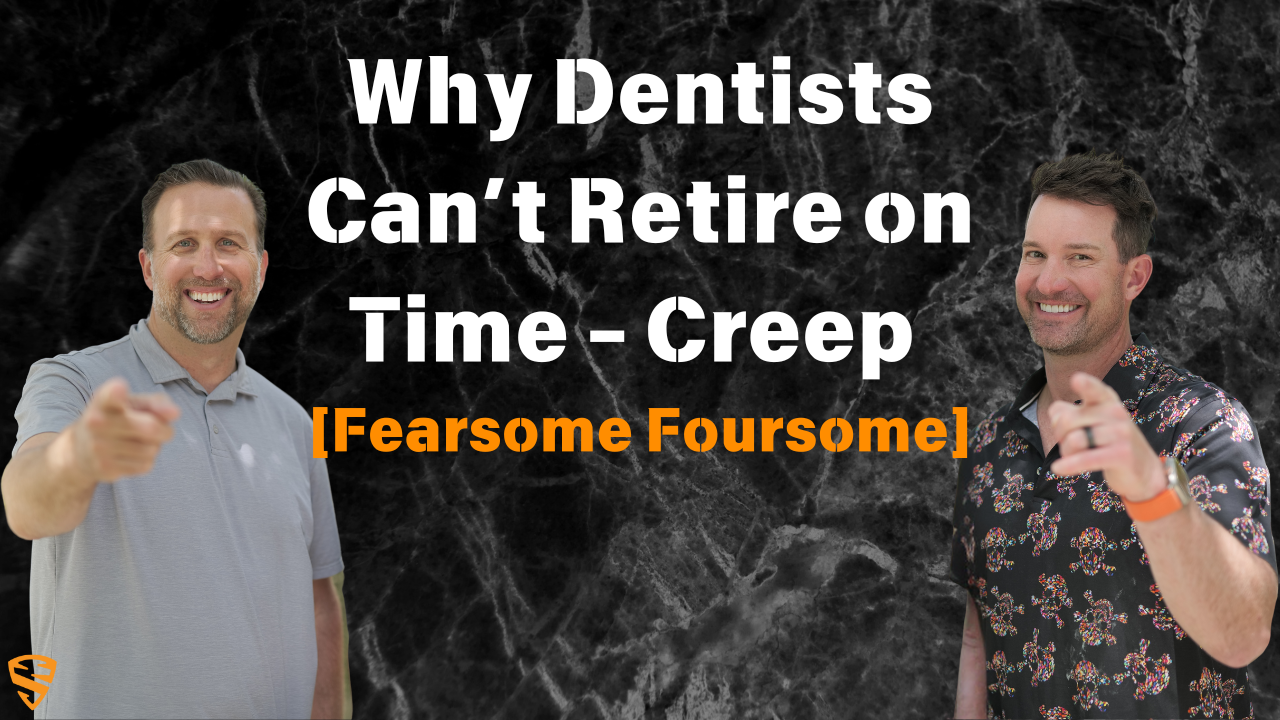
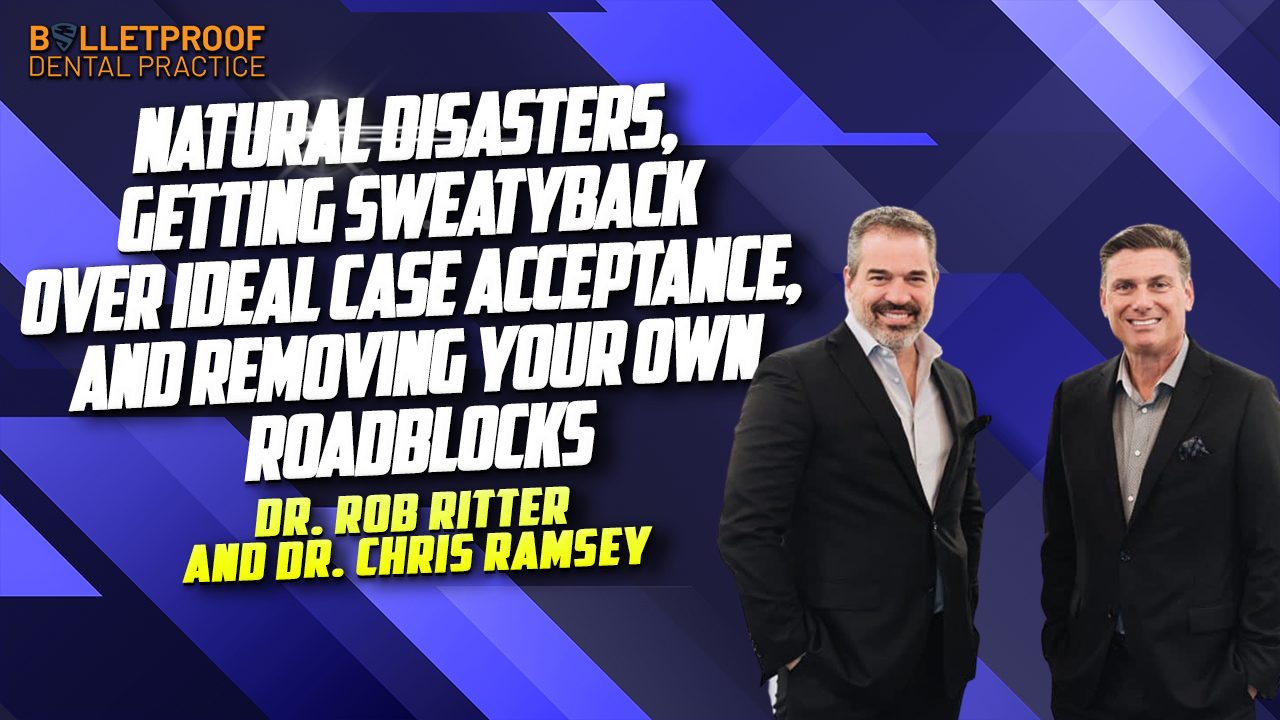
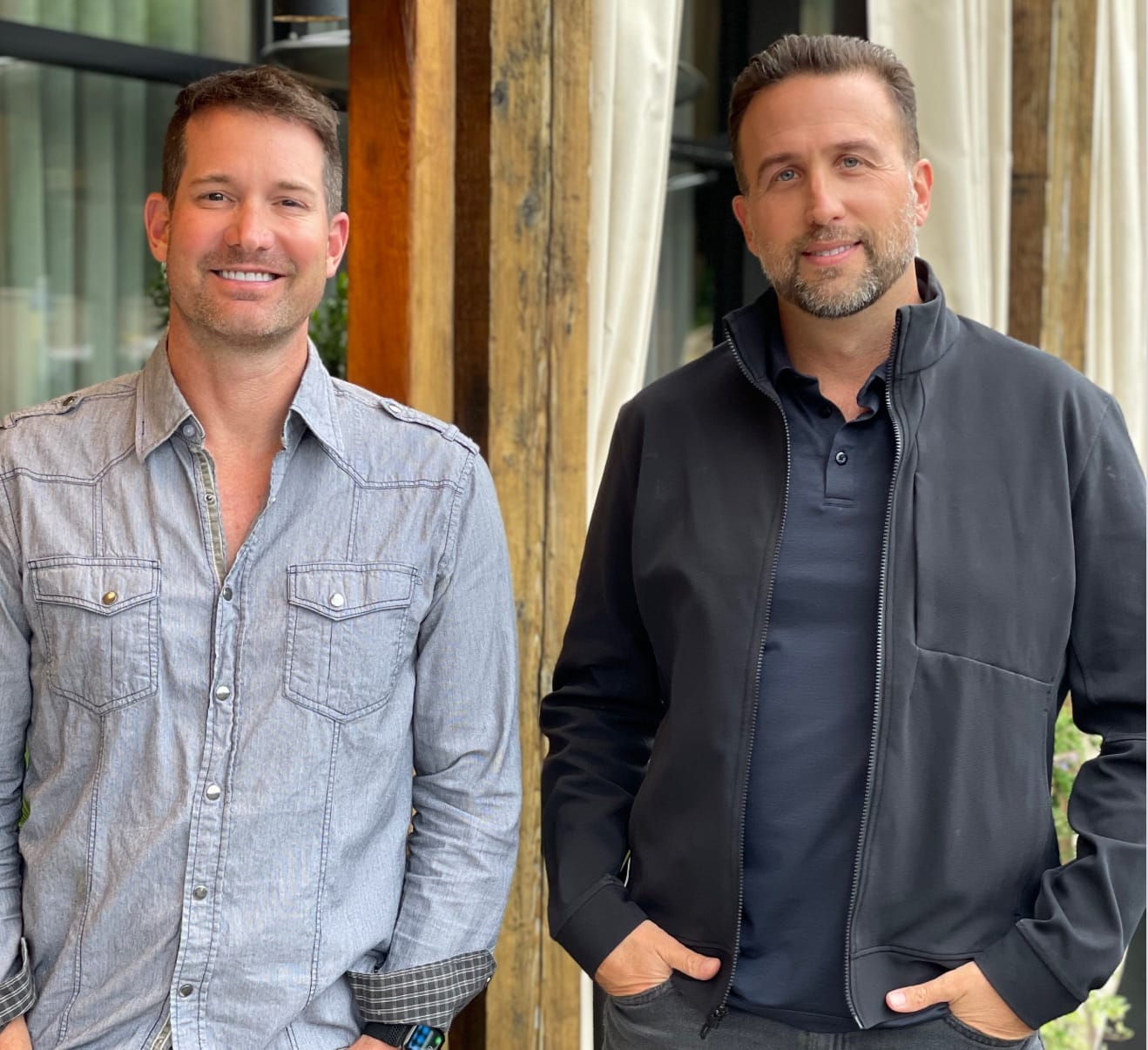
Natural Disasters, Getting Sweatyback Over Ideal Case Acceptance, and Removing Your Own Roadblocks with Dr. Rob Ritter and Dr. Chris Ramsey

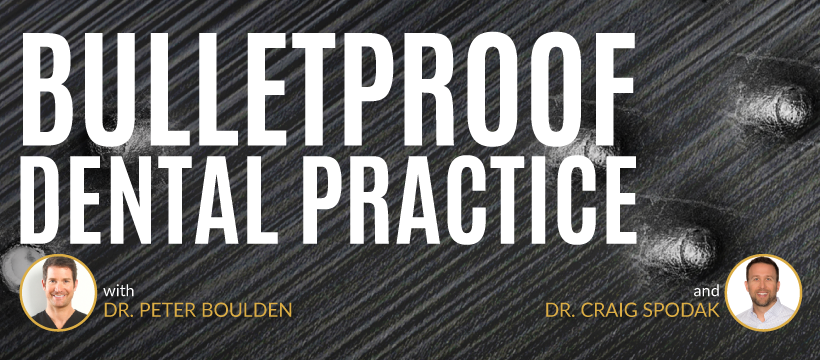
Bulletproof Dental Practice Podcast Episode 267

Hosts: Dr. Peter Boulden & Dr. Craig Spodak

Guests: Dr. Rob Ritter & Dr. Chris Ramsey

Key Takeaways:
Introduction
Ideal Acceptance
Rule Of Thirds
Digitization Of The Industry
Patient Journey
Marketing Emphasis

References:

Bulletproof Mastermind
Bulletproof Summit
Mighty Networks: Bulletproof Dental Practice
April 14-15  2023 Course Registration
AACD 2023

Tweetables:

I have zero conversations with people until they bring it up to me. -Dr. Chris Ramsey

You’re in a position where your opinion matters. -Dr. Peter Boulden

The context matters. -Dr. Peter Boulden

Knowledge is not power, execution is power. -Dr. Craig Spodak

The investment can’t return anything if they can’t apply it. -Dr. Craig Spodak


Full Episode Transcript

Below is the complete transcript of this episode of the Bulletproof Dental Practice podcast. Prefer to listen? Find us on Apple Podcasts, Spotify, and YouTube.

Read the full transcript

The following transcription was from the Bulletproof Youtube channel. Here is the https://www.youtube.com/watch?v=OyFeesHj2lk

.Chris Ramsey
0:00:00
We're jumping right in.

Peter Boulden
0:00:11
Okay, well not even going to do an intro. We're here.

Craig Spodak
0:00:15
No, because we already did.

Peter Boulden
0:00:16
We already started.

Peter Boulden
0:00:17
Craig's a fan of the no intros these days.

Craig Spodak
0:00:19
Well, I'm just kind of disappointed, Peter, that you and I didn't get the message to wear a black. I feel very Un-Vegas-like, not very magician-like, because we are with our magician.

Peter Boulden
0:00:29
Let me tell you why they are smart. Let me tell you why they are smart. They are so busy and so successful that it's a thing that Zuck does and Jobs does and it's called decision fatigue. And if you can just wear white V-necks, I mean black V-necks every day, it's one less decision that you have to make in your entrepreneurial day.

. Rob Ritter
0:00:49
It's school uniform, baby, it's school uniform.

Craig Spodak
0:00:51
Are you both wearing the same exact V-neck? Can I see your full, I wanna see more.

Chris Ramsey
0:00:55
Okay, that's the same, yeah.

Peter Boulden
0:00:57
It's standard issue at Grit or Razzy.

. Rob Ritter
0:00:58
Is it really?

Craig Spodak
0:01:00
Does everybody wear black there?

. Rob Ritter
0:01:02
Oh yeah, oh yeah.

Peter Boulden
0:01:04
Yeah, we do too, Craig.

. Rob Ritter
0:01:05
Our masks are black, our gloves are black,

. Rob Ritter
0:01:08
shoes are black.

Craig Spodak
0:01:09
So you obviously wear only polyvinyl gloves then, huh? They don't make black latex huh? So I feel like this podcast can go hard right or hard left right now. So if you're just wondering who the hell we have on the Bulletproof

Peter Boulden
0:01:28
pod, we got our buddies in Florida. Did you guys fare okay?

. Rob Ritter
0:01:35
We fared great. I feel so bad for the other coast. We have friends, our main laboratory's over there. Make no mistake about it, everybody gets back to their normal lives and maybe you see at six o'clock or 6.30 on the national news, maybe you pay attention, but there are some people that are truly, truly devastated. Lost everything. Imagine you guys right now, the lives that we live, and literally tomorrow, you've got no home, no office, and all your cars and possessions, pictures of your kids, everything is gone. Everything, gone.

. Rob Ritter
0:02:08
Gone.

. Rob Ritter
0:02:09
You've got just you and the health of your family, but you're standing there going, okay, and everybody goes, well, you can rebuild. I was thinking about people that do what we do. I'm like, you're done. Like, people aren't going to the dentist over the next year. They're trying to figure out their lives.

Craig Spodak
0:02:24
You know what I mean? Yeah, a lot of people lost, there's a lot of not just personal property, but lost, you know, there's going to be a lot of death and, you know, it's really bad.

. Rob Ritter
0:02:33
And I'm only thinking of our industry, you know, like think of how many dentists are in Fort Myers that they've got, there's no business to be had there. There's nothing, it's a completely different vibe and the ability to provide for your family and everything, that's all been taken away from you.

Peter Boulden
0:02:45
Yeah, it's in survival mode right now, right? The city's in survival mode and dentistry is not medical necessary.

. Rob Ritter
0:02:52
I went through that 18 years ago. We got double hurricanes 18 years ago, Francis and Gene, and I had to use my practice interruption insurance. Craig, were you here 18 years ago for this?

. Rob Ritter
0:03:03
Yeah, I was.

. Rob Ritter
0:03:05
He was 52.

Craig Spodak
0:03:06
I was 48, 18 years ago.

. Rob Ritter
0:03:10
I was 15. The practice got shut down three weeks at a foreign September bill paid by team employees with the practice interruption insurance but I mean nobody was coming in to do dentistry even if the practice is open

. Rob Ritter
0:03:24
because

. Rob Ritter
0:03:24
places were just destroyed so I I I really feel badly for the people on the West Coast I know what they're going through right now

Peter Boulden
0:03:31
well anyway Rob Chris yeah Ramsey and Ritter.

Craig Spodak
0:03:40
I think it's Ritter and Ramsey by the way, you don't want to get them all pissed off.

Peter Boulden
0:03:45
Oh really? Why does one precede the other?

Peter Boulden
0:03:47
Yeah, that's a good question.

Craig Spodak
0:03:48
Let's get right out of the way. Why is it Ritter and Ramsey?

Peter Boulden
0:03:50
Age before beauty, baby.

. Rob Ritter
0:03:51
Age before beauty.

. Rob Ritter
0:03:52
Well, okay, it used to be hair before anything else, but now that he's caught up to me in hair, we've got to go back to longevity.

Peter Boulden
0:04:00
So why? You guys are just beautiful hair over there.

Craig Spodak
0:04:03
A lot of hair going on over there. This is the reason to go check us out on YouTube.

. Rob Ritter
0:04:07
This was expensive, baby.

Peter Boulden
0:04:09
This was expensive. It's well worth it, buddy. You're looking sharp. So what's going on with you guys these days?

.Chris Ramsey
0:04:16
I think the busiest thing, I think what's going on,

. Rob Ritter
0:04:18
I think the thing that's keeping us the busiest right now is obviously, it's our day-to-day. Rob and I have been together almost 20 years. A lot of people that have heard us before talk about partnerships and things. You know, we've got a solid almost 20 years behind us making that work. And then obviously the last year and a half, our own educational course, the protocol, just boomed, you know, and it morphed into, it morphed into what we dreamed it would be, but questioned whether the how fast it would happen or what was gonna happen. And it really took off. And it's been super gratifying in the sense that we created something that wasn't another me too course. You know, there's a million places to go for implants or a great continuum you can take out in Scottsdale or Seattle or something like that.

Peter Boulden
0:05:06
You know, I think you guys filled and I'm gonna jump in. So if you're not familiar with the protocol, it's a hands-on course, you go down to the office, it fills the void of what I'm about to say. So I met you guys actually through the Hornbrook Group, and a lot of people listening to this may not even have known that was a thing. I don't know if it's a thing anymore or not. But the Hornbrook Group was a big group of on-site, continuing education in cosmetic dentistry and stuff like that. And that's, I think, actually maybe if I take that back, I may have met you guys through Gen X back in the day. Yeah. Maybe that was it. But I know weren't you both involved with the Hornburg Group at a time? I actually taught a PAC Live. Okay, so what was PAC Live and then I guess they spun off and then it was Hornburg Group and then I don't you know who knows what it is now. But for a while there, you know, Craig and I were getting these questions about people were saying like what CE should I take and you know we kind of look at each other and there's not that many good hands-on things, other than there's Coase and Spear, but there wasn't a Hornburg group, and so I'm glad you guys filled this, because I have a doctor who actually went through your protocol, and he said nothing but great things to say about it.

. Rob Ritter
0:06:16
Oh, who went?

Peter Boulden
0:06:17
Drew King.

Craig Spodak
0:06:18
Okay, that's awesome.

. Rob Ritter
0:06:19
Oh, yeah, great guy.

Peter Boulden
0:06:21
Great guy, right?

Craig Spodak
0:06:22
Great guy.

Peter Boulden
0:06:23
And he, so, I mean, you guys are doing good things, good for dentistry. I love being able to kind of, when you see that stuff, good for the profession. I know you both very well, I've known you for probably 20 years and I know that you are passionate about dentistry, you're passionate about your craft, you're passionate about your patient care. So when you get to get up there and lead, I love that because it does good things for the industry. I know your intentions come from a very pure place.

. Rob Ritter
0:06:49
So we wanted to do something, you know, the key here is what we really want to do was we both came out at this with different passions with the same goal. And I think one of the things I was personally passionate about was I had taken all the CE as all of us have throughout the decades here and done all this different stuff and yet there was no place that was telling me the obvious thing which was you can take all the CE in the world, take another Invisalign course, take another implant course, but if you can't get asses in the seat, what's the point? Right, I was just listening, Rob was just giving you guys mad props about a recent podcast that you guys did about language and verbiage, and I wanna listen to that in depth because I've only heard it in sections. I wanna hear it from beginning to end. And your guys are really good on talking about the communication. My thing was I just looked at the most the most recent Acceptance rates for average practices in America, you know, and it was amazing. It's 40% So you see 10 consoles and you only get four people to commit. I'm like, wow

Peter Boulden
0:07:51
That's all you're saying you're saying so as a human meaning someone just enroll in some kind of treatment that that counts towards the positive column, or are you saying proposed treatment of the aggregate treatment versus accepted?

. Rob Ritter
0:08:06
I'm saying you've proposed treatment to someone and they say yes or no. Basically they're like.

Peter Boulden
0:08:11
But could it be a partial acceptance is where I'm going.

. Rob Ritter
0:08:14
Say it again.

Peter Boulden
0:08:15
Could it be like a partial acceptance? Like, Mr. Jones, you got 19 grand, in case you got three.

Craig Spodak
0:08:18
Yeah, acceptance versus overall treatment acceptance.

. Rob Ritter
0:08:21
Yeah, the way I was asking the question to Dental Intel when I got the information was basically like, and I think it was, they were talking about comp, you know, we were looking at it from, even they were counting like this single units, people say, okay, I'm holding this treatment. And, and what's the percentage rate, you know, throughout the country. And, you know, they were showing me that it was 39%, 40%.

Peter Boulden
0:08:40
Wow. What do you think the issue is on that?

. Rob Ritter
0:08:43
Oh, 100%. It's everything that I talk about my own program, you know, I, I covered in my own stuff that I do, as you guys know, but then I obviously introduce a huge part of it in protocol, which is basically an understanding of what's going on during these conversations. How are you structuring? Right now, I've finally started to present in its entirety, for me personally, basically the art and science of a consult. I've been working on that for a decade because I've watched everybody go down a rabbit hole and it never makes any sense to me. I watch everybody talk to patients and everybody does the same thing. They start to have this conversation and the patient kind of, somebody has to, each person's gonna hold hands. Who's going to now lead the conversation? Who's gonna take the person down the path? And typically it's the patient pulling the dentist along a path that they don't wanna go down. You've all seen this example, right? Mrs. Jones sits in your chair and goes, it's really nice to meet you, Dr. X. So let me explain why I'm here. I'm thinking about maybe doing some things to make my smile look a little bit better. I have these two crowns over on my right. Those were done two years ago, so I really don't want to cut those off. So what I want you to do is maybe look at some of these and try to match this one over here. And you start having these weird conversations, and the whole time the dentist is like, no, no, no, no, and there's no rhyme or reason to how these consults are done.

Peter Boulden
0:10:01
So- And usually they acquiesce in the end, just so we're clear, like, okay, I'll try. Yeah, right. I want you to like me.

. Rob Ritter
0:10:08
Right, I want you to like me, and they cave and start doing things that they don't want to do. So the big thing for me, what I was passionate about, what I brought to the protocol, was the ability to say, look, in a given amount of time, there is a structured way to do a console, and if you follow these basic steps that are honed in cognitive psychology, social psychology, if you look at this and you understand the dynamics of it and you kind of script it through your brain about the steps necessary to have a conversation, it's huge. So my treatment coordinator run the numbers and I've had four no's out of the last 30 consults. So what is that?

Peter Boulden
0:10:41
87, 88, 86, 86, 86, 86, 86. 12% not accepted, yeah, 88%. Yeah, and when I say the consults,

. Rob Ritter
0:10:47
I'm not talking about a single crown. That's not a consult to me. I'm talking about eight or more units at a time being presented. Right.

Peter Boulden
0:10:54
What do you think ideal is, Chris? Ideal?

. Rob Ritter
0:10:58
Ideal acceptance rate. Oh my, well, for every dance, it should be 100%. I disagree.

Peter Boulden
0:11:03
I disagree.

Peter Boulden
0:11:05
You disagree?

Peter Boulden
0:11:06
Rob, I wanna hear what you think it should be.

. Rob Ritter
0:11:08
Oh, what the percentage should be?

Peter Boulden
0:11:10
Yeah, well, if accepted, yeah. If you're batting 100%, right? Chris, I'm gonna come back to this.

. Rob Ritter
0:11:17
So what do you think it should be? Something's not right. If everybody's 100%, you could be charging $500 of a year. And so-

Peter Boulden
0:11:24
Your prices are too low, you're under-diagnosing, you're not, you know, all these things, right? So you could be, or you could just be God's gift to proposing treatment and you could be like our buddy here in the bottom right. Hope he's the bottom right of your thing.

. Rob Ritter
0:11:39
No, I mean, it should be, the national average, like we said, is 40%,

Craig Spodak
0:11:43
but we don't really count.

Peter Boulden
0:11:44
That's too low.

Chris Ramsey
0:11:44
I would agree that's too low.

. Rob Ritter
0:11:45
That's too low, but I agree.

Craig Spodak
0:11:46
Well, the top 10%,

. Rob Ritter
0:11:49
I'm sorry, man, top 10% was in the high 60s.

Peter Boulden
0:11:53
Okay, so yeah, I am kind of of the mindset, and I'd love to hear your feedback. I love that it's 100%, Chris, because I know that you're like, look, give me an at-bat. I will hit they ball. I guarantee you I love that mentality, but you've you've addressed that swagger over the past of your entire career You've made it a science. So it's not just like I if you've made it methodical And you said you've been obsessed with that the past 10 years I think the goal personally is kind of a rule of thirds Right because there's always going to be you know a third are always going to say no third always going to say yes And a third is kind of undecided. So if you can convince that middle third to kind of go towards you, then I think that you're doing well. So 70% is kind of where I think is a good line of,

Craig Spodak
0:12:38
it's a healthy mix of like,

Peter Boulden
0:12:39
okay, I'm proposing enough treatment where I'm not getting 100% yeses. Because look, a dentist could go in and say, hey, Ms. Jones, you need an occlusal filling, right? And they could come back to you and be like, and they do that 12 times to the next 12 patients, everyone says, yes, it's covered by our insurance. My enrollment is 100%, right? Now, Chris, I know that's not the case with you because you're doing complex cosmetics and that's a different animal altogether. I'm just saying some dentists wear that as a badge of honor. Is that like, no one says no to me. Well, maybe you want to push the envelope a little bit more, right? Maybe you want to actually go into some comprehensive and diagnosis and have conversations like Craig has a lot. It was like, hey, you've got this unilateral where. It means you've got this massive interference back here. Your VDO's collapsed as opposed to like, hey, you need a new crown, right? That's all I was going with.

. Rob Ritter
0:13:27
What I found interesting though, when I was listening to your guys' last podcast, Craig had mentioned, you used a great term that I don't think I had heard that. And I was like, did you call it the weather map of the, you know, the ITERO scan that shows the occlusal? I love that, the weather map. That was great. But I always like to be clear about this. So when we talk about this, if we're gonna get into any depth of this conversation, I want people to know too, I have zero conversations with people until they bring it up to me. That's the truth. Now that might not be right, but I'm just saying, I don't go down rabbit holes with people that I don't think they're ready to hear because a lot of times we start having these conversations, we introduce things. Are you aware of that, blah, blah, blah, blah, blah.

Peter Boulden
0:14:06
So wait, in a, hold on, slow down. So in a hygiene exam versus a consult, right? Because there's two different things. So you're saying you don't bring something up in a hygiene exam until someone says it's concern of theirs.

. Rob Ritter
0:14:18
Unless we're talking about the obvious. They've got decay, they've got this, they've got,

. Rob Ritter
0:14:21
but I don't go, none of our team goes, how do you feel about your smile?

. Rob Ritter
0:14:25
Have you considered, you know, I don't do any of that. I don't do any of that because it's-

Peter Boulden
0:14:29
Rob, do you?

.Chris Ramsey
0:14:30
Not really.

Peter Boulden
0:14:31
No, I don't.

. Rob Ritter
0:14:31
I do.

Peter Boulden
0:14:32
I do too.

Chris Ramsey
0:14:33
I do.

Craig Spodak
0:14:34
Every single person, like, do you love your smile? And if their smile looks like they're a human can opener and they answer, I love my smile, I always say the same thing, me too. But I always ask people, do you love your smile? That's nice.

Chris Ramsey
0:14:46
Yeah.

Craig Spodak
0:14:47
I don't care what it looks like but I always ask I did I love hearing

. Rob Ritter
0:14:52
Oh, why are you asked but why are you asking if they haven't brought it up to you?

. Rob Ritter
0:14:55
I'm just curious. Why why are you asking because I think you're in a position

Peter Boulden
0:14:58
You're in a position where your opinion matters meaning that it can be aesthetics Yes, it could be functional, but they don't know the difference And so you're asking because you spent 20 years looking at one thing that mouth

. Rob Ritter
0:15:10
Right. Yeah, let me put it in different context. And again, I'm playing a little bit of devil's advocate for people that are listening. So if we're out at a bar and I go, hey Peter, what do you think about that shirt you're wearing?

. Rob Ritter
0:15:23
Total non-sequitur, the circular.

Craig Spodak
0:15:25
That's a ridiculous comparison, sorry buddy. Ridiculous comparison. Why not? Because they're actually, people are coming to your office as a professional to get your expert opinions. Like saying my AC contractor comes over and he starts saying something to me like, hey, I don't really like your shirt. You're a fucking AC guy. What's wrong with my, hey, did you know your AC is breaking? That's important.

Peter Boulden
0:15:48
The no. Yeah, the context matters, right? So if you would say, hey Pete, how do you like your drink because you're at the bar? I would have said like, that's the context.

Craig Spodak
0:15:54
If he's my bartender, do you love your drink? No, I don't. I wanted something sweeter.

. Rob Ritter
0:15:58
Well, I'm your bartender, let me help you.

Peter Boulden
0:16:01
Okay.

. Rob Ritter
0:16:01
Sorry guests. No, but tell me, give me a more applicable comparison. Not one that's in context. I'm trying to get young practitioners to not get stuck in this. If you're going to ask the question, you've got to be ready.

.Chris Ramsey
0:16:16
You love your smile.

Craig Spodak
0:16:17
You know, how do you feel about your smile? Well, no, no, no. That's not what I asked. So let me just say, do you love your smile? Yes, I do. Yes, I agree with you Mr. Chris. I agree you have a beautiful smile. Or do you love your smile? Not really. Why? Well, you see how all my crowns are different colors on the front? I hate that, but I was just told I couldn't fix it because I went to my family dentist and he says I can't fix it. What do you say? He says that all we do is porcelain fused to metal and I'm just using industry terms and those gray lines have to be there. Oh really? He didn't tell you that we have this? No, I didn't know about that. Well, we can do that. Would you wanna do something if we could?

Peter Boulden
0:16:55
Okay.

. Rob Ritter
0:16:56
Why not have that conversation? Well, do you feel that conversation would arise for someone who actually really did care, like were really unhappy? Do you think they would say something to you if they're in their chair, if they're in your facility and they're like, wow, it's a beautiful office. What a great team, holy crowd, this experience is amazing. You don't, if they really cared, you don't think they would bring it up?

Chris Ramsey
0:17:21
No.

Craig Spodak
0:17:22
Just my experience in 20, I mean, listen, we're all equally yoked in the experience department. And I have just seen providers that I've worked with through Masterminds and through other, that when they start introducing the simple question of, do you love your smile? Their practices, their personal practice, their personal production goes in a totally different

Chris Ramsey
0:17:41
next level.

Craig Spodak
0:17:42
It's fine, well also, let me preface that because there's contextual involvement too. All of our patients meet in a consult room first. So you're not in a dental chair, you're sitting knee to knee in a private room, you're reviewing medical history. All patients, no matter, all new patients go consult room?

Craig Spodak
0:18:00
All patients.

. Rob Ritter
0:18:01
Okay, so their lives are dynamic.

Chris Ramsey
0:18:02
There's a difference.

. Rob Ritter
0:18:03
Even a limited exam.

Craig Spodak
0:18:04
Well, you have intel that is now lousy to ask that question, versus Chris is saying, I'm going in blind.

Peter Boulden
0:18:06
That's not how they have rehearsals going through all these. Most people that are listening to you, we like to think that's the way, but most people, that's not how it's going. Most people in America are coming through hygiene, right? So they're getting their exams, x-rays, cleaning. Whether we like that or not, that's a reality. No, they're getting that in my practice, too.

. Rob Ritter
0:18:13
So, I'm not saying that's a bad thing.

. Rob Ritter
0:18:14
I'm just saying that it's a reality. I'm not saying that it's a bad thing. I'm just saying that it's a reality. I'm not saying that it's a bad thing. I'm just saying that it's a reality. I'm not saying that it's a bad thing. I'm just saying that it's a reality. I'm not saying that it's a bad thing. I'm just saying that it's a reality.

. Rob Ritter
0:18:23
I'm not saying that it's a bad thing.

. Rob Ritter
0:18:24
I'm just saying that it's a reality. I'm not saying that it's a bad thing. I'm just saying that it's a reality.

. Rob Ritter
0:18:27
I'm not saying that it's a bad thing.

Chris Ramsey
0:18:28
I'm just saying that it's a reality.

Craig Spodak
0:18:28
They're getting that in my practice too. It's just before the hygiene exam, there's a touch point of like maybe five minutes or less where it's like, hi, I'm Dr. Ramsey. I'm just gonna sit down with you for one minute or five minutes and just go through all this stuff.

Chris Ramsey
0:18:42
And one of the things-

. Rob Ritter
0:18:43
Peter, how many practices you think are doing you Craig's way?

.Chris Ramsey
0:18:46
How would we ever know?

Peter Boulden
0:18:47
I would, not that many. I would say 10%, maybe you're doing it like console room first.

Craig Spodak
0:18:55
How would we know?

Peter Boulden
0:18:57
Well, I think just by talking, Craig, and aggregating data.

Craig Spodak
0:19:00
Let me ask Alexa, hey Alexa, how many, I'm kidding.

Peter Boulden
0:19:03
I don't know, I think there's some resistance with that, meaning that my initial knee-jerk reaction is like, oh man, I'm already getting brought into this quote unquote sales room, right? Like that's, Craig, I'm not throwing shade.

Chris Ramsey
0:19:18
No, I know, I know.

Craig Spodak
0:19:19
Obviously, listen, if this was the first week my office was open, you'd be really scared.

Peter Boulden
0:19:22
Totally, right? So obviously what you're doing is not broken. Don't fix a thing.

Craig Spodak
0:19:26
Right, right, but it would scare the crap out of me.

Peter Boulden
0:19:28
But right, but to change my culture, right? We do it probably along the same lines as Chris and Rob, is that, you know, it's that is introduced through the hygiene exam because people quote unquote I want to get a cleaning right which opens which is a which is a gateway for More conversations, so I agree the truth I think the truth lies in somewhere where Craig is saying like do you like your smile is a great start for? Conversation and maybe it's set a different way, but sometimes sometimes people don't know that options are available I love the example you gave Craig about like hey well I was told I wasn't a candidate for Invisalign, so I didn't say anything. Always, all the time. I was told nothing could be done with these crowns, these metal line is, my doctor said that, my last dentist said that you had to have it because of strength reasons. I know there's nothing I can do about it. You know, things like that. So it's a great place to help.

. Rob Ritter
0:20:15
But that happens all the time for me.

Chris Ramsey
0:20:16
All the time.

. Rob Ritter
0:20:17
I just think young practitioners, young practitioners that are following you guys, or coming up with you guys, or getting great advice through Bulletproof, I think it's important for them to us to understand.

Peter Boulden
0:20:27
It's a great topic.

. Rob Ritter
0:20:28
You've gotta be okay with the fact that if you're a practitioner and you're trying to up your game a little bit, what will happen is if you're bringing to people and you ask that question, it will sound, initially, it will sound sales pitchy.

Craig Spodak
0:20:42
It will.

Craig Spodak
0:20:43
Oh, I totally disagree.

. Rob Ritter
0:20:45
Totally, man.

Craig Spodak
0:20:46
I totally disagree.

.Chris Ramsey
0:20:47
Rob, tell me.

Peter Boulden
0:20:48
Rob, jump in.

. Rob Ritter
0:20:49
I wanna hear it.

Craig Spodak
0:20:50
Ugh, come on, man.

Craig Spodak
0:20:51
I totally disagree with you, bud.

. Rob Ritter
0:20:53
I like the going back and forth. I'm somewhere in between. I do like, I will say, I do like going into a hygiene room when I get a prompt from either the patient or from the hygienist, hey, is there something I can do about my smile, or the patient is interested in talking to you about their smile. It makes things so much easier for me

. Rob Ritter
0:21:11
to start the conversation. I will work with you guys and double your practices in one year. Money back. I'm not fucking kidding. I swear to you. Look at me in the eyes. I will double your practices. Oh God. Shut up. Right. Give this advice to some young practitioners and you get them to say that they're going to when they catch when they catch a little resistance, they got it. Then they got to have a lot of things in their arsenal.

Craig Spodak
0:21:38
What is the resistance?

. Rob Ritter
0:21:40
Tell me the resistance, Chris.

Peter Boulden
0:21:41
Tell me the resistance. Well, because he's saying it's a leading question that people have the whole shit detector.

.Chris Ramsey
0:21:45
Of course it's a leading question.

Peter Boulden
0:21:46
And it says like, okay, here comes the sales pitch.

Craig Spodak
0:21:49
So it bothers you. So I will never ask a patient in my practice, do your crowded teeth bother you? I will never ask that.

Chris Ramsey
0:21:57
No, that would be ridiculous.

. Rob Ritter
0:21:58
That's a negative statement.

Craig Spodak
0:21:59
Or does, you know, if they say, well, my teeth are kind of crowded, put it this way, it's, crowded teeth are a health issue. They're not optimally healthy if they're crowded, because you're wearing, when you look at the way the teeth are wearing when they're crowded, oftentimes they're associated with wear. And age-inappropriate wear is something that is, as dental practitioners, we're not actually having that conversation nearly enough. So we're meeting a 26-year-old pretty girl, she's lost like 30% of her enamel, we're like, you look fine, no cavities, no periodontal disease, see you later. And then they meet guys like us when they're 45 and they need an FMR. So I gave this- I heard that on your podcast.

. Rob Ritter
0:22:34
I heard that on your podcast and it resonated with me.

Craig Spodak
0:22:38
So the reason why I bring that up is because we have specific knowledge. There's a paucity of professional advice. Your air conditioning guy will go in your house and be like, yeah, I just changed the filters. You get another one and be like, hey, you have mold in the coils and blah, blah, blah. And it's not a sales process. If he's trying to sell me something, yeah, people have a built-in bullshit detector. I'm not doing that. I am not interested in selling anyone anything. But if someone is living what I call a dental handicap life because they were told by 15 providers or 15 years before us that there's nothing they can do, then they just resolve to that fact. It takes one of us, either a listener or one of the four of us, to say, do you love it? No, I don't. Why? Tell me. Well, I just hate how they're all this, but I'm not a candidate for Invisalign, and I know that crowns don't look like teeth, and I know that you can't do anything. Why do you say that? Well, because I went to this dentist for five years, and he said all crowns have to have metal in them. Okay, good. Well, I'm glad we brought this up because they don't have to. You are a candidate. It's those types of conversations, it's incumbent upon us to have those. Not about sales, I don't care.

. Rob Ritter
0:23:45
I don't care if someone does work or not.

Craig Spodak
0:23:46
I really don't. Chris, how far, and this is, sorry,

Peter Boulden
0:23:49
this is gonna be a-

Peter Boulden
0:23:49
Do you wanna kick me off?

Peter Boulden
0:23:51
Intimate question, no.

Craig Spodak
0:23:52
How far are you booked out right now?

.Chris Ramsey
0:23:53
I'm going somewhere with this.

Peter Boulden
0:23:54
Okay, by the way, you guys have known me a long time.

. Rob Ritter
0:23:57
You know I either never answer a question directly or I always answer a question with a question. So, when you say how far are you booked out? It's an interesting thing because I have patients that are booked now about two and a half months from now to get work done. Between now and that two and a half months, do I have gaps to get people in? Yes. Okay.

Peter Boulden
0:24:21
The question becomes this,

. Rob Ritter
0:24:22
when someone says I'm booked out two and a half months, I can make that statement right now. It's true. That perception then becomes, I'm completely booked, meaning I can't get anybody in, which most dentists are full of shit. So, let's just get down to that. So the first thing is, how far am I out? I got some people that are pre-booked now, two and a half months out for me to start their stuff because of our location where we lie geographically and the nature of our area where people got other things going on

Chris Ramsey
0:24:53
and yada, yada, yada.

. Rob Ritter
0:24:54
So two, two and a half months out, I still got stuff on the books raring to go. I've got people that are lined up to start their uppers in January. So what month, November, yeah,

. Rob Ritter
0:25:03
so that's almost three months out.

Peter Boulden
0:25:04
Yeah.

. Rob Ritter
0:25:05
So, yeah.

Chris Ramsey
0:25:06
Let me tell you why I asked that.

Craig Spodak
0:25:07
Why did you go there?

Peter Boulden
0:25:08
Why did you go there Peter? Because we talk about this in the mastermind a lot, or to our masterminders a lot. And so, and everyone will shake their head. When you seem to psychologically feel like you are booked out, the verbiage, your enrollment, things change about your delivery because heaven forbid they say yes, and you add now more, you're feeling burnt out, you're feeling overwhelmed, you're feeling too booked, and now you go into a consultation, and you can't afford to ask, hey Mrs. Jones, does your smile bother you? Because now you're gonna get busier than you're already feeling busy. So the masterminds always shake their head like you almost under-diagnose and don't say anything and say, I'm gonna watch because I can't afford to be more busy is where I was going. So you have the luxury, you have the luxury, Chris, because people come to you and they seek you for something to not have to ask these leading questions that could lead to treatment because you're just that good. And I've seen you in action, like you're just that good. So you are a unicorn in this thing.

. Rob Ritter
0:26:05
I appreciate it, but as we talk about this, I think for our listener, I've always pictured somebody listening to this podcast with you guys, they're driving in their car. I'm gonna listen to this on the way home or I'm going to whatever. So I wanna make sure we're always talking about the same thing. So one of the things I wanna make sure we're clear on is there is going through hygiene and there is an actual consult. I mean, they've called and said, I'd like to make a consult with Dr. Whoever, because someone recommended me to them for some cosmetic work, or whatever. I need to see them because I got some broken teeth. A true consult, I truly believe, by the time that person comes to you, and there's a million reasons why I believe this, by the time that person gets to your chair, they're 90% there. 100%, I completely agree with you.

Chris Ramsey
0:26:45
They're 90% there.

. Rob Ritter
0:26:47
The last 10%-

Peter Boulden
0:26:47
All you can do is fuck it up.

Chris Ramsey
0:26:49
All you can do is fuck it up.

. Rob Ritter
0:26:50
And if you're a dentist, you're going to fuck it up.

29
0:26:53
Right?

. Rob Ritter
0:26:54
Yeah. That's what's going to happen. So I believe that wholeheartedly. So what I'm talking about as far as not needing to ask these questions and everything like that is our consults, when I'm done with you guys, I have a consult. My brain already tells me that person's taking time out of their day. They've done somewhat a decent amount of research everyone Google's everything now They've made a decision to take time out of their day drive over here come to an environment They've never been in fill out our stupid-ass paperwork a lot of friction there, right?

Craig Spodak
0:27:22
Well, they really want that because that's a lot of freedom and the reason why I said I could double your practice Because there's another half of those patients that are coming in that would be very interested. They just don't know what's possible So what had to happen for that consult to show up is they heard about cosmetic dentistry, they saw it look good either in a magazine or somewhere else on one of your patients, and they decided to come in. But the other half of them, just like they saw something about Mary and they thought veneers look like that. And I'm just saying, when they come into the hygiene and you sit down like, hey, nice to meet you, I'm Dr. Ramsey and blah, blah, blah, blah, blah, just a quick question, I always like to ask patients this, whatever the context of it is. I'll just say, do you love your smile? Yes, I do. Great, I do too. I'm really happy you're happy with your smile. I mean, you know, whatever. I mean, if you like your smile and all four of us like our smiles, it's a really great thing that we have. It's a great asset.

.Chris Ramsey
0:28:15
It's a great tool.

. Rob Ritter
0:28:16
Craig, can I ask a, can I actually jump in here for a second and ask a question?

Chris Ramsey
0:28:20
Yeah.

. Rob Ritter
0:28:21
Do your hygienists ask the same question of your patients?

. Rob Ritter
0:28:24
Or is everyone in our office more more than not talks the same

36
0:28:29
So like the weather map the

Craig Spodak
0:28:31
question so When the patient shows up yeah

. Rob Ritter
0:28:34
I do know that the hygienist has asked that question and then you might go in during the exam and ask the same question

Craig Spodak
0:28:39
Well like let me know so the order is a little off so a patient in our practice comes in before they meet any hygienist or anybody else, they meet a treatment coordinator, they get a panel in our office, they sit down in a consult room, we review their medical history. At that point, the doctor comes in, sits down, it's a quick interaction, it could be five minutes, hey, nice to meet you, oh, Sally sent you over here, I'm really happy. On our questionnaire, there's like questions about your smile, do you like it, do you have difficulty chewing, are you avoiding certain foods, do you avoid smiling? And so it's a simple like, hey, do you love your smile? If they didn't say that and a hygienist then wound up saying it in the room and said, you know, I got to talk to you about something. If it came up again, the hygienist would come get us. But we review, the hygienist reviews the occlusal gram, the weather map as we call. They're scanning every single patient. We're talking about age-inappropriate wear. We're talking about how teeth when they wear they get flat on the top those conversations are happening all the time in our office okay okay and then we go back in the concert room at the end and the patient that never consult rooms two times yeah at the end to check out yes or the is driving going, fuck that man. No, no, no, no, no, no, no, no, no, no, no.

. Rob Ritter
0:29:59
When, listen, if you're in Idaho and you're listening to this and you have four operatories,

Craig Spodak
0:30:05
you can do, no, no, no. When you're in Idaho and you're listening to this, you could have multiple different ways of doing practice. And my goal always was to re-imagine the way dental care is done. And if you add, if you went to the five people that are closest friends of yours and spent a day in their dental offices, you would find five entirely different models. So don't conflate this Peter Bolden and Ritter Ramsey on the same. You went to his practice, you'd be like, holy fuck, it's actually more, it's totally different. So the point I'm trying to make is you don't have to go to a checkout area for my practice. You can have a mobile checkout with a hygienist like Peter and I have. You can actually have a treatment plan presented and paid for by an assistant. So it's actually more efficient. I have same day dentistry, so yes, you'll have to go to the consult room, but you'll have four unit bridge done in one visit, in EMAX.

. Rob Ritter
0:31:04
So it's not inefficient, it's actually more efficient.

Craig Spodak
0:31:07
Obviously it works, it's just, it's what I love about this is that. No I know, but he was so quick to say fuck that because he has to go to a consult room, you have to go home with a temporary, bro. In my mouth, I don't want to go home with a temporary. I want to fix my tooth.

. Rob Ritter
0:31:19
Today we just did three units in-house.

Chris Ramsey
0:31:21
Oh, I didn't know that.

. Rob Ritter
0:31:23
That's new.

Craig Spodak
0:31:24
Oh, okay.

Craig Spodak
0:31:25
I'm talking the Ritter and Ramsey of September.

. Rob Ritter
0:31:28
I didn't realize this.

. Rob Ritter
0:31:29
Yeah, come on.

. Rob Ritter
0:31:30
We know what we're trying to say, but for instance, to give you a perfect example, like you just mentioned, like what's, like you just used, I know it's just an example, but someone needs a four unit bridge. Well, yeah, you're getting an attempt, you're goddamn right. Because I need you to test drive that temp, there's a lot of things to be done. So. Test drive our permanent, and I'll remake the permanent.

Peter Boulden
0:31:49
I'll do that too. Literally.

Peter Boulden
0:31:51
Oh my God.

. Rob Ritter
0:31:52
Oh wow.

Craig Spodak
0:31:53
That was great.

. Rob Ritter
0:31:53
Can we move this along a little bit?

Craig Spodak
0:31:56
Yeah.

. Rob Ritter
0:31:57
Oh shit, man.

Peter Boulden
0:31:57
You think I'm the moderator, Rob?

Peter Boulden
0:32:01
Yes, yeah, okay, so can we jump topics here?

. Rob Ritter
0:32:02
Let's jump topics. Okay, so let's start at the beginning because there's so much to talk about.

Peter Boulden
0:32:04
I really enjoyed that, though.

Craig Spodak
0:32:05
I got to say.

Peter Boulden
0:32:06
That was great.

. Rob Ritter
0:32:07
I like it when the soup gets hot.

Peter Boulden
0:32:08
Look at all the clips that come out of that. I like it when the soup gets hot. So, when we, thank you very much about talking about the protocol.

Craig Spodak
0:32:11
When we decided to do this, what I want to tell everybody was, we have been through,

Peter Boulden
0:32:12
me and Chris have been through all of Spear, all of Cois, I had done all of Dawson, he

. Rob Ritter
0:32:13
had done all of Panky.

Chris Ramsey
0:32:14
And I had done all of Dawson, he had done all of Panky.

. Rob Ritter
0:32:15
And I had done all of Dawson, he had done all of Panky. And I had done all of Dawson, he had done all of Panky.

Craig Spodak
0:32:17
And I had done all of Dawson, he had done all of Panky.

. Rob Ritter
0:32:18
And I had done all of Dawson, he had done all of Panky. And I had done all of Dawson, he had done all of Panky. And I had done all of Dawson, he had done all of Panky. And I had done all of Dawson, he had done all of Panky. And I had done all of Dawson, he had done all of Panky. And I had done all of Dawson, he had done all of Panky. And I had done all of Dawson, he had done all of Panky. And I had done all of Dawson, he had done all of Panky. And I had done all of Doss, and he had done all of Panky. And they're wonderful teaching institutions. Our course is not a replacement for any one of those curriculums. The problem with all of the curriculums are they don't show you how to tie it together in your practice. They just don't. It's not set up for that. It's not geared for that. And so what happens is, and this is no slant against any of them, but let's be honest. They'll have people at the back of the room, they come in as their, whatever they call them, then you go ask them for questions, and you're like, hey, listen, I've got this case. How many of these do you actually do in your practice? Answer, well, no, no, I don't have that kind of practice. I don't really, you know, I don't do the type of dentistry. I mean, where's the value there? So we said, let's go ahead and actually show people how to take all this wonderful knowledge and apply it in your practice. Chris goes over communication, there's nobody out there doing it. Some people have tried to emulate Chris, and not very well. And Chris does something that's very different than everybody else. And I talk about patient attraction. And then we talk about the digitization of dentistry and how to do this in a way that is easily applicable on Monday when you go back to your practice because otherwise we've failed you. And our biggest compliments have been the people who buzz us the next week and say, we just did everything you guys told us to do, I just sold two arches my first week back. Because we're showing them systems, I don't want to call it a cookbook, but we do give them in a sense a cookbook of how to take this wonderful knowledge and implement it in your practice and do the dentistry that you want to do at the fee that you can do it at. Because me and Chris just had a conversation this morning, and this is where I wanted to go with this too. You know, we have friends out there who have done very, very well. And we're not talking about you two guys, but they've done very, very well. But then they don't really tell you what's going on, really, that they're taking different insurances and they can give dentistry away for free. And Chris always liked to say, well, if you're giving away dentistry for free, Chris, what should they do?

. Rob Ritter
0:34:29
Yeah, they're always like, oh, well, you know, you guys, you know, what if patients can't afford it? And we have these conversations with a lot of dentists. You guys are doing this big course, but what you're not talking about is, what about those patients who come to see you that can't afford it? I go, that's not my concern. That's, it's not my job to make you be able to afford it. I can help you, but if you can't afford it, you can't afford it.

. Rob Ritter
0:34:48
You know, I want to drive a Lambo.

Peter Boulden
0:34:51
Well, what if I can't afford it?

. Rob Ritter
0:34:52
I drive something else, or I don't drive that car. You know, these dentists are always talking like, oh, no, no, but they're like, well, you should be helping these people out, helping these people out, and I'm like,

29
0:35:02
if you're so much helping these people out,

. Rob Ritter
0:35:03
why don't you go work at an Indian reservation, do everything for free? Well, when you say helping them out, though,

Craig Spodak
0:35:08
are you guys offering third-party payment options? Of course. Okay, so that's what, okay. Of course, yeah, we do that.

Peter Boulden
0:35:15
They're saying, yeah, I know exactly what he's saying.

. Rob Ritter
0:35:18
People are struggling with this concept of, if somebody can't do all their teeth, then it's your obligation to help them stage the case. Oh, interesting.

Craig Spodak
0:35:26
Got it.

. Rob Ritter
0:35:27
I've not heard that.

Chris Ramsey
0:35:28
Oh, yeah.

Peter Boulden
0:35:29
It's huge in dentistry right now.

.Chris Ramsey
0:35:30
All of these lecturers talk about staging.

. Rob Ritter
0:35:31
I've not heard of that, yeah. Building up the posteriors and fucking composite, then doing the anteriors and blah, blah, blah, blah, blah. And our answer is no. You know what staging is at Ritter Ramsey? Go home, raise more money, when you can afford it, I'll do your case. Or third party financing. But I'm not building your teeth up and composite in the back so I can do your front stick.

Chris Ramsey
0:35:54
Massive liability too with that.

Craig Spodak
0:35:55
Come on, come on.

. Rob Ritter
0:35:57
Dentists go down these paths. And you know what it is? It's the constant resistance train that drives me crazy. Let me tell you all the reasons why that won't work for me. And this is what you guys are about. I was at Bulletproof. You guys are constantly showing them how to get rid of the roadblocks that are constantly put up there. And it's such a weird thing that dentists are constantly saying, look it, we lecture all over. This weekend I'll be up in North of Boston and for the New England Academy of Cosmetic Dentistry. I'm doing my team building program up there. And I will tell you, I guarantee you I'm gonna meet a couple dentists, oh that won't work, because this is hand over mask. That's not gonna work for me. Because, and I'm like, listen, I've lectured in Japan, Australia, New Zealand, all throughout the US, it's the same, people are the same. Understand humans, and you will understand where the roadblocks you are creating for yourself. That's the problem.

. Rob Ritter
0:36:46
Yeah, so what we get, what we get a lot of, especially from one or two people is, oh I can't do that in my practice. My practice is insurance-based, and I feel bad for them, they're farmers. Well, you know, when I was a kid, I couldn't afford to go to the Okeechobee Steakhouse every weekend, I had to go to Bonanza. That's called life, those are life choices, that's what happens. I mean, it's not fun, but that's just the reality of it. There are some people who need full mouth reconstruction after 20 years of wear and they've blown out their teeth. I can only present the best dentistry I possibly can for them, and I'm gonna do it very well, and we're gonna stand behind our product, that's the other thing. It's another big thing for us, is we always stand behind it. But if they can't afford to do it, there are some times without, you take out the third party financing in there, what else are we supposed to do?

Peter Boulden
0:37:32
It's not your moral obligation to make.

. Rob Ritter
0:37:34
It's not.

. Rob Ritter
0:37:34
It's not.

. Rob Ritter
0:37:35
If your practitioners are listening to this right now, or follow you guys on the regular, I'm gonna say, let's say there are seven, eight years or less out of school, they're still kind of fired up. But how many people do you meet that have been doing it as long as we have, the four of us here, all of us a little bit longer, that are just fried? And my question is, why are you fried? And there's a multitude of reasons, but most of the people I meet are dentists that are going in every day, they don't have a cohesive team, they're doing dentistry they don't wanna do, they've been suckered in by people who've been working around by doing stuff they don't wanna do. So my thing is, we only do, this is the thing about Ritter Ramsey, we only do the dentistry we wanna do and we only treat the people we wanna treat. People go, well that's a very privileged position.

. Rob Ritter
0:38:18
Yes, cause we grounded out for 20 years and now we're in this position to do it.

Craig Spodak
0:38:24
So it's also a focus on your business model too, like you're not looking, you know So everything that we're saying is highly focused and that's what I love about dentistry. It's very it's every practice is a snowflake I mean if your business plan five years ago is to open up an office, you know ten offices or you know To a year you might have taken a different business plan with that and it's fine because you know You're very clear and concise on which who you want to treat what your practice wants to look like. I think the first step that causes major dissatisfaction in the profession is no one ever did that first visioneering step of what they wanted to create. So now they go hear what Ritter Ramsey wants to do, they hear what Spodek wants to do, Bold, and all these other people, and they're like, they don't even know. They just start chasing. They start running. I think it's good that you guys know, have that clarity about what you want to create, but I do think that that's another step. So I know being said no to a lot is what you're living to like crushes people's spirit But I think not having an accurate Plan for your career and just listening to all these different sound bites from different places and trying to be something that you never really Wanted to be that's how many? How many people do you know that are like on their eighth office and they fucking hate it?

. Rob Ritter
0:39:31
And they were never meant to said something. They don't know where they want to go, right? So what they're doing is they're sampling. They go through all these different CEs, trying to find that nugget that's gonna turn their life around. They never had a clear, concise path of where they wanted to go or where they wanted to wind up. And so they're just kind of flailing through their profession, which to me is sad, right?

Chris Ramsey
0:39:50
Because it is a great-

Craig Spodak
0:39:51
And seeking more academics, by the way. So when they're lost, they go deeper into academics, not into execution, what the protocol is doing. It's more occlusal training. It's more of the same, you know.

Peter Boulden
0:40:01
Tell me the breakdown. Can you guys tell me the curriculum? How many days is it, two? Two days. Two days, all right, so what's the breakdown of, and is it actually going over prep design? I don't even know, or is it just, is it going through communication, and yeah.

. Rob Ritter
0:40:14
So we break it down into two days. The first day is almost, almost no dentistry at all. Okay. The first day is all about the things that some dentists think that they've got, but they really don't, the ones that don't realize

Peter Boulden
0:40:25
that they don't have it. Like the stuff we talked about in the beginning, right?

. Rob Ritter
0:40:27
The enrollment, the Burbank's.

. Rob Ritter
0:40:28
Yeah, it's about patient acquisition. It's about social media engagement, having a great website, all the things that you need to do to set yourself up for success. Then it's about acquiring, not just acquiring the patients, then Chris talks to them about how to convert those patients when they eventually call, how do you answer the phone in your practice? What does your practice look like?

Peter Boulden
0:40:46
What's the aesthetic?

. Rob Ritter
0:40:47
What are you driving for, right? We're not trying to find the person coming in with the one broken tooth that's in pain that now has a scene in the dentist in seven years. We're looking for the complex cases, the small design cases, that sort of thing. So our focus is-

Craig Spodak
0:41:02
What do you do with the one tooth broken people? Well, hold on, keep going to the curriculum

Peter Boulden
0:41:05
because I want to get a holistic view of it.

. Rob Ritter
0:41:07
I think the correct description of a protocol is very simple. It's a chronological order to the journey from beginning to end. And that's what we created.

Peter Boulden
0:41:16
Patient journey.

Chris Ramsey
0:41:17
It's a patient journey.

. Rob Ritter
0:41:18
Yes. Are they going to find you and how do they find you? Now that they found you, they make the first phone call. What happens at that first phone call? How is that phone call handled? Team involvement. Now they decide to come in. Now they come in, now they sit down and do the consult. We go over all the patient psychology, everything goes in the art and science of the console now. They say yes now. How do you digitize all the records now? How do you communicate with the lab now? How do you do design? How do you prep the case? How do you do everything? But it's a chronological journey over two days from beginning to end of how do people go from fine? Not knowing who you are to finding you to going through the entire journey till the very very end and it's it's a like that

Peter Boulden
0:42:00
It's connecting all the dots right? Oh, I can go anywhere for prep design. You can go anywhere to, I guess, to listen to that phone verbage or something, right? But to see it in a holistic curriculum where it connects all the dots in continuum, that's important, right? Because it's contextually important. It's just, it shows the patient journey the whole way. And then you know, like, okay, as opposed to having to fragment, put these fragments together yourself as a dentist, who you probably, that's not your strong suit. You get to see it in an overarching.

. Rob Ritter
0:42:29
It's a global approach. Like the second day is more of the technical dentistry. Right, it's about the digitization, using digital chair side scanners. It's about the ceramic selection, all the minutia of dentistry. And then of course what we do is, you know, the whole temp swap thing, which is part of the protocol and trying in for color, which is very unique that nobody else is doing. Nobody has done that in a two day fashion. A lot of people, like you said, will show a prep design, but they just take it as for granted that you're attracting five patients a month to do full mouth's on. They never go over how to speak to the patient, how to interact with the patient, the touchstones in your practice, what your practice dynamic is like, what your practice looks like, how it literally lives and breathes. They don't go over any of that in these other courses. Again, we're filling a void that nobody else has.

Craig Spodak
0:43:15
Yeah, I see that. I see that. So, just out of curiosity, you said something, because I hear you guys can learn all this stuff and knowledge is not power, execution is power, and not having those missing pieces, you're just spinning your tires. So, I applaud you guys for what you're doing. I think it's awesome. You know, my buddy Tish went there too and said it was awesome as well.

Peter Boulden
0:43:32
That's right.

Craig Spodak
0:43:33
Tish came. That's right. He's great. Yeah, Tish loved it. But you said something that just kind of put up my antennas. You said, we're not looking to deal with the, or I don't remember the context of it.

.Chris Ramsey
0:43:43
But I'm like the person with a-

. Rob Ritter
0:43:44
No, no, no, let me be very clear with that.

. Rob Ritter
0:43:45
When we're marketing, specific marketing, we're looking for the complex or the small design cases. It's not that we don't take somebody who comes in with a broken tooth. But our emphasis on marketing is not to be to grab 100 new patients a month. It's not. It's to attract the type of dentistry, arch dentistry, that we're looking forward to doing. Just like, I mean, go ahead. Dentists don't need a course on how to tell somebody, hey, number 19's broken.

. Rob Ritter
0:44:12
Nobody needs that.

Craig Spodak
0:44:14
No, I was just thinking, I wasn't talking in the context of the protocol. I was like, you know, I just thought, because I'm just curious about your practice, like so someone shows up, new patient, broken number 19, you're like, good, we're ready to roll.

Chris Ramsey
0:44:25
Oh yeah, we're ready to go.

. Rob Ritter
0:44:27
We'll mill it here, like I did today. I did a number, I did one here today. Yeah, of course. Got it, got it. But you said something in a podcast that was absolutely, I said it to Ramsey this morning, that one podcast I listened to when you're talking about verbiage in the office.

Craig Spodak
0:44:40
It was probably Bolden who said it, if it was good.

Chris Ramsey
0:44:42
Yeah.

. Rob Ritter
0:44:43
No, it was both of you, it was a couple of weeks ago. Remember the one you did on verbiage in the office?

Peter Boulden
0:44:48
Yeah, things to not say yes. Verbiage about like, we say gross debridement, we talked about gross debridement a lot.

Peter Boulden
0:44:55
All that.

. Rob Ritter
0:44:56
There are other things at the end of that episode that were as good if not better. And one of the things you mentioned where you're talking about APA, and APA said something that was really important that I want people to understand. You said something to the effect of, and repeating what he said, people think they're coming for APA. No, no, no. They know when they come to APA, they're getting APA. What they're really coming for is a higher level of dentistry.

Peter Boulden
0:45:18
They think they want APA, right? But what they're really wanting is that experience, that touch, that whole experience.

. Rob Ritter
0:45:23
The experience and the higher level of dentistry. And I think that's what we've tried to do locally. We're not based in Manhattan. You know, we're here in Jupiter Palm Beach Gardens. But I think when people come to us, I think that's kind of what we're trying to establish the bar at, yes.

Peter Boulden
0:45:37
Yes, because you guys, but look, it starts with your curation of the patient, meaning from your social media is kind of attracting that. The picture behind you, as a matter of fact, like look at the, you got a picture of a smile design, I guess a restored smile behind you. Your website is portraying that. You guys talk about, I mean, so by the time someone gets to your practice, they're not coming for, I needed a dentist near me on Google, right? That wasn't what they typed in to get to you.

Peter Boulden
0:46:02
Correct.

Peter Boulden
0:46:03
So yes, they are a higher qualified patient because you guys are attracting that. You're setting the bait, metaphorically speaking,

. Rob Ritter
0:46:09
for that level of patient. But make no mistake about it, I always think of your version. Yeah, and make no mistake about it though, we are, by all definitions, restorative dentists. So all day long, we're doing restorative, single unit. Listen, everybody out there listening to this podcast, you'll make a great living you'll do it the easiest day in the world I ever had was a while back I had a Monday for single unit implant impressions oh my god it was like I was like wait am I done here am I done for the day you feel like you would have been a little longer we're gonna do one

Craig Spodak
0:46:41
more one more bite registration yeah any consults need me today oh my god

. Rob Ritter
0:46:47
don't make don't misunderstand us we know that you can make a great living doing some just general dentistry all day long. It's great, it's great. What we're trying to say is, there's a world of dentistry out there that your community needs. The question is, are you even on the radar in your community for someone to say, I need this? Are you even in the top three of a consideration? And if you're not, the question is, why? Why are you not? Do you just choose to say, no, I don't wanna be,

. Rob Ritter
0:47:13
well, the guy across the street's better than me.

22
0:47:15
Who said?

. Rob Ritter
0:47:16
Who said? You can't rely on dentists to say who's awesome in their town. What's the consumer think? How are they finding you? And that's where the protocol kicks off. Rob kicks off the very first day, the first hour, basically, these are the four pillars that you need to fix when you go home so that you will be seen or known in your community. Like, I'll be honest with you. I don't care what Craig is doing because he's so far south of me my patients aren't going there So we are always looking at what everybody else is doing a lot of people look up to you guys. What's Peter doing? What's Craig doing the truth of the matter is I'll give a shit I can emulate your success, but I got to be concerned with five to seven square miles around my facility. That's it

. Rob Ritter
0:47:55
I don't care how anybody else hyper local. Yeah, it's funny

Craig Spodak
0:48:00
We have such different views on it. As you're talking, I can hear, and that's why my comment is so foreign to you. We have such different views. Like my view, and it's not right or wrong, my view of dentistry is your dental, I think we as dentists overestimate the understanding of patients. Like we, maybe there's AACD guys out there right now that are like, oh, well, if you're not credited, like a patient would never go to you. Average patient doesn't even fucking know what a CD is. They don't even understand that. So I just think that what we really have here is very different views. Like my view of dentistry is that it should be, people think everything can be done by a dentist. In fact, they actually think that they don't even need a dentist or a small direct club and those type of direct to consumer things wouldn't be doing so well. It's surprising that the lack of understanding the patient never ceases to amaze me, that they don't understand what we understand. So my view is that they go to you because you're a well-regarded dental office. And when they show up, they actually expect that the average run-of-the-mill dentist can do cosmetics. They expect that. So that's why we ask in this practice, do you love your smile? Because it's an opening question.

Peter Boulden
0:49:20
We need to go back to something. They are not doing well, Greg, by the way. Smiles are awesome.

.Chris Ramsey
0:49:24
Well, put it in.

Peter Boulden
0:49:25
They have a 78% chance of going bankrupt right now.

Craig Spodak
0:49:28
Right, okay, so they made it, if you would have told me five years ago, hey, there's gonna be a direct to consumer orthodontic company. You simply take your own algebraic impression, send it off. No one's going to buy that shit. And guess what? There were millions of dollars that were spent in that endeavor. So it was a good thing. It was like, wow. Look, Target was fighting Walmart. Walmart was fighting Target. Then Amazon comes over and sucker punches both of them. No one knew this was coming. So at the time that Small Direct Club came out, the American Academy of Orthodontics is actually launching a multi-million dollar campaign saying, don't go to a general dentist, make sure you go to an orthodontist. Then all of a sudden, the SDC comes out like, don't go to either one of them, just come

Chris Ramsey
0:50:10
to us.

Craig Spodak
0:50:11
So all I'm saying is that there's an operative, patients don't understand what we understand. So my view of dentistry shapes the way I practice, just like yours does. I think there's a lot of people that show up, and I've seen it time and time again, but it's all anecdotal they come in because they have a broken front tooth chipped or worn and they walk out with an FMR

. Rob Ritter
0:50:29
Because that's what they actually needed

Peter Boulden
0:50:31
Okay, yes And that's happening I've seen this and I've actually been victim of this in the career is that you spend hundred the dentist will spend hundreds of hours Learning a new craft or skill. Let's call it implants or something Only to find that nothing changed in their ecosystem meaning their marketing didn't change. So what good is learning these new skills if you haven't gotten the at-bats to then perform? I love that. And that's where I love where you guys are saying, hey, it's not just learn this skill in an echo chamber and therefore you will be. No, you have to learn the skills to get you to even that conversation. That conversation to then get you to enroll. That enrollment to then get you to do some sleep.

. Rob Ritter
0:51:13
Totally.

Peter Boulden
0:51:14
Yes, and so that's why I love, that's why I like it's a great thing in comprehension is that it's not just go, because I learned how to do implants in an echo chamber. I got home and I didn't know how to enroll implants. I was like, I guess I can do it. And then I got too scared and then I just lost the skill altogether. And I was like, I'll just stay in my land and do cosmetics.

. Rob Ritter
0:51:31
But, but. Hey, there's something I want to, there's something we want to announce though, if that's okay, because I know we're going to run out of time here. So our courses sell out very quickly. We're very blessed in that way. We go on Instagram or Facebook or something like that or a podcast like yours and within 24 hours it sells out. And the next two courses are sold out. And we have some dates for April.

. Rob Ritter
0:51:57
You need a bigger room.

19
0:51:58
Yeah, so that's what this is about.

. Rob Ritter
0:51:59
That's funny that you said that, yeah. We have, because one of our partners is Align, the Invisalign company, we now are able to provide our course up at the Align headquarters in Raleigh, North Carolina, April 14th and 15th. And the reason we decided to do it there is I took a tour of the facility. And the facility is basically, the way they have it set up, the same thing that we have here in our own private office, only we can scale it and have more people there. So April 14th and 15th, we're going to be having the course at the Align Center, and we're very, very excited to share this with everybody today.

Peter Boulden
0:52:41
April 14th.

Craig Spodak
0:52:42
And Align, if you're listening for our upcoming summit in 2024, we'll be happy to use that same room.

. Rob Ritter
0:52:48
We haven't, you guys are the first, this is the first time we're ever announcing it for the first time. November sold out, February sold out, but April just got approved. Everybody kept saying, we've got to upscale this, we've got to upscale it, we need more people, that type of thing, and so we're excited.

Craig Spodak
0:53:06
And what's the matriculation size in this one? How big can you go, how many people?

.Chris Ramsey
0:53:14
As many as you want.

. Rob Ritter
0:53:14
Well, 30 would be a minimum, 50 would be great. But Alain's like, oh, no, no, no, we can put a lot more in that room. And we're like.

Craig Spodak
0:53:21
So what can you put in there, can you put 100? 70, I think.

. Rob Ritter
0:53:23
You could.

. Rob Ritter
0:53:24
Oh, that's awesome.

. Rob Ritter
0:53:25
I know, it's somewhere between 75 and 100. At the same time, I don't wanna lose somewhat of the intimacy that we have. So we gotta be a little careful with that. We gotta titrate that a little bit. But we haven't told anybody other than you two guys, seriously, we haven't mentioned it to a single person.

Peter Boulden
0:53:42
So how does someone register? Is it the protocol?

. Rob Ritter
0:53:46
Well, we have not opened registration right now, but we have a website called theprotocollive.com and we'll be able to put registration up there as well. We've just, again, we literally procured the dates last week from Align, so now we gotta put it all together. It'll be April 14th and 15th up in Raleigh And if you haven't been to that Center, it's mind-blowing how awesome it is and it's literally two miles outside of the airport There's a hotel right down the street. There'll be a bus service. That'll take you back and forth It's as convenient as it can get it has all the technology that we have here at the office It'll be there at the Align Center. You won't everything that we do here. We'll be doing exactly up there.

Peter Boulden
0:54:25
Awesome.

Craig Spodak
0:54:26
Yeah, I think about one of the biggest travesties in dentistry is those dentists who have spent hundreds of thousands of dollars or tens of thousands of dollars in years refining the academic aspects of their craft and don't get any traction and are going out of business or not successful. It's such a kick in the crotch to invest in yourself and not be able to have traction. Like I said before, it's not knowledge, it's execution that makes the change. So what I love about what you guys are doing, and as you guys were talking, it just makes such abundant sense to me that you actually connect all those dots and allow people to have traction because the investment won't return anything if they can't apply it. So with you guys, that little, and that's what I'm proud of you guys for doing. And I think I hear you about the intimacy, but it's such a problem in dentistry. I would challenge you guys to think bigger because there's a lot of guys out there, hardworking guys and gals that have learned so much and gone to all those courses and they still can't get it right. They just need that, the protocol to like make it kind of click into gear and actually move the tires.

. Rob Ritter
0:55:30
Well, we'd love to help everybody and we really do. I got to tell you, when people come back from the course and I get those texts and little videos, it just makes us feel awesome, right? Because we're sharing, I mean, I didn't come up with some of these things, some of the things we did, but some of it we just take it and kind of mold it a little bit easier for implementation for people. And to be able to share that, that's where I get my real enjoyment from the course, is being able to share this information, this institutional memory that we've had for over 25 years. It's really great, so thank you so much for having us. I really appreciate you guys. I love listening to the podcast. I love the higher level at which you're operating and you're trying to inspire other dentists to do by.

Peter Boulden
0:56:10
Where do you feel like we could get better, Rob?

Craig Spodak
0:56:12
Where do you feel like we could get better? Oh, good question, Peter. Thank you.

Chris Ramsey
0:56:16
In the podcast?

Peter Boulden
0:56:18
Yeah.

Peter Boulden
0:56:19
Yeah, just like what's… Or in the ecosystem.

Craig Spodak
0:56:20
You went to our summit. You have a really good…

Peter Boulden
0:56:23
Oh, we lectured. They both lectured at this last year's summit.

. Rob Ritter
0:56:25
Yeah, I saw it all.

Peter Boulden
0:56:27
And you've had enough exposure now, so where can we get better?

Peter Boulden
0:56:30
Well, I think there's probably some,

. Rob Ritter
0:56:31
I think there's, again, there's always gonna be a subsection of dentists that you could always reach that you're probably not. I think there might be some opportunities coming up for you guys, maybe next year, get in front of some younger dentists, right, Ramsey? Oh, yeah. Yeah.

Chris Ramsey
0:56:44
Remember where you were gonna go,

. Rob Ritter
0:56:45
but now they're gonna go ahead and… Yeah, yeah.

. Rob Ritter
0:56:52
So I was asked to speak to the AACD, and because of other obligations and things like that in that year, I wasn't able to do it, and I heard that they are reaching out to you guys to have the main stage. So I was like, all right, well, if you guys are gonna reach out to these guys, I think AACD is an amazing group of individuals, young practitioners who are all like-minded that could super, super, super benefit from the Bulletproof.

Chris Ramsey
0:57:20
Yeah, they would.

. Rob Ritter
0:57:21
So, if that opportunity is coming your way, I'm going to encourage you, please take them up on it. It's going to be in Grapevine, Texas next year, and it's in April, and I think it's going to be an amazing opportunity. I was shocked, I will tell you, when I spoke for you guys, the energy and the desire for knowledge from that group of individuals that you guys bring into bulletproof was just I mean It really took me back like I go to a lot of meetings still and a lot of it's the same You know milling about talking shit, whatever I've never seen a group of individuals so thirsty for so much information And I think one of the benefits that really stood out is everybody knows you too But everyone knows you to have taken such different paths and one's one office, one is multiple offices. And so it's an interesting dynamic that you both are teaching together, but yet you're like, look, we don't have one formula. We have a lot of things that make us successful. And I don't know, my room was packed and the energy coming from that group put off more energy than groups have done that are 500 in a room. So it was awesome. So I like. Yeah, I was gonna say, Peter, I like when you guys have different practitioners on that have different business models. I glean a lot of information from that. Because you're right, I don't do everything that Craig does or you do, Peter, we don't. And so when I pick up a little bit of information from, I always write down my little notes from there and what we're gonna change in the office. I just told him today a couple of things that we need to implement and I get it from these podcasts. When I'm doing my little beach walks that people make fun of me on on Instagram, I'm

Peter Boulden
0:58:58
not just talking about it.

Peter Boulden
0:58:59
I like those.

. Rob Ritter
0:59:00
How could you make fun of a beach walk?

Peter Boulden
0:59:01
I always do a beach walk. It's offensive to mountain people.

Peter Boulden
0:59:03
That means you won.

Peter Boulden
0:59:04
If you can walk on the beach in the morning every morning, you won.

. Rob Ritter
0:59:08
Not every morning. It's every Friday morning. Who makes fun of that? Yeah, I mean, it's a good, hey, listen, there's some good benefits of living in Florida when you're not running away from hurricanes, right, Craig?

Craig Spodak
0:59:19
Yeah, for sure.

Craig Spodak
0:59:21
Yeah, let's keep that in mind.

Peter Boulden
0:59:22
Well, thank you, that's good feedback. And yeah, in full disclosure, Craig got hit up last night and pulled the trigger, so we will be, I guess, taking your spot, Ramsey.

. Rob Ritter
0:59:32
Yeah, you slid into five spots.

. Rob Ritter
0:59:35
You guys are gonna be way better. That's gonna be good.

.Chris Ramsey
0:59:36
I mean, that I agree with.

. Rob Ritter
0:59:38
The AC should be very happy You're considered going to a CD should yeah, they don't miss if you guys your a CD These people should definitely hear what you have to say because those people are super thirsty for taking their practice to another level

Peter Boulden
0:59:51
That's why they're there. That's a like-minded group out there. Yeah, it's a different subset of people that we don't, you know, potentially have as listeners. And so, yeah, that's awesome.

Peter Boulden
1:00:06
Right, well, I think that's, you know, you guys-

Peter Boulden
1:00:07
So thank you, thank you, Chris, I just want to publicly say thank you for not being able to go.

. Rob Ritter
1:00:13
Right, he abdicated that slot and you split into it, Cougar.

Chris Ramsey
1:00:16
That's right, that's right.

. Rob Ritter
1:00:17
Okay, so I think we're in good shape.

. Rob Ritter
1:00:18
That's right.

. Rob Ritter
1:00:19
Yeah, yeah.

Peter Boulden
1:00:20
So happy- You know what they say about second place, though, Ramsey?

Chris Ramsey
1:00:22
It's first place for losers.

Peter Boulden
1:00:23
You're still a first place loser. Well, hey, first you laugh.

. Rob Ritter
1:00:27
Hey, you know, Pete, the next time you have us on, hint, hint, you know what we have to talk about in depth?

Peter Boulden
1:00:35
Tell me, tell me from your notes looking down. Health. Health.

. Rob Ritter
1:00:39
Oh, you want to do a biohacking?

. Rob Ritter
1:00:40
But, well, you know, okay, so you call it biohacking. All right, just total health.

Peter Boulden
1:00:45
You're right, it's not biohacking. It's you as your own health advocate.

. Rob Ritter
1:00:48
Remember, we had a conversation a couple of months ago and there's just so many things that me and Chris do that are some of the things that you do and some other things that maybe you don't do. And we always ask ourselves why people don't take better care of themselves preemptively instead of winding up in some of the situations that they're at. It makes no sense to us.

Peter Boulden
1:01:09
I love that. And actually, even since I've talked to you, I've got like three different things that I've been doing.

. Rob Ritter
1:01:15
Oh, I love my Chili Pad. I love my Chili Pad.

Peter Boulden
1:01:17
I can't live without my Chili Pad. Oh yeah, I got you on the Chili Pad.

. Rob Ritter
1:01:18
Did it change your life?

Peter Boulden
1:01:19
I'm telling you, man. Are you tracking your sleep score and stuff now?

. Rob Ritter
1:01:23
I don't have an aura.

Craig Spodak
1:01:23
I took my aura ring and threw it in the trash because I feel good in the morning. I'm like, I feel great. And then I saw I had like a 74, like need improvement. I'm like, damn, I can't even feel good. No. It tells you how you should feel.

Peter Boulden
1:01:35
No.

. Rob Ritter
1:01:36
Now imagine I came to you, Craig. Imagine I said, Craig, how do you feel about your night's sleep?

Craig Spodak
1:01:41
Oh, shitty, man. But you're not a sleep specialist. I hope you ask me that.

. Rob Ritter
1:01:45
Hey, I'm an expert on sleep.

. Rob Ritter
1:01:47
I sleep fantastic, therefore I know.

Craig Spodak
1:01:48
I went to the Cleveland Clinic, by the way, and they asked all these questions. Like, they dove into my, like, the executive health program. They dove into, like, my nutrition and water. I mean, that's, I think it's just incumbent upon us, and I want to reopen this battle. But it's just like, these are good questions because you have information that can help a layperson.

Peter Boulden
1:02:07
And we're done with that.

.Chris Ramsey
1:02:08
We're onto the next one.

. Rob Ritter
1:02:09
Hey Peter, I'll tell you,

. Rob Ritter
1:02:10
let's see, Peter May Dignus, I just got signed on. Just no money involved in it whatsoever, but literally just became, it's the first time I've ever had anything like this, because I don't do a lot of this,

. Rob Ritter
1:02:19
just became a brand ambassador for insidetracker.com.

Peter Boulden
1:02:22
Oh yeah, yeah, that's a cool, I mean, look, anytime you can get tests on a continuum, I think it's a good thing What is a tractor it's read your blood?

Craig Spodak
1:02:31
43 biomarkers David is that the thing you put the back in army snap it in there so interestingly That's a lever up aren't you on the aren't you on the PK? PCA P

Peter Boulden
1:02:42
PCSK 9 s 9 inhibitor on a clone of antibodies I am. I'm a man.

Peter Boulden
1:02:50
And I'm also on the…

Peter Boulden
1:02:51
So, interesting, they just talked about that. We are doing a lot of stuff with kind of the all-in podcast, like trying to emulate their model. We have a foursome. Actually, this is a foursome, kind of like that. And they just brought it up, and they were talking about how that's like this miracle drug and how… They're actually… Coolio was the way it came up. They were talking about Coolio and him dying, and how people really need to kind of like step in front of them and be their own advocates for their health. And then that came up, that inhibitor came up as like people versus a statin versus the inhibitors now. And he was like, and Shamath Palipapatiya was saying, it's literally like a miracle drug. It's a gene expression drug. It's not just a drug that you, that throws an atomic bomb at your cardiovascular system and like, and squelch the inflammation. It actually addressed-

. Rob Ritter
1:03:29
It's specifically targeted through monoclonal antibodies.

Peter Boulden
1:03:33
So for the first time in 47 years, I'm 47. First time in 47 years I ever had a optimum blood result back. Testing and getting it back where everything was green was just this last one.

Craig Spodak
1:03:46
So wait, what did it modulate?

Chris Ramsey
1:03:48
What things were bad?

Peter Boulden
1:03:49
It inhibits this enzyme called PCKS9, right? And so it changes, inhibits it and therefore it shuts down. If some people have genetic, right, they just produce cholesterol and they're just predisposed

Craig Spodak
1:04:03
to. So you're talking about your cholesterol.

Peter Boulden
1:04:05
Cholesterol, LPA, testing for LPA, testing for all sorts of stuff. And it just made everything better.

. Rob Ritter
1:04:12
Right, it brings down your, simply, it brings down your LDL, but it also brings down your triglycerides. My numbers, remember I shared them with you, I mean, it's a humble brag, my LDL now is at 34.

. Rob Ritter
1:04:24
And I only use it once a month.

Peter Boulden
1:04:25
You know what infants are at by the way 40 yeah so what does that tell you? Craig you should be on this drug because you have Frank's sign

Craig Spodak
1:04:32
yeah I heard about that. I have it too he fucked me the night before of the summit he's like dude I love you but you're not long for this world

. Rob Ritter
1:04:41
like this is real this is a serious thing. Frank's sign is on the ear Randy

Peter Boulden
1:04:44
yeah it's a horizontal line on the ear Craig's is clefting right now like dude you might not make it through this lecture.

Craig Spodak
1:04:52
He got really deep in there. He's like, dude, I love you, but you're a goner. He kept messing with me. So wait, what happened to Coolio, by the way? Coolio's dead. I heard, but why did the Coolio reference happen?

Peter Boulden
1:05:05
I mean, probably ripping lines for 20 years.

. Rob Ritter
1:05:07
Right, that's what I'm thinking. You think Coolio's like, you're not talking about like the rock dying of cardiovascular disease. You're talking about Coolio.

Peter Boulden
1:05:15
I think there was some cardiovascular thing. I don't know. Basically, they got on that and then he started talking about that. And I was like, wow, what are the chances that like this thing, and I just had this great, great blood result finally after questing for it for 40 years to have a good one, finally got one. And it's not because it was me. It was the fact that I was the own advocate for my own health care. And I was the one who

Craig Spodak
1:05:34
brought this to my doctor. I was the one who said I need this. I was the one who got approved for it.

Chris Ramsey
1:05:38
Right?

Craig Spodak
1:05:38
Imagine if you would have had a doctor though that would have said, do you love your cholesterol though?

Peter Boulden
1:05:42
That was full circle. And with that, thanks everyone. And with that, thanks everyone.

. Rob Ritter
1:05:47
Thanks so much for having us.

Transcribed with Cockatoo

Blog

The Outsourced Team Member

, February 26, 2026

What if Elon ran your practice?

, February 5, 2026

New Year Reflections and Goals

, January 8, 2026

Getting Out of the Chair
, December 4, 2025

EOS + BULLETPROOF PATHWAY

, October 16, 2025

Revolutionizing Dental Care

, October 9, 2025

Packard’s Law

, September 26, 2025

BECOME UNF**KWITHABLE

, April 10, 2025

Invest Like the Rich

, March 27, 2025

HOW TO BOOST CASE ACCEPTANCE

, February 6, 2025

Do These Before End of Year

, December 17, 2024

State of Dentistry

, May 2, 2024

Who’s Got the Monkey

, April 17, 2024

Enrolling More Dentistry

, April 17, 2024

Freedom of Direction

, March 8, 2023

ALWAYS BE RECRUITING

, November 23, 2022

Bulletproof Storytime

, May 18, 2022

Mastermind Announcement

, May 14, 2022

Reduce the Friction

, March 30, 2022

Heroin and a Salary

, December 22, 2021
How it Started, How it’s Going

, December 10, 2021
All things Real Estate – Part 2

, November 24, 2021
All Things Real Estate – Part 1

, November 17, 2021
How To Talk To Your Team

, November 3, 2021

Your Revenue Doesn’t Matter

, October 21, 2021
Fortune Rewards the Bold

, September 15, 2021
Summit Wrap Up 2021

, July 28, 2021

Debt Repayment Methods

, June 16, 2021

Bottlenecks to Revenue

, June 9, 2021

The Bulletproof Pathway

, March 17, 2021

Comfort Zone & Lifestyle Creep

, February 17, 2021

1 VS. 5 Locations

, February 10, 2021

Team Alignment is EVERYTHING

, February 3, 2021

Work As Hard As You Can

, December 9, 2020

Becoming a Thoroughbred

, November 27, 2020

Dealing with Upset Patients

, October 22, 2020

Team Compensation Negotiations

, September 17, 2020

The Risk of Burnout

, September 9, 2020

When to Expand

, August 27, 2020

Don’t Blow Your Ask

, July 16, 2020

Your Last Dance

, June 2, 2020

Looking for Silver Linings

, April 7, 2020

HR Answers in a Corona World

, March 19, 2020

The Summit Recap

, March 3, 2020

Dr. Baird is BAAACK!

, February 20, 2020

The Insurance Conundrum

, January 9, 2020

2020: Your BEST Decade Yet

, January 2, 2020

Leadership with Dr. Jenny Perna

, December 19, 2019

Smartest in the Room

, September 19, 2019