Show Me Your Friends and I’ll Show You Your Future with Randy Smith
Bulletproof Dental Practice Podcast Episode 294
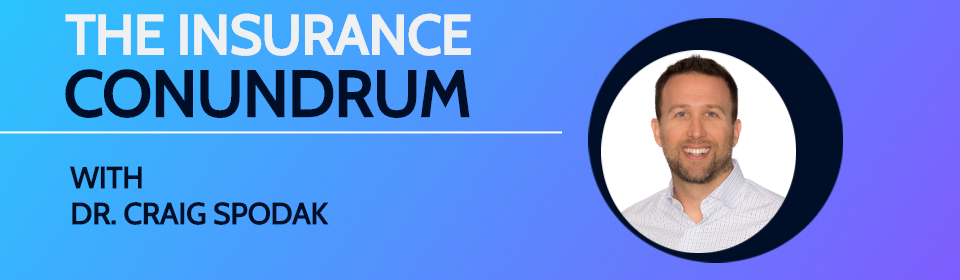
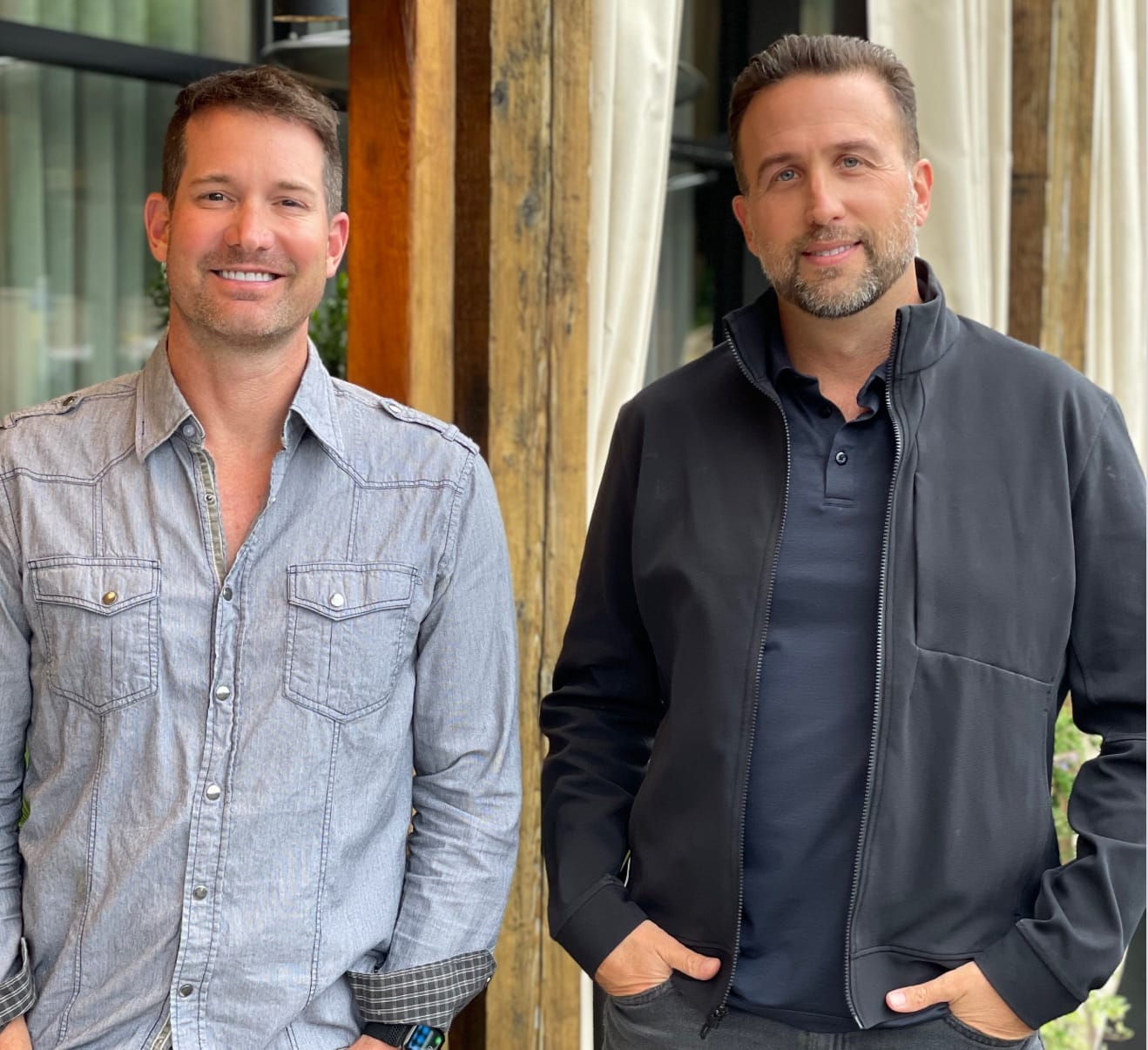
Hosts: Dr. Peter Boulden and Dr. Craig Spodak
Guest: Randy Smith
Key Takeaways:
Introduction
Thoughts On Regional Banks
TikTok Legislation
Actionable Item To Move Out Of Regional Banks
Interest Rates
Private Equity
Take Time Aside
Low Cost Way To Stop Attrition
References:
Bulletproof Summit
Bulletproof Mastermind
Bulletproof ERC
Mighty Networks: Bulletproof Dental Practice
To Sell or NOT to Sell PLUS Mastermind Ski Retreat Recap
What Got You Here Won’t Get You There: How Successful People Become Even More Successful
Warrior Sailing
Tweetables:
People, in the face of uncertainty, need a process. -Dr. Craig Spodak
Recessions happen when people stop spending money. – Randy Smith
Don’t look at anything with your face on the paper. – Randy Smith
Look at everything from a macro view. – Randy Smith
There comes a time when it’s the right time. –Randy Smith
It doesn’t help that you’re really on people. -Dr. Craig Spodak
Most deals don’t close. -Randy Smith
So many people operate by gut. -Dr. Peter Boulden
Full Episode Transcript
Below is the complete transcript of this episode of the Bulletproof Dental Practice podcast. Prefer to listen? Find us on Apple Podcasts, Spotify, and YouTube.
Read the full transcript
The following transcription was from the Bulletproof Youtube channel. Here is the https://www.youtube.com/watch?v=WIrkNHgvTaU&t=11s
Randy Smith
0:00:00
Look at the end of the day everybody's got to protect their own situation. That's what we do right We try to improve our situation and right now People with regional banks will probably be okay because just imagine if 200 of them failed Government's not gonna let that happen, right? So it's like, you know, the worst thing usually never happens and you know, the best time doesn't last forever The worst times don't last forever I don't picture 200 banks failing because that would be implosion in our economy that we couldn't handle and the government would step in. But does that mean that one or two couldn't fail, that the government doesn't step in? And what would… On the depositor side?
Craig Spodak
0:00:34
On the depositor side. And so what does that mean?
Randy Smith
0:00:37
You go give money to a bank and then you want to run your business with it. The bank goes out of business and takes all your money. I don't see the government letting that happen. They didn't let it happen with SVC. So then why did you start off with that? I, you know, move everything. Why was the… Because I don't want that one or two week period of I can't get access to the money. Okay. Do you think the likelihood of this
Craig Spodak
0:01:01
actually happening that… Low. Very low. Very low. Okay. I'll go on record and say
Peter Boulden
0:01:06
We are recording. Scott Youngwood did call it that, Craig. You are right. I didn't say Joey Bacchanella's podcast.
Peter Boulden
0:01:17
By the way, I just want to clear the air how incredibly hurt I was that the two of you
Craig Spodak
0:01:21
launched the podcast without me. I knew that was going to be first. And you guys were on. This is like, yeah, you knew this was going to be first because, Randy, like, I don't know if you know this, but I consider you one of my best friends outside of my consigliere. And when you said, hey, I got a break, I got a podcast with Peter, I thought you were fucking with me. I'm on a boat, and I'm like, well played, sir. You're like, no, seriously.
Randy Smith
0:01:47
I like your description of me.
Craig Spodak
0:01:49
I describe you as my dentist.
Peter Boulden
0:01:50
Oh, fuck, whatever.
Craig Spodak
0:01:52
That's not true. But anyway, I was so hurt, but it's my L of one, and you and Peter don't have L's of one, and for those of you who don't know what I'm talking about, we're talking about the culture index. What's your L, Randy? I think my L is 10.
Craig Spodak
0:02:02
Yeah, you have absolutely no heart.
Craig Spodak
0:02:03
You're cold as a robot. You need me in your life.
Craig Spodak
0:02:05
It has made me so insecure since I learned that, too.
Randy Smith
0:02:06
I'm being gentler.
Craig Spodak
0:02:07
I'm helping old ladies across the street and stuff.
Randy Smith
0:02:08
I'm like, whoa. I question all my decisions. Randy, if you saw my phone, the cascade of events of Craig's butt hurtness going through, and me kind of being a little bit more robotic like you and not empathizing with him made it worse. I was the worst dad.
Peter Boulden
0:02:14
I thought you guys were masculine.
Randy Smith
0:02:15
Did that talk to Randy for years?
Peter Boulden
0:02:16
I was the worst dad. I was the worst dad. I was the worst dad. I was the worst dad. I was the worst dad. I was the worst dad. I was the worst dad. I was the worst dad. I was the worst dad.
Craig Spodak
0:02:25
I was the worst dad. I was the worst dad. I was the worst dad. I was so upset. I thought you guys were messing with me. Because I talked to Randy for years. I'm like, I can't wait to have you on the podcast. You're like literally one of my closest friends. And when you said you're having it without me, that was a perfect way to razz me. And then it was true.
Randy Smith
0:02:40
And then it was true.
Craig Spodak
0:02:41
It was like, I'm actually taking my wife to dinner right now. Okay, ha ha ha. And then later you show me the picture.
Peter Boulden
0:02:48
So this is a sympathy pod for Craig Randy.
Craig Spodak
0:02:51
All those years, all those years you were between Peter and I. And now we've removed the middle man. You didn't remove my buddy Michael?
Randy Smith
0:03:00
Yeah.
Craig Spodak
0:03:01
Anyway, let's get to the real facts here. So I hope everybody enjoyed the last podcast with Peter and Randy. But what I'm excited about is to have you here to go over a bunch more topics, but also for people to get to see the real you. Because I listen to that, I'm like, a little bit more flat-lined Randy. That's a little bit, that's not the Randy I'm used to. That's not the Randy that drove his scooter into the hair salon for the first day I met you. When you drove your Vespa into the building. You were getting your hair cut and I didn't want to leave it outside and I didn't have
Randy Smith
0:03:30
a lock.
Randy Smith
0:03:31
Oh my God.
Craig Spodak
0:03:32
And so I drove into the salon. He literally brought a working, not a California vest, but that's electric, a gas…
Randy Smith
0:03:40
No, an actual, yeah, a 150, a big one.
Craig Spodak
0:03:43
That's crazy. A big one.
Randy Smith
0:03:45
But I'm excited for the audience to get to hear you. Anyway, I want you to know that Peter and I had a great time. I know you did.
Craig Spodak
0:03:49
And I did watch the podcast, and I thought Peter and I did really well.
Peter Boulden
0:03:52
You know, we did fantastic.
Craig Spodak
0:03:53
I'm going to go see a patient. I'm going to go right back. Okay, well, there's a lot going on here, Peter. So…
Peter Boulden
0:04:00
Tell me. The fact that you guys are both in person, that sounds, you're side by side. I need you to get together a little bit closer.
Craig Spodak
0:04:07
Okay, for those that are on video, you can see it, and we're very close together. But there's a lot going on. I've been blowing Randy up. Like yesterday, I texted him like, hey, what do I do? I've got money over different bank accounts, regional banks, and blah, blah, blah. So I know that as of today, Monday, at 2 o'clock, the bank, regional bank stocks are actually rallying and I think it's been eased some of the concerns but I'd like to jump right into that because if you have a dollar more than the FDIC of $250,000 of insurance is that money in a precarious spot? Is it for those that have regional banking deposits or business banks and stuff like that? Are we looking down the face of a problem with regional banks?
Randy Smith
0:04:50
So what I would say is I did get your text yesterday and this morning, and I know you were concerned, and so was I. And everybody accused me of panicking when I moved my money, but I moved my money the day after SVB collapsed. And the reason I did is because runs on the bank are real. They're rational because only smart people would quickly get their money out of a bank that they may not be able to get it out of next week. So are you are you causing the panic? Are you part of the problem? Or are you solving your own problem? And and most
Craig Spodak
0:05:24
of us want to solve our own problem. I think it's both by the way. I think you're causing the problem. You know, if the FDIC insures you 250,000 and you have 2.5 million.
Randy Smith
0:05:39
I understand which is why they went in and backstopped which I supported that idea. But you know how this is.
Craig Spodak
0:05:45
When you say supported you like called, you called Powell? Jamie, it's me?
Randy Smith
0:05:50
No I, by the way when Janet Yellen makes the presentation she's so bad on camera it's almost unbelievable. I feel like I'm watching my grandmother try to run our our economic policy and and she must be really smart to have that job
Craig Spodak
0:06:07
Oh, but I haven't seen it in the last couple of interviews Well, the good news is that I think we can all agree on both sides of the aisle that Biden is a very good speaker And we're all feeling very confident in his diplomacy and his articulation. That's good Regardless of where you are politically. I think that's the safe thing to say. Let's go back to the banks for a second. So right now, and Peter, jump in here because you're a small business man, I'm a small business man, we all are, and probably most of your listeners. But right now, around this country, entrepreneurs are getting taken to lunch by their regional banker and they're sitting down and they're looking at their client, the banker, and he's saying, everything's going to be fine. Here's our situation." And the entrepreneur is going, don't worry, I'm sticking with you. You've always stuck with me. And then over the next 90 days, the entrepreneur is pulling that money out of the bank account and moving to one of the big four. Are you kidding me? You're really saying that right now? I'm telling you it's going on all over America. Do you realize the importance?
Randy Smith
0:07:07
Almost everybody I've talked to is moving their money.
Craig Spodak
0:07:08
I know, but do you realize the responsibility of this microphone and the influence that we have. You are literally gonna cause, Peter, what say you on this, bud? We gotta put a pin in that right now, because I'm worried about-
Peter Boulden
0:07:22
I will concur with that. I have a lot of friends that are doing very similar. They are moving to the systemically important banks, which is, in my opinion, part of the plan, right? This is all a shift towards the central bank digital currency, right? And want to be able to track that. So in order to track everything implicitly, the easiest thing to do is to put it to one of the big four banks. And Janet Yellen has made it very clear in a congressional, I guess, deposition that they will not be extending the same courtesy they did to regional banks that they did for
Craig Spodak
0:07:58
SVB. When did that, you guys heard that?
Randy Smith
0:08:01
No, no, no. What she's been asked on many – I'm glad you brought that up, Peter, because I was going to mention that as well – is she has not assured everybody that everybody's okay, because that's like writing an $11 trillion check for the government. But what she says is everything's fine, stay the course, steady, easy, but she has not said you're all insured. Now as depositors in regional banks we assume that we'll be insured, right? Because imagine the lawsuits if we weren't. If my bank fails and and they bailed out, you know, they backstopped SPV. You've got to use the word backstop not bailout. Right. Because the the owners, shareholders, and bondholders are going to be wiped out. But right now 70% of all
Craig Spodak
0:08:48
commercial real estate debt is regional banks.
Randy Smith
0:08:50
Yeah. Right? So we need regional banks. We can't all be with the big four. That's way too much control for the big four and for the government that insures them.
Peter Boulden
0:08:58
100%.
Randy Smith
0:08:58
And so if we need regional banks, they just have to come out with some sort of legislation and policy that makes us all comfortable.
Craig Spodak
0:09:03
Yeah, like four days ago.
Randy Smith
0:09:05
Yeah.
Randy Smith
0:09:05
And oh, by the way, for probably not a lot of money, you could write a code that would manage all those bank accounts that you're talking about. So when everybody says, oh, it would be impossible to have 10 bank accounts with $250,000 each. No, there are applications that do that. No, it wouldn't. You could do that very easily, and you could probably write checks off of all of them systemically, whatever. But we shouldn't.
Peter Boulden
0:09:26
That's just insane, though. That doesn't solve the problem of anything, meaning that the FDIC has only insured the amounts of the $22 trillion that's at exposure. They've only got about $200 billion in treasury. So it solves nothing to open up 10 bank accounts.
Craig Spodak
0:09:42
Right. It's so dumb.
Peter Boulden
0:09:43
It's like just it's just that.
Craig Spodak
0:09:45
It reminds me of the pandemic rule. Wear your mask when you walk in a restaurant. The minute you sit down, take it off. And like, there's no logic behind any of this. It's just a way to give people a process so that they feel comfortable. I think people in the face of uncertainty need a process. Like, stand on one leg and rub your head with your left hand. You'll be fine. But coming back to the idea about moving your money around, I was dealing – just speaking with a friend of mine who is a lot smarter than me and he said – I told him like, well, I'm not really aware about it because my regional bank I have blank dollars in deposits but I owe them like six times the amount of money that I have in deposits. He's like, yeah, that doesn't help.
Peter Boulden
0:10:22
That's not the same.
Craig Spodak
0:10:23
What do you mean? He's like, well, in the bylaws, in the arrangement of your instrument of your loan, if they lose all your money, it is not deducted from your balance. So that was disturbing, but I think we have a responsibility to our listeners. Like really, and I'll come to Peter in a second, because I know Peter's answer, because Peter's you know, fast in the temple as we speak. What is your real thought, Randy, that you really believe that the regional banks, the depositors are not going to be secure. What's your real thought? Like, be honest here. So, no bank can survive a run. You understand that, right? Right, I understand that.
Randy Smith
0:11:01
So if everybody calls tomorrow and says, I want my money back, the bank collapses.
Craig Spodak
0:11:04
All of them.
Randy Smith
0:11:05
Right? Yeah. So, is that a house of cards? That's a house of cards, right? Yes. Because when we put our money in, we don't tell the bank, you can hold this and do whatever you do with it to give me a little bit of yield or no yield, and I want to be able to get it back in a moment's notice. We are allowed to get it back in a moment's notice, but if everybody wants it back in a moment's notice, the bank implodes. So just think about that for a second. So no matter what they say, no matter what Janet Yellen says, you are taking the risk. Let's talk about a sleepless night. week plus night, right? If, you know, I had money in First Republic, right? Almost seven figures in First Republic, right? In a checking account, and I was earning, or a money market account, and I was earning maybe 3.5%, something like that. And I moved it out of First Republic simply because I thought everybody was gonna pull their money out of First Republic because they were the number one on the news after SVB. And so I just didn't want to be the last guy holding the bag. Now, if the government backstopped it, they might have made it good a week later, or two days later, or five days later. I didn't want those nights of sleep, or lack of sleep. I'm just saying, hey, I'm going to move my money. And the problem is, if I'm doing that, so is everybody else. So this is why I hope the lawmakers right now, there's two things. One, they've got the debt ceiling vote coming up. They need to be working on that.
Craig Spodak
0:12:27
legislation. Like yesterday. Right. And if it comes out tomorrow, it's too late. I mean, it's just crazy it's not coming out already. Yeah, and also, the stock market, I've never seen more what they call choppiness. I call it whiplash in the stock market over the last three months. I mean, we've been up to 4,200, down to 3,800, up to 4,200, down to 3,800 in the S&P.
Randy Smith
0:12:47
The bank stops are up, the bank stocks are down.
Craig Spodak
0:12:49
Why are they up today? Today they're up because, well, just, you know, all the articles that get written get written after the news, right? So they basically tell you what happened, you know, they don't, they can't really forecast correctly. So one thing that's amazing about the Wall Street Journal is if you have a good day in the market, the next day they tell you why. And then the next day you have a bad day in the market, and then the next day they tell you why.
Randy Smith
0:13:09
But they can never tell you the day in advance. We'd all be better investors. So yeah, it's crazy. We need we need legislation. I don't know how to write it.
Craig Spodak
0:13:18
I mean, they're going to have to put they're going to have to quadruple the amount of the FDIC insurance or else or else there's 200 banks on the brink of the same fate as SVB. And I think I think that 150 is that what it was? 200 is about 200 on the on that that that have exposure very similarly to First Republic, SVB, and this doesn't even bring up,
Peter Boulden
0:13:46
like are you guys familiar with the choke point 2.0?
Craig Spodak
0:13:49
Is that a Brazilian Jiu-Jitsu move?
Peter Boulden
0:13:52
No, no, but it is basically like a lot of these banks were very crypto-friendly banks, right?
Randy Smith
0:14:00
Oh yeah, yeah, yeah, the fear that they're going to go in and use this to get banks to kick out crypto and try to wipe them out.
Peter Boulden
0:14:07
To eliminate exit ramps and on ramps and exit ramps from fiat to crypto and crypto back, right? Meaning the person who the survivor, whoever was going to acquire this Silvergate, bylaws that they have to have nothing to do with, not bylaws, in the conditions of buying it over or taking over the assets, they have to eliminate all of the crypto assets. Like this is actually in the FDIC bulletin. So the choke, you can Google this, we won't get into it here, but if someone's interested, you can just Google kind of choke point 2.0 is what it's called. And so many think that this is just, this is them feeling vulnerable with Bitcoin specifically and crypto. That's deep but I appreciate the sentiment it just it takes into a lot of assumptions. Well look at you know it's not me saying it and I didn't do it.
Craig Spodak
0:15:06
No, no, no I know, I know. Look at what Obology said. I saw that. I read, I watched that 90 days.
Randy Smith
0:15:12
There was an article today, Peter, in the journal that JP Morgan and US Bank are picking up a bunch of those crypto deposits, which is really unique because JPM, I think, is number one and US Bank is number five, maybe. So yesterday, the news was the choke point, and then this morning, those big banks are taking up some of that business.
Craig Spodak
0:15:37
So what do you make of that?
Randy Smith
0:15:39
So all we did was kick the can down the road on that because just pivot to TikTok for a second, right? If you read the bill on how they would ban TikTok, it's a piece of legislation that basically says that our federal government can use whatever means necessary
Craig Spodak
0:15:53
to protect us from like digital threats. Right. So if they ban TikTok using that piece of legislation, what could they do with Bitcoin?
Randy Smith
0:16:04
Is Bitcoin a digital threat?
Craig Spodak
0:16:05
Didn't one of the presidents like seize all US gold owned by private companies? Wasn't that a thing like Eisenhower or something like that? They literally made it illegal for US citizens to own gold bullion or something. I don't know. Jamie fact-check that for us.
Randy Smith
0:16:22
Anyway, the…
Craig Spodak
0:16:23
We don't have Jamie. I just thought that was funny.
Randy Smith
0:16:25
It did sound cool.
Craig Spodak
0:16:26
Yeah.
Peter Boulden
0:16:27
Yeah.
Peter Boulden
0:16:28
The old reserve act of 1934 that signified that American people could no longer hold
Randy Smith
0:16:33
gold. Yeah.
Craig Spodak
0:16:35
So like it's been done.
Randy Smith
0:16:36
Yeah. So they could they could use that tick tock legislation. And by the way, I'm not saying they shouldn't ban tick tock. I don't know enough about it.
Craig Spodak
0:16:43
But I do know that tick tock has access to 75 percent of anybody under 30 years old more than any other media. Yeah, the amount of intrusive, the depth of how intrusive that application is to seeing everything on your phone is like crazy. Joe Rogan talked about that, like if you were to actually read the terms and conditions, you would never actually sign up for that.
Randy Smith
0:17:08
Right.
Craig Spodak
0:17:09
So Peter, it is shocking to me how many people, one, have not actually heard about ERC, and two, have gotten the wrong information. And you and Trey being two of them, I mean, I consider you to be an epic business person. And when I talked about the employer retention credit to you, you were really dismissive of me. Like, no, I went through that, I got it, you know, it was great, I got it, it was done. And even Trey just now, we were just talking to him on the last pod, he's like, yeah, I already, you know, my accounting firm, they got it very little, they only got like five or 10 grand. So we know this is totally misunderstood.
Peter Boulden
0:17:41
I was told I didn't qualify until I went to a specialist and they're like, you absolutely qualify and here's the number. And it almost startled me. My jaw was off on the ground.
Craig Spodak
0:17:51
I'm like, are you serious? Yeah, you don't believe it.
Randy Smith
0:17:53
You don't believe it.
Peter Boulden
0:17:54
But don't ask your CPA. Ask someone who specializes, which is why we actually have this awesome arrangement and we created a link and the company is Bulletproof ERC to help kind of implement this because from this pot of money that Congress has allocated, we want the people listening from Bulletproof to take advantage of it. So this is why this announcement is going on because it's, like I said, don't ask your CPA, ask the people who this is the only thing they do all day every day.
Craig Spodak
0:18:21
That's why we had to do this because initially of telling everybody, telling you, telling everybody, like, oh, Edwin, we don't qualify. So like, oh, this is not going the way it's supposed to. Like, you have to go to the people that do it. So I'm really proud of that. My buddy, Norm, works at the company. Norm, as you know, is like the nicest guy in the world. He's literally like Ned Flanders. He's like, how do you do what you do? He'll fill out your form, he'll walk you through the process, he'll do the Zoom call with you. It's literally white glove services. You don't have to do anything. And this is what they do. And it's an unbelievable program. You have two ways to pay for it. You can either pay up front, or they can just take a percentage when they give you the money, and it is awesome. You did one, I did the other. We won't tell which one, who did what, but it's a government program. It's going to run out. Do not delay. It's amazing how many people are like,
Randy Smith
0:19:08
I'll handle it a couple months.
Craig Spodak
0:19:09
I don't have time. You don't need any time.
Peter Boulden
0:19:11
Like, this is like crazy.
Peter Boulden
0:19:12
First come, first serve, right?
Craig Spodak
0:19:13
First come, first serve. And I mean, I know the government's treated you well through the CARES Act, and you're thinking to yourself, well, maybe I don't need this.
Peter Boulden
0:19:20
It is your money to have.
Craig Spodak
0:19:21
This is part of the CARES Act.
Craig Spodak
0:19:22
Right.
Craig Spodak
0:19:23
It is part of the CARES Act, but I mean, even when I thought about it, I'm like, nah, I'm
Peter Boulden
0:19:26
good.
Randy Smith
0:19:27
I don't want to take, you know, more money.
Craig Spodak
0:19:29
But this is a program that's allocated for people like you who have kept your employees, kept your businesses open. Do not take it for granted. If your account told you, your friend who's a lawyer told you, do not leave that stone unturned. Go to bulletprooferc.com. Spend five minutes. It's worth the due diligence. Do not assume anything. And even if you filled it out, you got something, but it wasn't, you know, what you think is commensurate for your size business, go ahead and reopen the process. You can amend these things for different years. So do yourself a favor, take the five or 10 minutes, have a Zoom call. You may be leaving hundreds of thousands of dollars on the table, which is not prudent for you, your business, and the families that your business supports. Do it for them.
Peter Boulden
0:20:17
So anyway, well, no, I think it's interesting. Look, I think with the takeaway, people listening to this, right, I always try to vicariously think if I was in the receiving end of this information, like, okay, this is great. What is the action, right? And it's not opening 10 accounts. It's not opening 10 business accounts. That cannot be the solution. Is it, A, like you said, moving some, moving, if you feel like your money is vulnerable, moving to a systemically important bank, right?
Craig Spodak
0:20:44
A big, a Wells, a Chase. You don't have the service on those, like, you know, from my original.
Peter Boulden
0:20:49
I agree. I'm a big fan of regional. I do both of my, well, one of my bankings.
Craig Spodak
0:20:55
Regional banks help build my business. Yeah, me too. I mean, all my, and for me, I need cash deposits that are like well in, like, almost seven figure range. Like, I need that level of float for my business. So like, it's crazy. Like, what's the actionable item short of moving out of that regional bank?
Randy Smith
0:21:13
Bitcoin?
Randy Smith
0:21:14
Oh, come on. No.
Peter Boulden
0:21:16
So.
Randy Smith
0:21:17
Peter, how's your business going?
Craig Spodak
0:21:17
No.
Peter Boulden
0:21:18
Um.
Randy Smith
0:21:19
I need you to get this out.
Craig Spodak
0:21:21
I need you to open up a Coinbase account.
Randy Smith
0:21:23
So, Peter, the, I don't, look, at the end of the day, everybody's got to protect their own situation. That's what we do, right? We try to improve our situation. And right now, people with regional banks will probably be okay, because just imagine if 200 of them failed. The government is not going to let that happen, right? So it's like the worst thing usually never happens, and the best time doesn't last forever, the worst times don't last forever. I don't picture 200 banks failing because that would be an implosion in our economy that we couldn't handle, and the government would step in. But does that mean that one or two couldn't fail, that the government doesn't step in? On the depositor side? On the depositor side. And so what does that mean? You go give money to a bank and then you want to run your business with it, the bank goes out of business, takes all your money. I don't see the government letting that happen. They didn't let it happen with SBB.
Craig Spodak
0:22:19
So then why did you start off with that? I, you know, move everything. Why was the first one to buy it?
Randy Smith
0:22:25
Because I don't want that one or two week period of I can't get access to the money
Craig Spodak
0:22:29
ok you know I think the likelihood of this actually happening that all very low very low ok Peter will go on record and say very low Peter what about you well I would agree low I would agree they will fix this in the way they will fix this when it comes to an issue is they will just do what they do best and
Peter Boulden
0:22:45
that is turn on the money printer
Craig Spodak
0:22:47
Yeah. Which is going to be the amount of money would take to ensure all the deposit. No, no, no. It's not the insurance. There's backstopping and the prevention of failing banks, right? Will cost upwards of one to two trillion dollars.
Peter Boulden
0:23:05
Sure.
Craig Spodak
0:23:06
And to ensure that going in hindsight to ensure it would not have been that difficult to ensure the FDIC to a higher limit.
Peter Boulden
0:23:14
The insurance is all bullshit, in my opinion. How do you have something where the treasury fund that's designed to insure it is only about 1.5% of the amount that you're trying to insure? So, if everything fails, your insurance, I know it's a warm, fuzzy, and feels good, that goes to shit too.
Randy Smith
0:23:30
You know, most insurance rates, if you think about it,
Randy Smith
0:23:32
are only 1-2% of the insured value. It's just that it doesn't work with money because the bank fails.
Craig Spodak
0:23:41
Everything fails. Look at what happens in Florida when you get a hurricane. Yeah. Like try to get insurance on your house now.
Randy Smith
0:23:46
But there's 49 other states that progressive insurers that didn't have a hurricane.
Craig Spodak
0:23:49
Right.
Randy Smith
0:23:50
So that's how insurance works.
Peter Boulden
0:23:51
This is a national hurricane.
Randy Smith
0:23:52
Correct. If a bank wipes out, everybody loses. It's a cascade.
Peter Boulden
0:23:55
It's a cascade of the interconnected banking. Like it doesn't stop.
Craig Spodak
0:24:01
We couldn't issue payroll for two days in our practice because somehow our payroll company was tied to SVB. I don't know how, and we don't use some like Silicon Valley payroll company, but like the normal, like we're in the big three payroll companies. It had some form of contagion to SVB. Just to show that example, it was like our checks were held for like a day. Wow. How'd you like that? It didn't, well, I mean, as the business owner writing the check, it makes me feel like I'm like a failure because it's like, you know, can you hold your check for a couple of days? You know, hey, here's the check, don't deposit it. It doesn't feel very good. My first few years in business, I always had more payables than receivables and we would actually print the checks and match up the invoices and set them on the corner of my controller's desk. And then as we got deposits in, we would figure out how many checks we could release. I mean, talk about, talk about living at red line and that only lasted 10 or 12 years.
Craig Spodak
0:24:55
True.
Craig Spodak
0:24:56
Brandy would always tell me, and this is a great analogy for us is like every time, like one of his builders would get upset and call him and be like screaming about the install or something like that. Or you get one negative comment. He'd say it, it felt as though the toilet was flushing and I was watching my business Completely circle and flush down the drain. It's like when we as Dennis get a bad Google review like oh my god This is gonna be it It's like beginning of the end yeah and all your mind goes and draws the conclusions why this is step one of a 10-step Process to you completely going and solve it Yeah And that stays with you till the very end until you sell your business. And then the funny thing about what you said about selling the business was, you said you sold the business, you saw the money get wired in, it looked really good for a couple days, like holy shit, it's really there. And then you felt, number one, the obligation to deploying that capital, I mean, look at the climate we're in right now, and number two, you realize that you had the money all along, it was always there. So I love that idea. So for those, Dennis, out there that don't do net worth analysis, you'll feel, you'll get a good sense of how. Don't yet. Don't yet. They're all going to do net worth analysis. Everybody who listens to your podcast is going to have an up-to-date financial statement every month. Right. But that's part of the summit.
Peter Boulden
0:26:19
This is a teaser for the summit, right?
Craig Spodak
0:26:20
Isn't that document you two are cooking together? But like for those that, you know, because listen, as dentists we just, we're like kind of sheep herders. We had four sheep today, we have five sheep tomorrow, six sheep, and then you just, whatever you can count, you feel good about. But what you really don't understand is you own the land that the sheep are on, and sometimes your sheep business is actually not that profitable, but the land is actually more profitable. And you also used to tell me that every time you look at what you made for the year, you also say, well, how much principal did you reduce? You know, so count that. The best money that you can earn is the passive income that is not in cash, but in paid off equity. It's moving money from right pocket to left. You can't spend it. It's illiquid, but it's actually part of your net worth, and that's how to get to real wealth. It's not chasing the dollars.
Peter Boulden
0:27:04
So, question.
Randy Smith
0:27:07
Randy, would you rather have,
Peter Boulden
0:27:08
in this kind of instability, let's just say that our currency is in a little bit of instability right now.
Craig Spodak
0:27:16
Would you rather have equity or cash? Oh, such an easy one.
Randy Smith
0:27:21
So Peter, when you're building a business and building your net worth, you're going to concentrate your effort, right? And then when you liquefy your business or you multiply your net worth, you know, 4X, 10X, whatever, wherever you are today, whatever your goal is, the way to protect it is to diversify, right? To have broad diversification instead of, you know, narrow. And so I'm a guy who always holds about 7% cash, and I have friends that hold 20% cash. The guys that are holding 20% cash have lost a big chunk of it in the last 24 months with the rampant inflation we've had. I will tell you that I feel like most people like right now is not the time where you'd kind of want to go out and buy a new car or go out and, you know, recessions happen because people stop spending money. What about a house? Rich people stop spending money and people without as much money stop spending money because it just doesn't feel good if you feel like your net worth is getting worse or if you feel like there's risk on the horizon. What's weird about the bad times though is the bad times don't last very long. You know, like high interest rates never last long. Look at all the history of high interest rates. They don't last long. They come in to solve a problem and we solve the problem and then the high interest rates
Peter Boulden
0:28:40
go away.
Randy Smith
0:28:41
Peter brought up a point earlier is how is the Fed going to solve this problem? They're going to turn on the printing press. What's that going to do? That's going to exacerbate inflation. More money chasing goods and services. That's the only way inflation is created is by printing money. If there was no printing money, there'd be no inflation.
Craig Spodak
0:28:56
Okay, so if we're going into a period of rising inflation, you said, I wouldn't buy a car, but what about an appreciating asset? Would you buy the house right now?
Randy Smith
0:29:04
Well, that's a complicated narrative right now because prices are coming down. So probably I would if it was a long-term purchase. Listen, I tweeted this morning. I know, I was the one person that saw your tweet. I know, I know. Because I'm new on Twitter. You just texted me. I'm new on Twitter. But I had a funny thought this morning. I was, Peter, I was thinking this morning at every asset I've ever owned. And I'm a real estate guy.
Craig Spodak
0:29:27
I've had office buildings. I've done condos. I've done construction. I've done some development. You own a Giant Eagle in Ohio, one of your premier properties.
Randy Smith
0:29:35
I've got a bunch of Walgreens and CVS's and all this stuff. And I've had a bunch of stocks over the years.
Craig Spodak
0:29:41
And one thing I can tell you is everything I've ever sold, I wish I owned today. Correct. Yeah. Right? And the funny thing is, Peter, I haven't told you this yet, but that land I just sold like three months ago, I have all this cash from that. I'm like, I'd probably rather have the land right now. And there's no chance if you own land outright that it's going to get taken from you outside of like an invasive force coming in to come and do your property. You know having that level of cash right now, I'm not feeling so good about that.
Randy Smith
0:30:06
Yeah, it's a weird feeling. But we do want to, you do want to have cash for rainy days, right? And your business could have a rainy day. I mean, imagine this, what if one day something happened where the government said you can't run your dental practice for the next three months. I mean, I know that would never happen.
Craig Spodak
0:30:23
No, I know, that's just crazy. Like what do you mean, like shutting you down?
Randy Smith
0:30:26
Shutting you down.
Craig Spodak
0:30:26
Oh, my God. Preposterous.
Randy Smith
0:30:27
Yeah. So so it never happened. Anyway, so, yes, we need to have enough cash for that.
Craig Spodak
0:30:32
Most people like to have your bank account or something like that. Let's say you drove a truck or something and you live in Canada. I don't know. Let's say you did a protest and they seized your bank account. Right. Like something ridiculous. Anyway, so I'm a big fan of cash. But but when you have cash, so where do you put it? Obviously, you want it to be insured or at least not be taken away in one of the big four banks, let's say, for this case. And then you can buy T-bills and money markets and things like that, which are a ready liquid market. You can make 4.6% is what I'm making in my T-bills right now. And you just told me, on your call this morning or your text this morning, I found out that there's private money market accounts through like Merrill and stuff like that that are in the low mid-fours.
Peter Boulden
0:31:14
Yeah.
Craig Spodak
0:31:14
It's decent.
Randy Smith
0:31:15
Yeah. I'm 4.6%. And they own interbank loans. They own T-bills. They own-
Craig Spodak
0:31:21
So it's a portfolio value.
Randy Smith
0:31:22
Yeah. Yeah. And it's immediately liquefiable. But that doesn't mean it can't go down in value. That doesn't mean you can't lose your return. I mean, when the tide goes out, all these asset prices go down. And so you really just need holding power to get through the bad times, because when the times are good, everybody's going to dinner and everybody's buying a new car.
Craig Spodak
0:31:44
What's funny is you think you're earning, this is the irony of where I love people when they talk about like, well, I'm earning 4.5% of my cash.
Peter Boulden
0:31:53
No, you're actually, you just slowed your slippage down to 1.5.
Craig Spodak
0:31:56
Well, no, that's the official number, Peter, 6% inflation. We all know we don't have 6% inflation. But like you're not yet, so it's just you down. In my investment group, there are a bunch of smart guys that are really excited about four and a half only as a hedge against inflation. They know they're going backwards. By the same token, I have two mortgages on my two houses for 2.75% for 10 years interest only. So what are those mortgages really costing me, Peter? They're costing me minus five, right? Like they paid me to take the money because of inflation. The house is appreciating, the mortgage is not. Well, I mean, that's what inflation does. You know, everybody's so excited about the handouts and the printing of the money through COVID, but really what it did is it helps the rich because inflation helps the rich. You know, the same inflation that kills you from spending Helps your assets yeah And not only that but inflation pays off the national debt because they print money today And then it depreciates by 2% a year which is their target so when they say target They just want 50 years from now the debt to be zero if they didn't keep printing So I think one of the so they the feds go goal is never to have zero inflation
Peter Boulden
0:33:09
It's always to have 2% so back to dentistry for a second you guys Craig you had brought up something about a house, right? So let's spin it to a practice, an expansion on this. And this is where I think that America is the greatest place in the land, in the world to make, to have leverage and create arbitrage. For example, yes, the interest rates are high right now, which makes people paralyzed and they do nothing. So there's dentists saying, like, I'm not going to buy a practice right now because interest rates are too high.
Craig Spodak
0:33:38
But guess what?
Peter Boulden
0:33:39
We make an arrangement with the bank and we say, Hey, bank, I'd like to take a 30 year mortgage or a 10 year mortgage. And the bank says, okay, we will uphold that. And we won't go shopping for someone better than that. That's going to give the money to a meaning, but we can go refinance our loan and things become favorable. They cannot do that, right? So it's a, it's an advantage for us.
Craig Spodak
0:33:58
And two more advantages to Peter, just to, just to add on those. Number one, that's tax deductible, your interest rate. So if you are borrowing at 6% and you're in a 40% tax bracket, you're only paying 60% out of 5% at 6% interest rate. And number two is if you have a loan that's locked and it's a month closing, you can actually ask your bank and they're legally obligated to give you the lower rate. So you lock the high end, but they don't lock the low end. You can actually make your bank, I've done that before, like one week before closing.
Peter Boulden
0:34:28
It's a legal obligation.
Craig Spodak
0:34:29
But there is a legal obligation. Are you aware of that or am I just talking shit?
Randy Smith
0:34:35
I think you're talking shit.
Craig Spodak
0:34:36
Okay, that's fine. We'll edit that whole part out.
Peter Boulden
0:34:38
Yeah.
Craig Spodak
0:34:39
You look smart.
Randy Smith
0:34:40
So I will tell you. Exactly. I will tell you.
Craig Spodak
0:34:45
You know you're gonna do that Peter. Peter's gonna make a clip of that.
Craig Spodak
0:34:48
And put it everywhere.
Peter Boulden
0:34:49
I'm like, no, no, no, Craig, you're wrong.
Randy Smith
0:34:51
You just. The intro.
Craig Spodak
0:34:53
Um, anyways, you know, I still have a phone with the screen to ever like that. This is basically, um, life sucks. Go ahead. I'm sorry.
Randy Smith
0:35:00
I have my family. My wife has a picture of me.
Craig Spodak
0:35:02
I'm searching.
Craig Spodak
0:35:03
No, it's funny.
Randy Smith
0:35:04
Your wife has a picture of me too. Um, anyway, Peter, um, you know, if, you know, if you look at the historical interest rate rise and fall, everybody talks about 1982 and that 18% interest rate. I mean, you can't talk to any boomer with them not mentioning it. What they don't tell you is that they refinanced it for half of that a year later. So if you want to buy a business, let's say if you're going to borrow 600 grand and your rate was 6%, now it's 8%, that's 900 bucks a month difference, so if you're gonna buy a business. It's gonna make 200 grand a year 250 400 Whatever the incremental cost of the additional borrowing net of the tax Savings from from the expense of the interest is is really I mean we're not in crazy interest rate territory Let's not forget that five years ago if you bought a house you were paying 5% and everybody was cool with that Oh, we're happy, but then yeah, but then it went down to three and now everybody's pissed off that it's seven or eight. It's really not the end of the world. Peter and I have been saying that too. People are like, oh my God, the interest rates are so high. I'm like, they're four. They're not 2.5, but they're four. Four is still good. Remember we had one of our masterminders from a prior year. It's like, oh, I missed the boat. I could have got a 2.5% re-find. Now it's four. I'm like, do it. There's still more pain coming. Remember, it's crazy. I guess my point is this. Even 5.5 or 6 is still good. That's where we're at right now, right?
Randy Smith
0:36:28
So the dentist Peter that needs to buy a building or a practice.
Peter Boulden
0:36:31
No, I guess here's where I'm going Randy, and you may not know this about dentistry, but a well-run practice should have an investment yield of 25%.
Craig Spodak
0:36:39
Okay?
Randy Smith
0:36:40
Right?
Peter Boulden
0:36:41
So even if you're taking, even if your cost of capital is 7%, you're still, the delta is still an incredible investment, right? And you only stand to be able to refinance, like you said, into more favorable terms. And like Craig said, even that interest is a tax advantage situation, right? It's abated from your earnings. So it's a funny thing. I'm hearing it more and more everyone's like I'm just gonna sit I'm gonna sit tight right now why while interest rates are high and I'm thinking hmm okay I get that but
Randy Smith
0:37:20
like that's what mathematically I do not get it yep that's what the economy is Peter and just so you know if if you want to make the 8% or 7% mortgage whatever it is now seven and a half you want to make it feel good what if I told you if you bought a house today or a building and you paid seven and a half
Craig Spodak
0:37:35
percent interest what if I told you in six months it was going to be 12% interest?
Randy Smith
0:37:40
You would love that you did.
Peter Boulden
0:37:41
You'd feel like a hero.
Craig Spodak
0:37:42
You would love that you did that deal. And so the rates are going up and then they're going to come back down because don't forget the Fed has now had two months in a row where it can't meet its obligations because of the interest rate because they pay the same interest on their debt that we pay, right?
Randy Smith
0:38:00
So the problem with bonds.
Peter Boulden
0:38:03
The treasury.
Randy Smith
0:38:04
Yes.
Randy Smith
0:38:05
And so, Peter, the thing you mentioned about printing more money, that's going to keep inflation here longer. So I don't think the rates are going back down to 3%. In fact, they should have never been there. And that's a whipsaw reaction to fix broken economies, right? Is to lower the interest rate to zero. And in Japan, it's less than zero. They actually pay you to take the money there. A healthy interest rate probably for the Fed is somewhere in the 2.5 to 4% range. Today, it's 4.75 and we're all freaking out. The other thing for your listeners is don't look at anything with your face on the paper. Everybody who has a business also has a personal life. You've got Spodak Dentistry and then you've got Craig Spodak, and you've got a house and a mortgage and cars and investments and a net worth, and you've got your business. When you're looking at decision-making about building a practice, buying a practice, buying a building, whatever, you have to look at everything from the macro view. In the macro view, if you're to borrow money two points higher right now, it's no big deal. You can manage around that. The interest rate shouldn't be stopping our economy. It's relatively low, but if you read the papers and talk to your friends, they're going to go, yeah, I don't think we should be buying anything right now. This interest rate thing is a real tough racket. You know what I mean? Everybody's freaking out about it.
Peter Boulden
0:39:25
Randy, I want to flip that on its head a little bit. We did a podcast maybe three or four ago where it was a big dialogue about to sell or not to sell a practice. There is an amazing amount of pressure on dentists to sell their practice right now. Pressure from the outside, meaning a private equity standpoint. And we kind of disclosed on there that Greg and I have gone through the process only to arrive at the same conclusion that, like you said, and I'm going to stick to this line, the money was there all along, right? But you get romantic about this, wow, there it is all at once. So I guess my point is, Craig, I think this, even after this SVB and the banking crisis and now the uncertainty of the dollar, I think it's even more imperative that we would probably put, if we did that podcast now, Craig, is what I was saying. Oh shit, I know. You would actually say, now is the absolute worst time to sell because equity, back to my question, would you rather have equities or cash? Equity meaning a business or the ability to make.
Craig Spodak
0:40:33
Yeah.
Craig Spodak
0:40:34
Unless your business is very capital intensive like real estate or what have you, you just told me that you're making 25% on your equity annually.
Craig Spodak
0:40:47
Right, right.
Craig Spodak
0:40:48
Where are you going to get that? Yeah, so I just want to explain to everybody, you will never make that money as an investor because once again, you're going to take that one practice where you're concentrated your effort, you're working it yourself and you're making 25% and now you have to protect it for the rest of your life. You won't be making any 25% bets because to make that kind of money in the real world, you're taking real risk of loss. I know many people who've liquefied their businesses, not dentists, but have sold their businesses, taken the money, made bad investments, and been wiped out. So many, many people. So I'm a big fan. The other thing, let's go back to tax, because that's one of my, like, I'm a semi-subject matter expert on tax. And not, yeah, not, well, not a tax professional, but I understand tax and how it works in business and your personal life and the tax incentives that are available to you through real estate investing, etc. Anyway, when you own a business, you earn income, you pay expenses, and then you pay tax. When you are an investor or a W-2 employee, you earn, you pay tax, and then you have your expenses. You want to be on this side of the equation. When you sell your business, you no longer have the ability for a lot of write-offs. Again, you have to look at everything in the macro. What are my tax advantages that I'm using through the business that I would lose if I sold the business? So when you're doing that spreadsheet of, you know, you should assume returns in the 6 to 7 percent range, not 10 to 15, and you should assume that you're losing some amount in tax advantages that you're currently enjoying that you won't enjoy. Right? So for you guys, especially if you love what you're doing and you're enjoying it, I would highly recommend that you keep your business, build it, grow it. And then when you've built up a net worth outside of the business and in the business, there comes a time when it's the right time. I had offers to sell my business when I was 35, when I was 40, when I was 45. I promise you I would have lost all that money in development, in the great financial crisis if I had sold it. I held it until I was 55, and for me that was the right time. I remember I was contemplating a sales like this as this building was going up. So this building was going up, I was, you know, it's a lot of fear, and the narrative is very strong. You know, there's a lot of people like, you should take some chips off the table, that's a typical way of saying it. You're very concentrated in this one thing, what if this, what if that, take some chips off the table, we won't change anything, rah, rah, rah. And it's just such a pervasive dialogue in dentistry right now. It is incredible, the amount of like stories. And then the conformational bias of like, oh, as soon as I sold it, it went really well. And when we distill it down, we're like, is it the partner, the strategic partner that came on? No, it really wasn't, to be honest with you. They're not doing a lot for me, but I'm more at ease now. And then their leadership style changes, because they did take the chips off the table. And then the business can get unstuck, because they don't have some panicked business owner roaming around. In some ways, there's a delicate balance between explaining what you want your team to do, and then getting really far out of the way to let them do it. And the panic of the business owner sometimes is the very thing, the psychology that ruins
Craig Spodak
0:43:57
everything.
Craig Spodak
0:43:58
After 35 years of owning and operating a fairly big company, I've been the president for three and a half years
Randy Smith
0:44:05
since I've sold, and I'm running it better today.
Craig Spodak
0:44:08
For what reasons?
Randy Smith
0:44:09
Because I'm not being electric shocked every day by everything. You know what I mean? Fear, uncertainty, doubt. Lawsuits, problems, market fluctuations, whatever. But when I was younger, I mean, the idea of selling is super sexy, right? It's the idea of having a couple million dollars or more in your bank account is really a powerful motivator, right?
Peter Boulden
0:44:35
It's a sexy narrative in dentistry, just so you know, Randy, like that we hear people get up on stage and they boast about, well, I got a 10, I got a 15X, right? And it's like Craig said, it's a pervasive narrative that's going on where it's making a lot of dentists be like, hmm, maybe I should do that too. Me too. I should do that.
Craig Spodak
0:44:54
There are a lot that are doing it that I don't think are doing it for the right reasons. Peter, did you listen to the Paul Hutchinson podcast I did?
Randy Smith
0:45:00
I listened.
Craig Spodak
0:45:01
Well, let me just kind of skip to one part of it. Paul sold to that DSO that's part of a root canal system. The name goes, you know, one of the many that are part of a root canal.
Peter Boulden
0:45:13
Ezeal Buckle?
Craig Spodak
0:45:14
Yeah, there's many, but yeah, one of those. And he said, how much better his quality of life is, and I asked him a very directed question. I said, is it because of the strategic help you're getting? He says, not at all, I'm getting nothing. I mean, not nothing, but very little. He said, I'm like, then what is 90% of it? He said, 90% of it relates to how I feel as a leader. So if you could, and that's why the net worth analysis is so powerful, because if you could realize, like holy shit, like Peter and I would trade net worth analysis all the time. And like we kind of came up together the last seven years and really changed the trajectory of our network because of assets and things like that. Practices did better, but we also made good investments along the way. And we're seeing things that are coming our way because of those investments. And it was, it was like, holy shit, Peter, when I talked to each other, like if this was half, I'd feel good. If this was half what it's what our net worth is, we'd feel good about it. And like, what's your placeholder for this? I'm like, I don't know, I put this, well shit, then I'll do that too. And like, when you start realizing these are real, this is your real net worth, and when you have that confidence of saying, I could afford a pretty big screw up, I could afford a downturn, I could afford a three month shutdown, you start to navigate your business differently. And Tony, you know, I'm a big Tony fan, he always says the two things that affect the business, it always relates to two things, it always relates to the psychology and skill set of the owner. And he said, of those two things, 90% of psychology. If you're running around like I have in the past, I've been such a douchebag as a leader, worried about every little mistake. That mistake could be the beginning of this and it causes all…
Randy Smith
0:46:39
I second that.
Peter Boulden
0:46:40
Yeah.
Craig Spodak
0:46:41
You did. Yeah. I mean, you're just saying that for comedic value. I know that because you love my practice, but you it's a normal
Peter Boulden
0:46:53
There are I agree Craig is a normal process in the life cycle that every owner goes through that frenetic
Craig Spodak
0:46:59
Well, you know this is an initial to break the momentum and get a business going you have to be like a type-a Douchebag at some level and then what you have to be a douchebag Well, the point is you the point is you have to be on every detail, every day. Let me take the credit card. Failure is not an option. Right, failure is not an option. But what you don't do is you don't shift gears as the business becomes successful. You double down on what you used to do. It's like that book, What Got You Here Won't Get You There. You need to pivot. You need to grow as a leader. It's like when Donald Trump was campaigning, he was this reckless guy that would say crazy shit that was so comedic and so great. You're like, oh, maybe I'll give this guy a shot. Figuring that when he became president, he transitioned to…
Randy Smith
0:47:39
He's become presidential.
Craig Spodak
0:47:40
Right, right.
Craig Spodak
0:47:41
He'll become president? No, he's the same guy the whole time. And he's still like every success, like, yeah, I did that. So it's like we need to shift gears in our development of our life. And I think it's really important that you're talking about this. I don't want to let you talk, but because you're just not aware of how pervasive the magazines and the speakers and they're incentivized to sell your practice. So they actually get a vig if they sell your practice. So you have a podcast, like, hey, if you want to sell, contact me and I'll let you know. And they get a VIG on it. So let me tell you something cool about your guys' business, and I think you know this. You have a very addressable market. Every human being needs a dentist, right? And then they roll into your doors for service and support and maintenance, whatever it is that you guys do for them, and you guys make a profit. And that is what private equity likes. And private equity is the largest growth asset in the United States. 50% of family offices now have their money in private equity. Frankly, there are not enough public companies to buy any more stock. There are less now than ever. Yes, there are 3,500 public companies on the New York Stock Exchange. That number was 7,000 10 years ago, or maybe it was 12 years ago. Private equity is where it's at. That's where people are investing their money, and they're just chasing yield. They're buying car washes, they're buying dentists, they're buying flooring contractors. So yes, they're chasing you. Yes, they're gonna offer you really cool stuff. On all the deals that I've seen that you have gotten, the deal starts like where it looks like this, but then with all the fine print, they were kind of buying you with your own money
Randy Smith
0:49:08
and all that kind of stuff.
Craig Spodak
0:49:09
Yeah, of course, with housing cuts, right?
Peter Boulden
0:49:11
So you really need-
Craig Spodak
0:49:12
And a clawback. Yeah, you really need an advisor on your side, maybe not in the industry, to evaluate the deal. But at the end of all of that, you're going to end up with X amount of money in your bank account, and that's the money that you have to figure out, is it enough? In most cases, it's not. Most deals that go down like a snowball actually fall apart and don't close. Most deals do not close because people finally realize that it's not enough, right? Of course. That's why I'm a big fan of building your net worth as you're owning and operating your business and taking the tax advantages of doing that. And then when the time is right, you're simply exiting and getting the rest of the
Randy Smith
0:49:51
money out, but you've already built a net worth.
Craig Spodak
0:49:54
So you're like building a money machine with the business until such a point that the money machine actually makes your life simple. And then the selling of the business is gravy.
Randy Smith
0:50:03
Yes. Yeah, I love that.
Randy Smith
0:50:05
Yes. Yeah, I wouldn't sell the business to get rich. You already have that money.
Craig Spodak
0:50:09
Right, right. You already have it. And I guess the decision you have to make is can you get 25% or greater risk-free? And if you can, yeah, to hell yeah.
Randy Smith
0:50:18
You know, and a lot of people will say, well, I have a friend who's making 10%, 12%, whatever. We all are. I have investments that make 25%. The problem is I'm not smart enough to put more than 21% of my net worth in that one, right? My average return is probably closer to seven or 8%, right? Because you don't want to take that much risk. And no matter how good of investor you are, the best investors in the world make really bad bets and lose a lot of money a lot of the time. Hedge funds get wiped out
Craig Spodak
0:50:47
with some of the smartest fricking PhDs running the company and doing the analytics and they get wiped out for making bad bets. Because they only need five unicorns for the hundred shitty bets. Right. Peter you said something earlier on that voice text to me that's really cool and I've been thinking about it all day. So Randy the problem is is that most there's many dentists that are only making 3% net profit out of practices and 5% and what does the dentist do when he has a business that's failing and not doing well. He goes and takes a course on how to prep teeth faster or a new technique, a clinical technique. Their default is like, I must not be a good enough dentist or technician. So let me go and learn the five steps to doing the root canal faster. And what Peter was saying, Peter, I wanted you to jump in. We're lecturing at the American Academy of Cosmetic Dentistry, which is really cool and I'm really proud of that but it's interesting that they have this breakout and it's a breakout about it's just three of us it's Peter and I and two other guys and it's a small segment of the American Academy of Cosmetic Dentistry but Peter actually said like he thinks that this is what's gonna add the most dollars to people this segment alone and Peter can you distill what you said in that voice text back to Randy and I? Yeah to give some context Randy I was just giving Craig I had kind of was driving along of our best ideas and I was like, this is the way I would envision the intro going to this to this this forum that we're essentially we're a part of, right? So Craig, it's a three hour basically a three hour course and there's and there's three people doing it. So each one of us have an hour and it's all kind of focused on the experience, right? Marketing Mark, you know, and so my argument was that many people come to, you know, a very trade specific, the American Academy of Cosmetic Dentistry are coming because I want to learn the latest bonding. How to become a better dentist. I want to learn a new prep here or this new material are coming. But I would say that in my voice memo to Craig, I was saying that arguably the lever that's going to make you more quote unquote bulletproof or make more money is going to be in the form that we've just kind of discussed. It's like an ancillary breakout. The same thing, I was invited to speak at this really prestigious organization called the Seattle Study Club. I was actually thinking, I don't know if it's a good fit for me. I realized through Peter and others saying that they're finally seeing that there needs to be an investment in the understanding of your business. So for those dentists out there that are hearing the 25% I'd be happy with 2.5% or how to just not lose money. Your knee-jerk reaction to become a better dentist is not going to help you navigate out of this. There's plenty of dentists that are wonderful technicians, they're amazing dentists, they're going out of business right now because they don't believe in this stuff. What do you mean that cult culture is important or marketing it's bullshit people come to see me because I'm dr. Jones and dr. Jones I'm a doctor you know like maybe even had doctor friends of mine say like well you know are you a doctor are you a business owner how do you feel as a dentist well you have an obligation if you own your practice you are a business owner your patients are customers when you recommend treatment it's a sale you have to get comfortable with that duality. If you're just a doctor that works in a practice and doesn't want to care about marketing, that's cool. There's a million, there's hundreds of thousands of opportunities.
Randy Smith
0:54:10
Your patients don't know that.
Craig Spodak
0:54:11
You have to decide what you want to be in. There's this really dirty idea, this dirty secret. When I came to town, I was the first dentist to market and all the dentists hated it. My marketing, I had a website. I took a larger ad out in the yellow pages. It wasn't like…
Randy Smith
0:54:25
You wanted to take their customers. That's your job.
Craig Spodak
0:54:28
Right. That's the job of a business owner. To add value. Hey, just so you know, for all of your listeners, I hope there's a dental office you're competing with in your trade area that you're trying to destroy. Because that's…
Randy Smith
0:54:40
Well, we're not…
Peter Boulden
0:54:41
Yeah, that's a little hard.
Craig Spodak
0:54:42
There was one that we had a lot of business meetings with. He's local, but he's a good guy.
Randy Smith
0:54:44
So, no, no, we had friendly competition, too. But let's face it, we're trying to build our business. The purpose of a corporation is to deliver profit to its shareholders. Period.
Craig Spodak
0:54:57
Full stop. Even if you're just one shareholder. The purpose of a corporation is to deliver profit to its shareholder. Yeah, let that sink in. So be a dentist, do your day job, be the best at it. I was a flooring contractor and I think I was one of the best at it. But then when I finally learned to work on my business and treat it like a business, I literally had two hats I was the business owner hat and I was the operator hat right and and it's a little bit hard to flip-flop and one of The ways to do that is to take time aside, you know in my presentation I always talk about are you spending five hours a month on personal finance? Most people are spending five hours a year Maybe there's a metric of you should spend five hours a month on your KPIs and things to look at your numbers. Because a lot of people just say, the solution is for me just to work my butt off. Yeah, work a little harder.
Randy Smith
0:55:43
Yeah, just work hard and solve problems. Randy, I don't have time for your number. I don't have time for your number gimmicks.
Craig Spodak
0:55:50
Yeah, yeah, you're trickery.
Randy Smith
0:55:51
Yeah, so.
Craig Spodak
0:55:52
If you have no time, you can't be strategic. The other thing is, I made a note. I was thinking about this podcast this morning, and I made a note because one time I was with you guys listening to some people talk about customers that had left the practice, you know, like 18 months in a day, they're no longer your customer. Yeah, no activation, yeah. Right, so, and I'm like, okay, so if it was my business, and maybe this metric doesn't work, right, but if it was my business, the day that my patient, if I was a dentist, hit 18 months in a day, I would call their cell phone and say, this is Dr. Smith. I noticed you haven't been in in a while. Did we do something wrong? Can we earn your business back? Are you getting good care?
Randy Smith
0:56:34
Right? And I would leave that voicemail. So, if that's – how many calls could that be a month, Craig?
16
0:56:40
Is that 10 calls a month?
Randy Smith
0:56:41
Is it 100 calls a month?
Craig Spodak
0:56:42
Yeah, it's 20, 30. Yeah.
Peter Boulden
0:56:44
Okay, so – No, for a bigger practice, it's probably 100.
Craig Spodak
0:56:47
But for the average listener, it's nine. So make those calls because you know what half of them are gonna come back because you actually called. By the way they're gonna be at a restaurant with six other people and be you know Dr. Randy Smith the dentist just called.
Peter Boulden
0:57:01
So guess what Randy, guess why this never happens. Go ahead. That will never happen because as dentists once we get that doctorate we think that we are quote-unquote and I've been there so I'm not saying I'm above that. I shouldn't have to do that. I'm not gonna do that. I'm a doctor. It looks like I'm groveling. It looks like I'm desperate
Craig Spodak
0:57:24
and I will never show my vulnerability. I'm with the post-operative call, by the way, the post-operative call. I don't wanna call. Maybe we'll think something's wrong. Like what's wrong with, so we always talk about the single greatest thing you can do in your practice is to call the day of the procedure. Hey, Randy, it's Dr. Lee Zell. I wanna make sure that I love that massive and people are like should I spend an extra five grand on Google?
Peter Boulden
0:57:42
I try should we do this no one Randy nailed it if you truly want to stop attrition in your practice 100% Yeah, the easiest lowest cost solution All that patient, but I would bet you to say that that's how many needs are bro. I would happen that does Yeah, the easiest someone knows that I want to hear about it, because it would be, you would be the unicorn in dentistry of someone who's doing that.
Randy Smith
0:58:08
Yeah, common law to be doing that. If you listen to this pod and you do that.
Craig Spodak
0:58:10
You should do that.
Randy Smith
0:58:11
You know, Peter, I think my.
Craig Spodak
0:58:13
The easiest thing to do is not to go to Golden Corral either. Not, the Lipitor is actually easier than going to Golden Corral, but people don't do what they're supposed to do.
Randy Smith
0:58:20
So my note, my silly little note that I wrote when I got out of the shower this morning, is customers aren't a pool of revenue. They are individuals who make decisions. And a call from a doc to a cell phone would go a long way. It's what I would do. Yeah. I, in fact, you know what? If you would do some sort of revenue share with me,
Craig Spodak
0:58:37
I will call all your customers that don't come back. How much is it per customer? Let's figure something out here. Cause I'll do my best. Do impersonation of me. Hi, it's Dr. Craig Spodek, United States of America. I want to make sure that you're getting your cleanings.
Randy Smith
0:58:51
So I think I said it right the first time. You did. Why haven't you been here? Are you getting good care?
Craig Spodak
0:58:56
Right.
Randy Smith
0:58:57
I'm just concerned. Can I help you? Did we do something wrong? Maybe you don't say that. You know, you'd have to workshop whatever it is.
Randy Smith
0:59:02
Yeah.
Peter Boulden
0:59:03
And you know what happens? I mean, it's a script though, right?
Randy Smith
0:59:05
Meaning it's kind of a…
Peter Boulden
0:59:06
It is, Peter, but everybody… You would get really good at it.
Peter Boulden
0:59:08
And you would say the same thing every time.
Craig Spodak
0:59:09
Everybody would be… So if you weren't so obsessive with your dental care and you became 18 months in one day, you'd actually get a video from my practice at 12 months and one day saying hey we're concerned we want to make sure you're getting care if you're getting care that's great we'll make sure you don't neglect your dental health and then a different thing at 18 months and one day with an offer to come back as credit for the who do you send that I'm doing I'm submitting the video but I'm not deleting the voicemail that you leave on my cell phone okay great gonna be your that's gonna be I'm just telling you guys what I'm a patient worth a grand a year that means that one yeah 1200 a year yes okay so if you lose 12 patients a month and you could get six of them back is that six grand a year for making a few phone calls? Right. Yes. Come on guys, you're business owners. I know that's the point.
Peter Boulden
0:59:49
It's not even the yearly thing Randy, like potentially you know and if we get into the lifetime value of a patient but let's say that that that call was that the change in trajectory from that patient to now stay in your ecosystem forever, so to speak, right?
Craig Spodak
1:00:03
Of course. And to tell those friends, though, Peter, imagine the marketing of that. Imagine the marketing of, my dentist just called me. What do you want? He just wanted to make sure I'm getting good care.
Craig Spodak
1:00:11
You know what?
Craig Spodak
1:00:12
The new place is not that great.
Peter Boulden
1:00:13
We revert to high tech. I'll have our software text you. I'll have our thing. And Randy, if the consumer is saying, yeah, I'm probably not going to look at that, I'll skip over that.
Craig Spodak
1:00:22
But I will not skip over the fact that you just left me a voicemail. But by the way, Peter and I have talked about this before. Doctors that give their cell phone number out to patients do better than doctors that don't. Some doctors are like, I can't give my cell phone number. I don't want them calling me. If you say,
Randy Smith
1:00:37
if you have any problems at all, contact me personally in a business, that is fantastic. Craig, my website has had my cell phone number and it says, I'm Randy Smith. I'm the owner. Here's my cell phone number for 25 years. I'm not afraid of anybody calling. Right. I want them to call. Right. Now, also, I just want to tell your listeners that I also did not have a business where everybody was addressable market. I only have about 20 customers, and they're irreplaceable because I have 80% market share in our trade area. So we literally cannot lose a customer. So of course I'm going to pick up the phone and call them. But just on what we're talking about here, if nine calls a month could maybe yield you five grand a year, didn't you just make 60 grand after the first year of that? So did you make 120 grand after the second year of that?
Craig Spodak
1:01:22
Well, never mind the goodwill, the marketing expense of that alone. I mean, why spend money on a pay-per-click ad? It's like, we're the best, service with a smile, when you can actually do that.
Randy Smith
1:01:30
Keep a custom.
Craig Spodak
1:01:31
No, I know, I agree with you 100%. And by the way, we go round and round, Peter and I do this a lot, where we go round and round about are you a business owner or not? And I think that unfortunately, if you're listening to this podcast, you're probably are a business owner, you're trying to be a business owner, you're trying to get better. But there's like probably the reason why consolidation is happening so fast in our industry is there's most dentists don't believe they're business owners. They are, they own the business and they're just kind of winging it. And they're not going to a summit, they're not listening to stuff. And like, that's why like Peter and I, we offer like, you know, we offer a 10 times guarantee on the summit. So like if someone comes out, brings their team, and buys all the tickets, and they don't do better because of, 10 times better, I'm sorry, they don't do a multiple of 10 times what they spent, we give them their money back. Because there's so much bullshit in our industry, there's so much, there's so many like consultants that have never been dentists, and they're like, here's the five steps to get to a million dollar practice, and it's just, it's riddled with bullshit. Like you don't have that, there's probably no flooring guys like, how did you get flooring business in five easy steps to 25 million? No, you don't have that, because we have an addressable market. So there's so many charlatans. And it's just really painful.
Randy Smith
1:02:32
Yeah, I get it. I get it. So Peter, along the lines of customer retention,
Craig Spodak
1:02:40
how many new customers do your listeners get a month?
Peter Boulden
1:02:43
Well, this is something that we talk about at Bulletproof a lot, Randy, is something that we call it. And I'm going to get to your question, your answer here, is really instead of tracking the new patients that are coming through the front doors, we promote people to look at the net growth, right? The people who are, the attrition that's happening by people becoming inactive minus the new patients, right? That is the true net growth of your ecosystem.
Craig Spodak
1:03:06
And no one talks about that. They're like, I've got 175 new patients a month, but 194 became 18 months and one day inactive. So your net growth is negative. No one talked about that. Yeah, I think net growth could persuade you to think things are okay. Of course, yes. The only way to know your net growth is if you have some sort of plug-in to your software. I understand.
Randy Smith
1:03:27
You would know. I understand. But when your person gives you the document that says how many new patients this month and how many left, just please make sure that your SEO and everything is working to keep new ones
Craig Spodak
1:03:40
coming in the door, but go get the old ones to come back.
Peter Boulden
1:03:43
Yeah, you see, what I'm hearing you say, Randy, is like the amount should not be tolerable, whatever it is, right? Meaning it's a simple solution. Don't get comfortable with, well, it's only a 10% attrition rate, or it's only a 3% attrition, whatever it is, right?
Craig Spodak
1:04:03
Don't get complacent with that number because it's an easy solution potentially for you.
Randy Smith
1:04:09
Absolutely. And I think the phone call or however you do it, have your spouse call, you know, but it's not as good.
Peter Boulden
1:04:17
No, I think it needs to come from the person that has the relationship with them, right? So if you're in a multi-doc practice, meaning that if I didn't have exposure to that patient even though I am the principal of the practice, people would be like, who is this?
Randy Smith
1:04:28
Right? Yeah, no, I agree.
Peter Boulden
1:04:30
So it needs to come and it potentially could, you know, it could even be disseminated to the hygienist who really have a stronger relationship with a lot of the patients, the doctor does
Craig Spodak
1:04:39
for sure.
Peter Boulden
1:04:40
Unfortunately, though, it puts the burden, it's like, oh, great, one more thing for us to do, right? Like one more thing for us to be responsible for. Hey, can you make these post-op calls? Or these…
Craig Spodak
1:04:51
Well, you pay for reactivation. Yeah. I mean, why not incentivize them? Yeah, yeah. It's like a set of dialing for dollars. On a Saturday, you could just be…
Randy Smith
1:04:57
Yeah, incentivize them. I like it. So, you know…
Craig Spodak
1:05:02
I mean, how much is it worth to incentivize hygienists for dialing for dollars if they actually create a spreadsheet, this person was 18 months on one day, we got them to come back, and blah, blah, blah. I mean, great to pay them. What a great little hack, I like that.
Randy Smith
1:05:12
I thought you were gonna pay me.
Craig Spodak
1:05:14
No, I'm paying, oh, you're going to do it for me. I'm going to make the call.
Peter Boulden
1:05:17
Oh, that's awesome.
Craig Spodak
1:05:18
Let me hear, can you do your best Britney? Let me hear that one then.
Craig Spodak
1:05:20
She's good.
Randy Smith
1:05:21
She's scary, man. I had a really good meeting with her last week.
Craig Spodak
1:05:25
She said my PerioGel is just, you know. I know, he's on Periprotect, by the way. I went from fives, I went from fives to threes, and I got the gas. Plug in for Periprotect, by the way, their sponsor. I, Randy doesn't know this, but Randy's like, you know when you put your prayer protect in I'm like, oh, I don't I don't use prayer protect He's like dude. Are you what what the fuck? You don't you don't use prayer protect? This is a flooring guy telling me how remiss I am And you know what I did I go to pretty gets me very protected Call me. I know that Randy can only call one person. He has a prayer protect reason It's me because everyone else would think he sounds like he's making a handicap like I have marbles in my house I know that that's my at least my 15 is for day where I can capitalize on The way you ever see Seinfeld when Kramer got numb from the dentist and he went to the cab to flag a cab And the ladies like someone else like the cameras like no, you know, that's my cab. Oh, I'm sorry. I'm like, oh Please go in the cab He's mentally retarded because of his Novocain, and they treat him totally
Peter Boulden
1:06:29
different.
Craig Spodak
1:06:30
And then they're like, do you live by yourself? He's like, yes, I do. Because he had Novocain all in his mouth. And then they invited him to a party to show him, like, to sponsor him. He's normal.
Randy Smith
1:06:39
I think he's…
Craig Spodak
1:06:40
Anyway, that's what that reminded me of.
Randy Smith
1:06:43
Anyway, yeah. I'm sorry.
Craig Spodak
1:06:45
Good one on the period. By the way, you're four minutes late for Dr. Liesel. Oh, is that why? Yeah. Yeah. He has an appointment at three o'clock here at the office. OK. And I don't they are ready for Randy. That's what that's why James is peaked and he gave us a dirty look. No, he gave me a dirty look. And I think that's so in full disclosure, Randy has a toothbrush in my bathroom. He's the only man. We're not. That's crazy.
Peter Boulden
1:07:10
Let's not go with this story again. You guys did just mastermind.
Craig Spodak
1:07:14
And it was
Craig Spodak
1:07:15
Randy. So Randy walks in because he's asked to brush his teeth before getting a dental visit. I'm not going to go see those girls without getting my teeth
Randy Smith
1:07:22
cleaned.
Randy Smith
1:07:23
Anyway, Peter, anything else? No, no.
Peter Boulden
1:07:25
I'm excited to, you know, get to spend some time with you get in person. Come come summit and Las Vegas summit, please. Well, it's really it's kind of it's, you know, Craig, I hate to tell you, but it's really born from our amazing pod that Randy and I did together.
Craig Spodak
1:07:43
Let the listeners know what value Randy's bringing.
Peter Boulden
1:07:45
Well, it's the financial planning, right? And getting things, financial planning, getting your house in order, kind of looking at, getting the macro of your own financial independence. And we, and Randy, you know, has created kind of a, what do you call it? Randy's 20.
Randy Smith
1:08:03
I call it Randy's top 20. It's really a bad name, but, uh, uh, it's really my 20 tips for people to get their financial life in order. It was started by mentoring my children who are in their thirties now. And, um, it's a fun, uh, little thing. And, you know, Peter, even a sophisticated guy like you, uh, after we went through it, you said, Hey, there's some great takeaways here for me. So we hope to demonstrate that at the summit and get people thinking about their finances and how to manage them correctly and all the different nuances.
Peter Boulden
1:08:37
I would say that that exercise, like the personal financial statement, Randy, has been the single most empowering thing that I've done as a adult. Because when I worry or when I get scared or whatever, I, I will revert that and look at that and be like, huh, this is an unfounded fear, you know? Um, and I don't update it as much as you, but, but so many people operate by gut. They do not make very good data-driven decisions. I was one of those people. Um, and I think it's just, it's the most important, you know, we look at our KPIs and our business and we look at our retention rates and our attrition and patients going active, but most dentists don't have a PFS, don't know their financials, don't know their financial situation from a net worth, and I would say that that's probably one of the master KPIs that we should be looking at.
Craig Spodak
1:09:32
Peter, you can run your business from your gut if you have a hot dog stand. Anything above that, you need financial metrics and financial statements and income statements. I think you've said that to me before. And
Randy Smith
1:09:46
timely. So anyway, okay. All right, well, you're late. How do I exit the pod? Well,
Craig Spodak
1:09:54
I just wanted to end real quick. Just like that, Randy. One last thing too. One last thing I want to say. Randy, it's awesome, you know, having, you know, your expertise in my life for all these years. And what I'm really excited for is that if everybody has this, um, approximately to you, because when I met you, I couldn't take the days off that I can take now. And you know, having a friend like you is created the value for my own life and, and understand my business. And it's such a great treat for all these listeners to have proximity to you through the summit and through these podcasts. And as a small gesture, if this is adding value to you, the listener, there is that Wooded Sailor, correct? I said that.
Randy Smith
1:10:35
Warrior Sailing.
Craig Spodak
1:10:35
Warrior Sailing, sorry. I'm sorry, I butchered it. We'll edit that. I'll make it look perfect. It's Warrior Sailing. And I know that you do this selflessly and that you believe in this charity and it's a good charity. And if you want to speak just in closing one second about that just so people can
Randy Smith
1:10:51
make a donation. So Warrior Sailing is an organization that my wife and I support we're the finance chairs it's a small organization we treat 250 injured and ill veterans a year and we do not take people boating we do therapeutic care and we do it through the sailing community and it's warriorsailing.org
Craig Spodak
1:11:09
okay well so if there's ever if there's been any value that he's given now in the future, please consider warriorsailing.com. You got it. Thanks, Randy. Go get your teeth worked on.
Randy Smith
1:11:22
Thanks, Peter.
Randy Smith
1:11:23
All right. I'm looking forward to it.
Peter Boulden
1:11:25
Thanks, Randy.
Peter Boulden
1:11:26
Hey, Peter, it was creepy not being able to look at you.
Randy Smith
1:11:27
I'm kind of lame.
Peter Boulden
1:11:28
I know.
Craig Spodak
1:11:29
Well, yeah.
Craig Spodak
1:11:30
We have a weird set up here.
Peter Boulden
1:11:31
Yeah. So, okay. Thanks, guys. Thanks, Randy. Bang, bang, bang, bang Loaded cocktail name is Shoot Loaded cocktail name is Shoot Loaded cocktail name is Shoot
Transcribed with Cockatoo
Blog
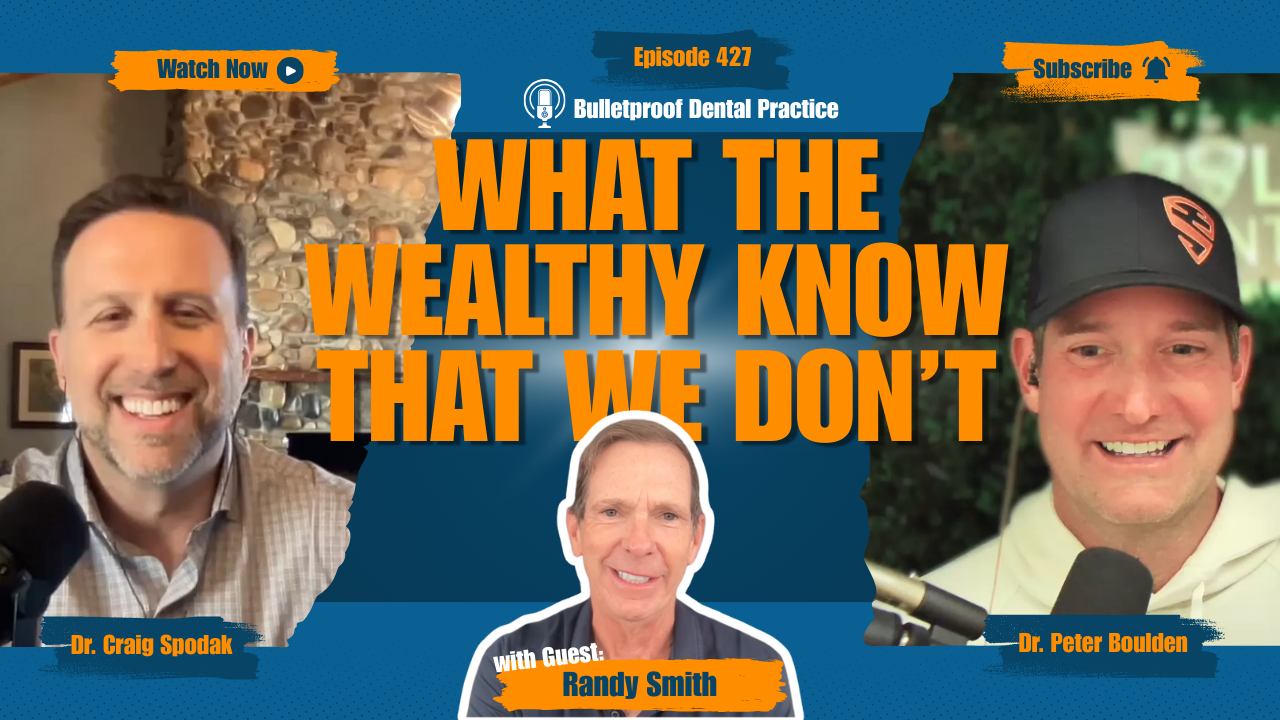
















1+1=3 The Power Of Alignment and Delegation For You and Your OM with Erika Pusillo
, October 31, 2024








, June 15, 2023
, June 8, 2023
, May 31, 2023
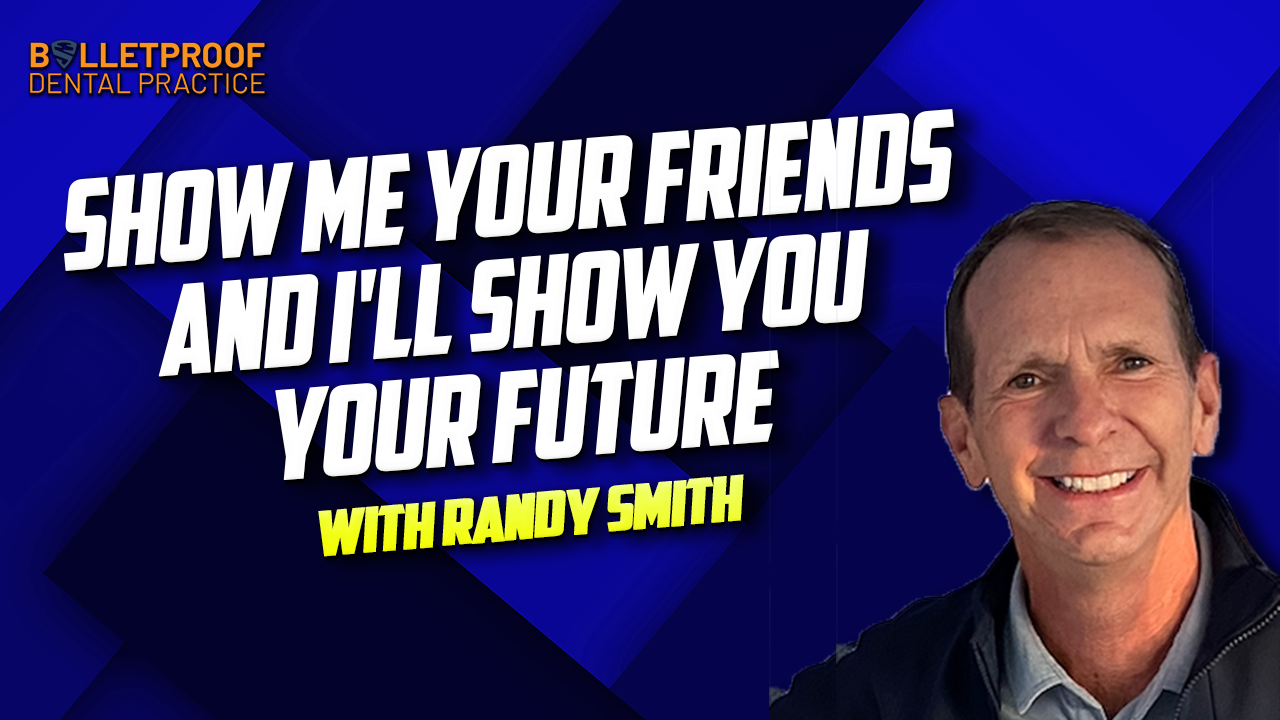




Look at These 3 Stats if You’re Thinking of Going Out of Network with Teresa Duncan
, January 11, 2023
, December 28, 2022
Knowing What You Don’t Want with Judy Kay Mausolf of Culture Camp and Erika Pusillo
, November 30, 2022


Cabo This Week, Immersion Learning, Biggest Breakthroughs, Your Personal KPI is Net Worth
, November 2, 2022
, October 19, 2022





Business is not Productivity, Productivity is not Profitability with Chris Salierno
, September 22, 2021







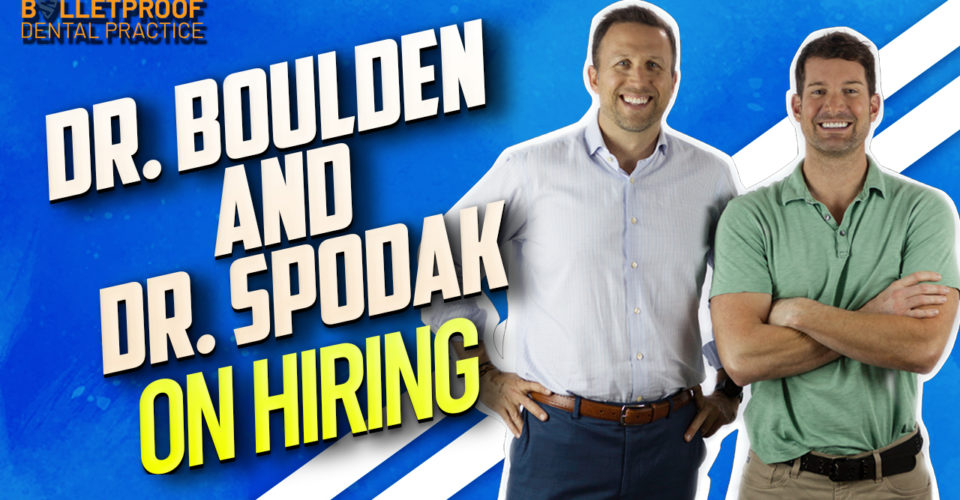


3 Biggest Bottlenecks of an Entrepreneurial Dentist: PART 2 with Perrin DesPortes of TUSK Partners