What’s My Dental Practice Worth? The Valuation Multiples Nobody Explains Honestly
Ask ten dentists what their practice is worth and you’ll get ten fantasies. “My buddy sold for 3x collections.” “A DSO offered me 8x EBITDA.” “My CPA said it’s worth a year of revenue.” Almost all of it is wrong — and the gap between the number in your head and the number a buyer will actually wire you is where dentists get ambushed at the finish line of a 30-year career.
Here’s the truth nobody frames cleanly: your practice is not worth a multiple of what you produce. It’s worth a multiple of what’s left after everyone gets paid — including a dentist to replace you. Get that one distinction right and you’ll negotiate from strength. Get it wrong and you’ll leave six or seven figures on the table.
What Actually Determines a Dental Practice’s Value?
There are two languages of valuation, and you need to speak both.
1. Percentage of collections (the small-practice language). Traditional GP practices selling to another dentist typically trade around 60%–80% of annual collections. A practice collecting $1M might appraise near $650K–$750K. This is the number bank lenders and practice brokers reach for on solo-to-solo deals. It’s a rule of thumb — fast, dirty, and increasingly outdated for anything with real profit.
2. Multiple of EBITDA (the buyer-with-capital language). This is the language DSOs, private equity, and sophisticated buyers speak — and it’s the one that can pay you dramatically more. As our team laid out in a Bulletproof valuation framework, dental practices commonly trade at 5x–7x adjusted EBITDA, with larger, cleaner, faster-growing practices pushing the top of that range and beyond.
The catch — and it’s the catch that trips up almost everyone — is the word adjusted.
What Is EBITDA and Why Does “Adjusted” Change Everything?
EBITDA is Earnings Before Interest, Taxes, Depreciation and Amortization — roughly, your true operating profit. But a buyer doesn’t value the profit you take home as an owner-operator. They value the profit that remains after paying a dentist market rate to do your clinical work. That deduction — usually 25%–35% of the production you personally generate — is the single biggest number owners forget.
Run the math honestly:
- Practice collects $1.5M
- You personally produce $900K of it; a replacement associate would cost ~30% = $270K
- After that adjustment and normalized overhead, adjusted EBITDA lands at, say, $450K
- At a 6x multiple, enterprise value ≈ $2.7M
That same practice valued at 70% of collections? About $1.05M. Same practice. Same chairs. A $1.6M difference — purely based on which buyer you’re built to attract and whether your numbers survive scrutiny. That’s not a rounding error. That’s a house, a college fund, and a decade of freedom.
How Do You Calculate Equity Value When You Still Owe Debt?
This is where dentists panic unnecessarily. Debt does not disqualify you from a great sale — it just gets subtracted at the end. The clean sequence:
- Adjusted EBITDA = operating profit + your debt-service payments added back (debt payments aren’t operating costs)
- Enterprise Value = Adjusted EBITDA × your multiple (5x–7x)
- Equity Value = Enterprise Value − Total Debt + Cash
Worked example straight from our framework: $600K adjusted EBITDA × 6 = $3.6M enterprise value. Subtract $800K debt, add $50K cash = $2.85M in equity. The enterprise is worth $3.6M; the part you own is worth $2.85M. Buyers purchase equity, not enterprise. Know the difference before you sit at the table.
Why Do DSOs Pay More — and What’s the Catch?
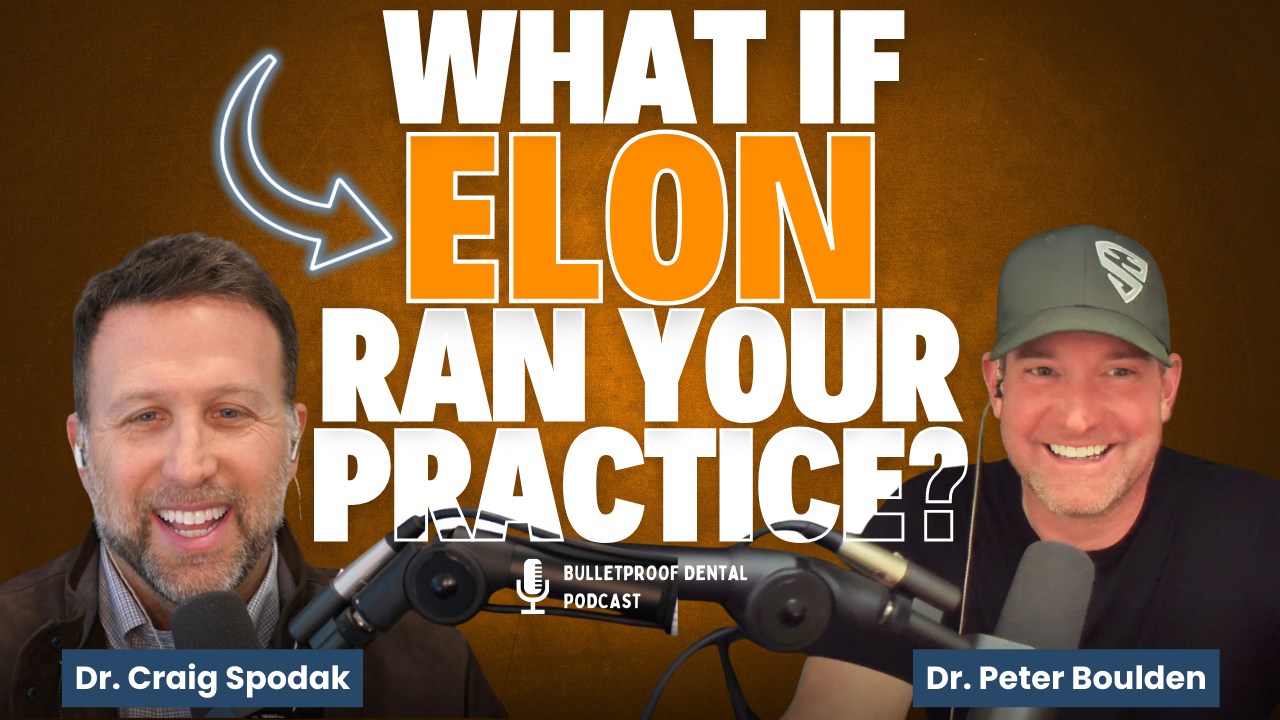
On a recent Bulletproof Dental Practice Podcast conversation, the guys got into exactly how the big money works. As Craig Spodak put it, the large groups aren’t just buying your profit — they’re buying multiple expansion. A DSO acquires your practice at, say, 6x, folds it into a portfolio, and resells the whole platform years later at 12x–13x. “It averages out to be like an 8 or 9,” one guest noted, describing the second bite of the apple the platform captures — often on your practice.
That’s the catch Pete Boulden hammers on: the headline multiple is real, but so is the leash. Craig’s warning from that same episode is one every seller should tattoo on their forearm — “when most practices get acquired, long-term they don’t do well because the dentist that wants to sell is the guy who wants to pull the golden parachute and exit. There’s no transition strategy in place, and they don’t typically survive long-term.”
Translation: the highest number on the term sheet is not the same as the best outcome for your team, your patients, or your legacy.
What’s the Move That Actually Raises Your Number?
You don’t raise your valuation the month you sell. You raise it over the 24–36 months before, by attacking the levers buyers actually price:
- Profitability over production. A high-collections, low-margin practice is worth less than a leaner one. Overhead discipline directly multiplies at 6x.
- Reduce owner dependence. If the practice collapses without you, you’re selling a job, not an asset. Systems, an associate, and a strong team turn “your income” into “transferable cash flow.”
- Clean books. Buyers discount messy financials aggressively. Every add-back you can’t document is money you don’t get.
- Growth trajectory. A practice up 15% year over year commands the top of the range. A flat one gets the bottom.
Craig floated the most underrated option of all on that episode: instead of the DSO parachute, bring in an associate, sell them equity over time, take deferred equity yourself, and preserve the legacy while still getting paid. “There’s three currencies,” he said — “time, emotion, and finances. And you’re going to pay with all of them.” The DSO check maximizes one and can quietly bankrupt the other two.
So — What’s Your Practice Really Worth?
Here’s the honest answer: your practice is worth whatever your adjusted EBITDA × the right buyer’s multiple comes to, minus your debt. Not what you produce. Not what your buddy got. Not what feels fair after all those years. The market pays for transferable, defensible, growing profit — and it pays a premium to the dentist who engineered the practice to run without them.
The dentists who get the number that changes their family’s life aren’t lucky. They’re prepared. They knew their EBITDA cold three years out, they built a practice that doesn’t need them, and they walked in knowing exactly which language each buyer speaks.
You don’t have to figure this out alone in a lonely profession where nobody talks real numbers. That’s the entire point of what we’ve built. Start with the Bulletproof Dental Practice Podcast, where Pete and Craig break down the money most dentists never hear discussed. Come sit in the room at the Bulletproof Summit with owners who’ve been through the exit. And when you’re ready to build a practice that’s actually worth what you dreamed — with peers who’ll tell you the truth — the Bulletproof Mastermind is your tribe.
The 1% of dentists, who want 100% from life.
Blog




































1+1=3 The Power Of Alignment and Delegation For You and Your OM with Erika Pusillo
, October 31, 2024


























, June 15, 2023

, June 8, 2023

, May 31, 2023













Look at These 3 Stats if You’re Thinking of Going Out of Network with Teresa Duncan
, January 11, 2023


, December 28, 2022



Knowing What You Don’t Want with Judy Kay Mausolf of Culture Camp and Erika Pusillo
, November 30, 2022




Cabo This Week, Immersion Learning, Biggest Breakthroughs, Your Personal KPI is Net Worth
, November 2, 2022

, October 19, 2022
























Business is not Productivity, Productivity is not Profitability with Chris Salierno
, September 22, 2021













































3 Biggest Bottlenecks of an Entrepreneurial Dentist: PART 2 with Perrin DesPortes of TUSK Partners