Selling to a DSO vs Private Buyer: The Money Comparison Nobody Shows You
There is a number that will land in your inbox one day. A DSO or a private-equity-backed group will send an LOI, and the multiple attached to it will be big enough to make your hands shake. Before you sign, understand this: the headline number and the money that actually reaches your bank account are two very different things. The dentists who get hurt in a sale are almost never the ones who negotiated a bad price. They’re the ones who never understood how the deal was structured.
On the Bulletproof Dental Practice Podcast, Pete Boulden and Craig Spodak have sat on both sides of this table. Craig signed an LOI to sell and walked away from it at the last minute. Pete has said publicly he regrets not naming a number when a DSO told them to. This is not theory for them. So let’s do what nobody selling you a transition does: compare a DSO exit and a private-buyer exit by the money that ends up in your pocket — and the life that comes with it.
How is a DSO offer structured versus a private buyer?
A private-practice buyer — usually another dentist or an associate buying in — typically pays you a valuation based on a multiple of earnings or a percentage of collections, financed by an SBA or conventional loan. It’s largely cash at close. You hand over the keys, the note gets funded, you’re done. The multiple is lower, but the money is real and it’s yours.
A DSO or PE-backed group is playing a completely different game. The eye-popping multiple you see is rarely all cash. It’s a stack:
- Cash at close — often 60–80% of the enterprise value.
- Rollover equity — a chunk of your proceeds converted into shares of the parent company, betting on their next “recapitalization.” This is where the fairy-tale returns are promised and where the risk lives.
- Earnout / holdback — money contingent on you hitting production targets for years after you’ve sold.
Here’s the tactical trap Pete hammers on: the multiple is applied to your adjusted EBITDA, not your collections. If your practice runs on your own hands producing 50–60% of the revenue, the buyer “normalizes” your dentist compensation to a market associate wage before they calculate EBITDA. That single adjustment can gut the number. In one podcast conversation, a guest described spending three years deliberately dialing his own production down from 50–60% of the practice just to make the practice sellable at a real multiple. Read that again. He had to make himself less valuable to the chair to make the business more valuable to a buyer.
Which one actually puts more money in your pocket?
Run the honest math, not the brochure math:
- The DSO multiple is higher on paper — but a big slice is rollover equity you cannot touch and may never fully realize if the parent company’s next sale underperforms or never happens.
- You keep working. Most DSO deals require a 3–5 year employment commitment at a reduced, capped compensation. You sold the upside and kept the alarm clock.
- The cash-at-close from a strong private sale can rival the guaranteed portion of a DSO deal once you strip out the contingent equity and earnouts.
- Taxes and fees. Deal structure changes your tax treatment dramatically. The “number” is pre-tax and pre-advisor-fees.
Craig put the emotional side of it bluntly on the show. He said a DSO once told him and Pete to “name your number,” and even at a hypothetical 25x EBITDA — a multiple everyone at the table agreed was impossible — he’d still say no. Because when he sat with the decision, being 85–90% sure he was going to do it, it “felt like an existential thing, like a death.” He built the organization. He loves what he built. No multiple made that feeling go away.
And then there’s the line every seller needs tattooed on their forearm. Pete and Craig talk about this constantly: when you sell your business, you’re going to take that money and go right back into business — just not your own. The dentist who sells to escape rarely finds freedom on the other side. They find a capped role in someone else’s machine, or they swing the pendulum so hard they wind up equally unhappy for a brand-new reason.
When does selling to a DSO actually make sense?
We are not anti-selling. There is a buyer for nearly every practice, and Craig says exactly that — there’s a solution for just about every type of practice out there. A DSO exit can be the right move when:
- You are genuinely done, near retirement, and want maximum de-risked cash without a multi-year runway.
- Your practice is large enough that even the “normalized” EBITDA supports a serious number.
- You have no associate or family successor and no appetite to groom one.
- You’ve done the emotional work and know you won’t feel the “death” Craig described.
It makes far less sense when you’re selling out of burnout, exhaustion, or fear — because those are operational problems disguised as an exit decision. Pete’s tactical read: fix the practice that’s making you want to run, and you’ll either fall back in love with owning it or sell it later from a position of strength for a bigger, cleaner number.
What’s the real cost of consolidation?
Here’s the part the LOI doesn’t mention. When private equity buys in, the dentist purity of the thing gets removed — the group now answers to a short-term financial objective, not to your patients or your team. Same-store performance, the actual health of each individual office, is exactly what gets neglected when a company owns hundreds of locations. You didn’t build your practice to become a line item in someone’s leverage ratio.
That’s the whole reason Bulletproof exists. Dentistry does not have to go the way of medicine. But it will, one tired owner at a time, if the best independents keep selling to consolidators because nobody showed them a third option: build a practice so strong, so systematized, and so profitable that you hold all the leverage — whether you sell one day or never do.
You don’t have to make this decision alone
The loneliest moment in a dentist’s career is staring at an LOI with nobody in their corner who has actually done it. That’s the gap the Bulletproof tribe fills. At Bulletproof Summit, you’ll sit in a room with owners who have signed these deals, walked away from these deals, and built practices worth walking away from. Inside the Bulletproof Mastermind, you get the peer group and the frameworks to make your practice bulletproof before the offer ever arrives — so you decide from strength, not exhaustion.
Don’t let the biggest financial decision of your life get made by a stranger with a spreadsheet. Come find your people.
The 1% of dentists, who want 100% from life.
Blog
























1+1=3 The Power Of Alignment and Delegation For You and Your OM with Erika Pusillo
, October 31, 2024




















, June 15, 2023

, June 8, 2023
, May 31, 2023










Look at These 3 Stats if You’re Thinking of Going Out of Network with Teresa Duncan
, January 11, 2023

, December 28, 2022

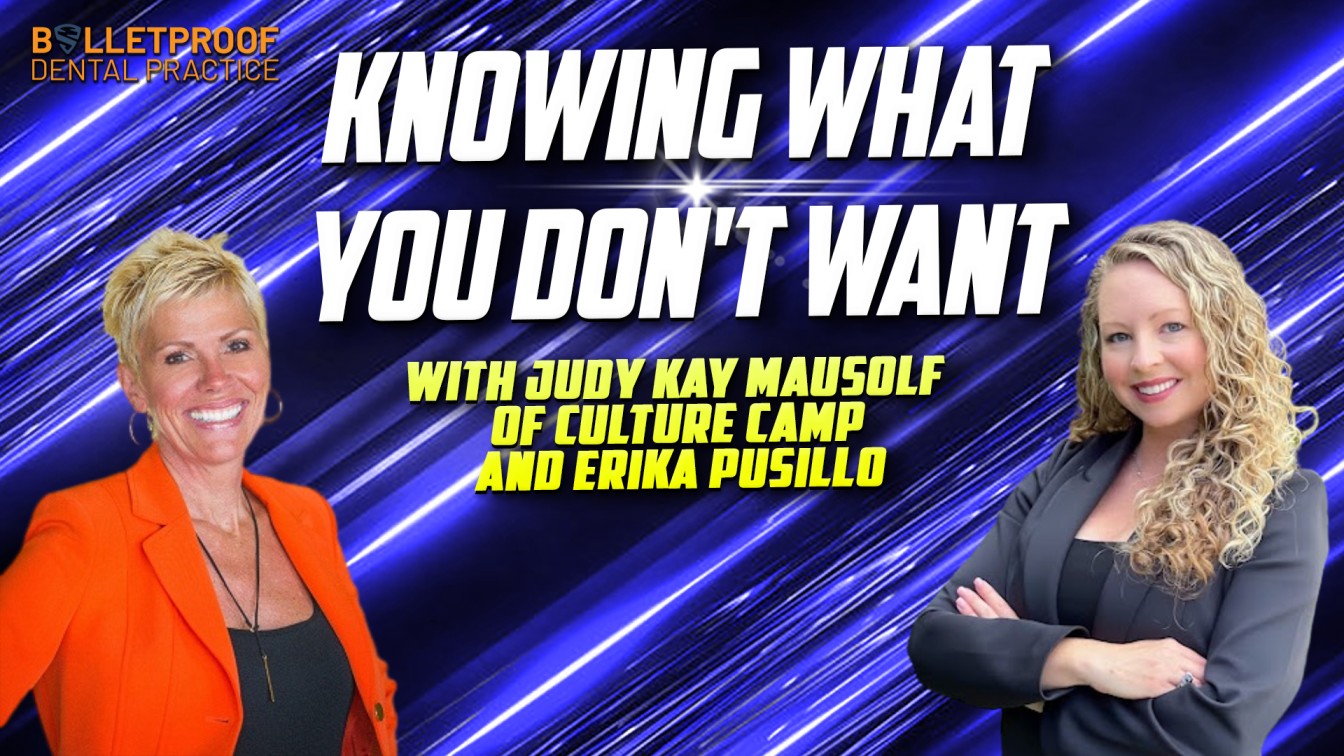
Knowing What You Don’t Want with Judy Kay Mausolf of Culture Camp and Erika Pusillo
, November 30, 2022



Cabo This Week, Immersion Learning, Biggest Breakthroughs, Your Personal KPI is Net Worth
, November 2, 2022
, October 19, 2022







Business is not Productivity, Productivity is not Profitability with Chris Salierno
, September 22, 2021






















3 Biggest Bottlenecks of an Entrepreneurial Dentist: PART 2 with Perrin DesPortes of TUSK Partners