How to Drop Dental Insurance Without Torching Your Schedule
Nobody has ever walked out of your practice and said, “Thank you for being in network. I really appreciate the 40% you just wrote off.” Craig Spodak said that on the Bulletproof Dental Practice Podcast, and it lands like a punch because it is true. You are the only party in the room grateful for the discount, and you are the one giving it. Dropping a PPO is the single most misunderstood, most feared, and most quietly profitable decision an independent owner can make. Here is how to do it without torching your schedule.
What does “dropping dental insurance” actually mean?
Let’s kill the confusion first. Going out-of-network does not mean you stop treating insured patients. It means you stop signing a contract that forces you to accept a discounted fee schedule. Your patients keep their insurance. They still get reimbursed — often at a comparable dollar amount — but the reimbursement flows to them, and you collect your full fee. You are firing the middleman, not the patient.
Every PPO contract is a trade: you hand over 30–45% off your fee in exchange for the insurer “steering” patients to you. The question is whether you still need that steering. If your phone rings because of your reputation, your reviews, and your marketing — not because you’re a name on an insurance list — then you are paying a massive tax for a service you no longer use.
How do you know if you’re actually ready to go out-of-network?
This is where discipline beats emotion. Do not drop a plan because you’re angry. Drop it because the math says the patients will stay. Pete Boulden runs multiple practices — three fee-for-service and one that still takes a PPO — and the reason he can straddle both models is that he made each decision with numbers, not feelings. Before you send a single termination letter, pull these:
- Plan-by-plan write-off report. Rank every PPO by total annual write-off dollars. The worst offender — the one costing you the most for the least patient volume — is your first drop, not your biggest plan.
- Patient concentration per plan. If one plan represents 35% of your active patients, that’s a different risk profile than a plan representing 4%. Start with the low-concentration, high-write-off plans. Low risk, immediate margin.
- Your true fee schedule. Most owners haven’t raised their UCR fees in years. You cannot go out-of-network on stale fees. Fix your fee schedule first (that’s a separate playbook).
- Your new-patient engine. If insurance steering is your only patient source, build marketing and reputation before you cut the cord. Out-of-network practices live or die on demand you generate yourself.
Why do lawyers and accountants tell you not to do it?
Because they don’t run a dental practice. On the podcast, when an owner mentioned that his lawyer warned him against dropping insurance, Pete cut straight through it: “Don’t get business advice from people who don’t run businesses.” Your attorney bills by the hour and is paid to see risk. Your accountant looks at last year’s collections and panics at the thought of change. Neither of them has ever sat in your chair, watched a PPO claw back half a crown fee, and then done it again 400 times a year.
Here’s the defiant truth: the people telling you to stay safe are almost never the people who’ve built anything. Expect resistance — from advisors, from staff, sometimes from your own gut at 2 a.m. That resistance is not evidence you’re wrong. It’s the toll you pay for going first.
What’s the smartest way to actually drop a plan?
You don’t rip off the band-aid. You do it surgically:
- Drop one plan at a time. Terminate your worst PPO, hold everything else steady, and measure attrition for 90–180 days. Real-world attrition is almost always lower than the fear in your head. Learn from the first drop before you touch the second.
- Consider the hybrid model. Craig runs a version of this: the general side may stay on a PPO while the specialists — oral surgery, perio, higher-value procedures — stay entirely out-of-network. As he puts it, out-of-network you charge your real fee; in-network you’re charging $700 for the $1,000 procedure “as a courtesy.” Segment where the write-offs hurt most and protect those first.
- Give patients a runway and a reason. Send letters 60–90 days out. Explain that nothing about their care changes, that you’ll still file their claims, and that they’ll still receive out-of-network benefits. Train the front desk to say it with confidence, not apology.
- Offer an in-house membership plan. For the truly uninsured or the price-sensitive, a membership plan captures the patients who might otherwise leave — at margins a PPO could never touch.
What does this really cost you — and what does it give back?
The write-off is the quiet killer of independent dentistry. A 40% haircut on a book of business isn’t a discount — it’s a business partner you never agreed to take on, one who does zero work and collects a fortune. Recovering even a fraction of that write-off can move your net income more than a full year of chasing new patients. That is why this is a margin decision before it’s a marketing decision.
But the real payoff isn’t only financial. It’s autonomy. When you’re out-of-network, you decide your fees, your schedule, your pace, your standard of care. You stop practicing to a reimbursement grid and start practicing to your own excellence. Clinical quality is the floor. The life you build above it is the point.
Who should you have in your corner before you pull the trigger?
Not your lawyer. Owners who’ve already done it. This is exactly the profession’s loneliness problem in miniature — you’re staring down a decision that terrifies you, and everyone in your normal orbit tells you to stay safe. The dentists who go out-of-network successfully almost always have one thing in common: a room full of peers who’ve walked the same fire and come out with fatter margins and their sanity intact.
That room exists. It’s the Bulletproof Mastermind — owners who’ve dropped plans, raised fees, and rebuilt their practices around freedom instead of contracts. It’s the stage at the Bulletproof Summit, where these numbers get shared in the open. And it starts with the podcast, where Pete and Craig say the quiet part out loud every week.
You are not alone, and you never have to make this call in the dark. Dropping insurance isn’t reckless. Doing it without a tribe is. Come find yours.
The 1% of dentists, who want 100% from life.
Blog
























1+1=3 The Power Of Alignment and Delegation For You and Your OM with Erika Pusillo
, October 31, 2024

















, June 15, 2023

, June 8, 2023

, May 31, 2023









Look at These 3 Stats if You’re Thinking of Going Out of Network with Teresa Duncan
, January 11, 2023
, December 28, 2022
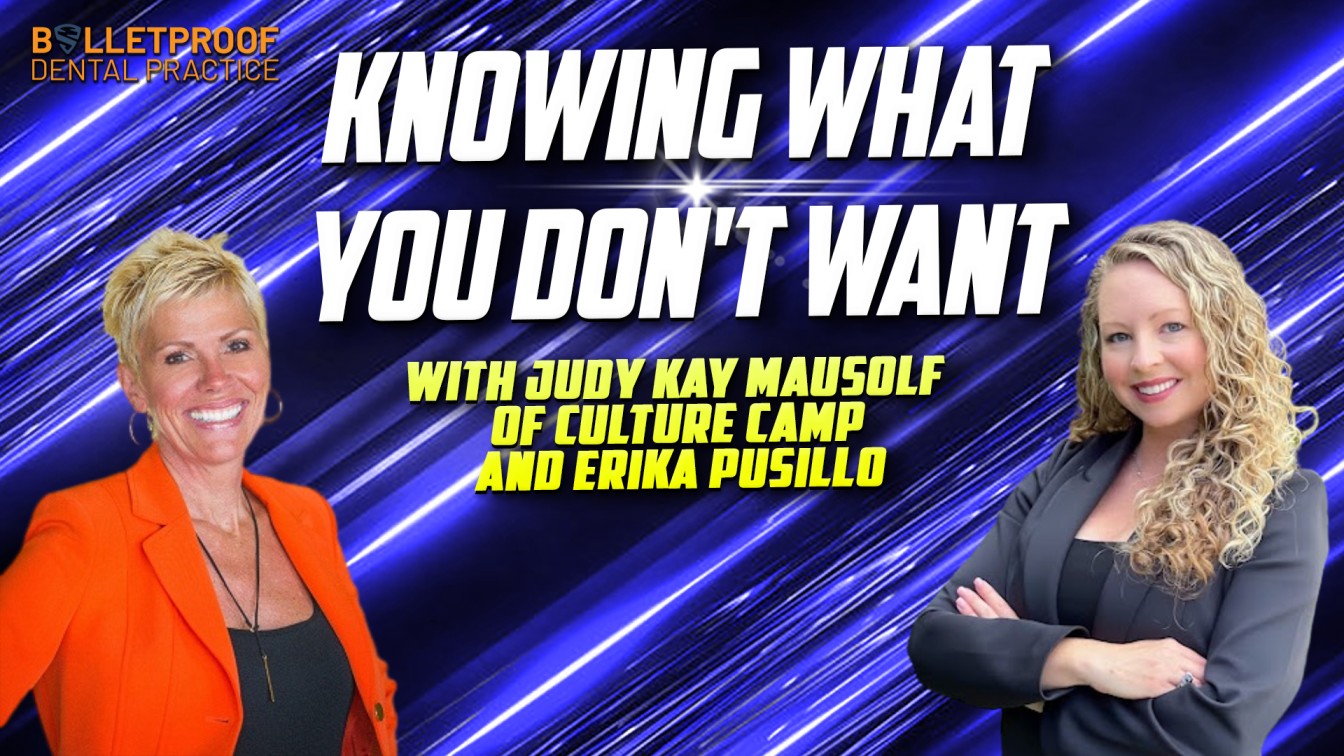
Knowing What You Don’t Want with Judy Kay Mausolf of Culture Camp and Erika Pusillo
, November 30, 2022


Cabo This Week, Immersion Learning, Biggest Breakthroughs, Your Personal KPI is Net Worth
, November 2, 2022
, October 19, 2022






Business is not Productivity, Productivity is not Profitability with Chris Salierno
, September 22, 2021














3 Biggest Bottlenecks of an Entrepreneurial Dentist: PART 2 with Perrin DesPortes of TUSK Partners