How to Set Your Dental Fee Schedule (and Actually Raise Your Fees)
Your fee schedule is the single most powerful profit lever in your practice — and most dentists set it by accident. They copy the office down the block, take whatever the PPO hands them, and then wonder why they work six figures of production a year and take home a fraction of it. On the Bulletproof Dental Practice Podcast, Pete Boulden and Craig Spodak have hammered this point for years: when you let an insurance company set your fees, you have handed a stranger the keys to your income. This is how you take them back.
What is a dental fee schedule, really?
Your fee schedule is the list of prices you charge for every procedure code you perform. Simple on paper. But here’s the trap Pete describes bluntly: “Insurance companies commoditize the dentist. That means they set your fee schedule, set your reimbursement, and they treat you no different from the guy down the block.”
Every time you sign a PPO contract, you agree to a discount off your full fee — often 20%, 30%, sometimes 40%. And as Pete puts it, “the average patient spends $2,000 or $3,000 with you. That means every year forever you’re paying for that patient.” That write-off isn’t a one-time cost. It compounds across every patient, every procedure, every year you stay contracted. Set the schedule wrong and you are volunteering to be a discount vendor for the rest of your career.
How do you actually set your full fee schedule?
Start from data, not from what feels comfortable. Here’s the Bulletproof framework:
- Anchor to real market data. Services like Fair Health (a nonprofit that aggregates real claims data by ZIP code) show you the actual usual, customary and reasonable (UCR) range for your geography. As Dave Monahan noted on the show, in-house plan platforms pull directly from Fair Health to price procedures honestly. Know where you sit — the 50th, 70th, or 90th percentile — instead of guessing.
- Set your full fee at the top of the reasonable range, not the middle. Your full fee is your negotiating floor with every PPO. Set it low and you cap your reimbursement forever. Set it high (but defensible) and every future contract negotiation starts from a stronger number.
- Understand the discount stack. Teresa Duncan warned Bulletproof listeners about the costs beyond the obvious PPO write-off — the disallows, the appeals you lose, the patient arguments you eat. Those “adjustments over and above your fee-schedule difference” are pure lost revenue that never shows up in a simple contract comparison.
- Raise fees on a schedule, not on your nerve. The number one reason dentists don’t raise fees is fear. Craig’s response on air: “Don’t be so scared.” Review fees annually, minimum. Build it into your calendar so it’s a system, not a gut-wrenching decision.
How often should you raise your dental fees?
At least once a year. This is non-negotiable in a Bulletproof practice. When money supply expanded by 35% in ten months during the post-COVID cycle — a number Craig walked through live on the podcast — every dentist holding fees flat was quietly taking a massive real-dollar pay cut. Inflation doesn’t ask permission. If your fees aren’t moving up annually, they’re moving down in real terms.
The tactical move: raise fees in small, consistent increments patients barely notice, rather than one giant jump every five years that triggers sticker shock. And here’s the part nobody tells you — patients overestimate dental costs anyway. Dave Monahan’s consumer research found people overestimate procedure prices by 200 to 500%. The fear of your fee is almost always bigger in their head than the actual number.
Should you raise fees or drop the insurance instead?
Sometimes the right fee-schedule move is to stop letting a carrier set it at all. Pete tells the story of a colleague with a 76% case acceptance rate: “I said, you know what, doc, I don’t think you need to sign up on plans. Patients are loving you. You can’t help yourself but make them happy.” When your clinical excellence and patient relationships are that strong, PPO contracts are a tax on your own success.
Dr. David Eshom — 100% fee-for-service since 1992, doing $3.2M in production — put the math plainly: a case that runs $7,500 at his office is “less than five” at an in-network practice. He’s not bound to UCR caps. That’s not a lie; it’s the true cost of the discount you never see on the contract. If you’re not ready to go fully out-of-network, an in-house membership plan is the bridge — you set your own fee schedule and payment terms, and roughly 20-30% of most practices’ patients are already fee-for-service without any dental plan. That’s your low-hanging fruit.
What’s the real cost of getting your fee schedule wrong?
Craig frames the deeper truth better than any spreadsheet: money is a good goal, but it can’t be the only goal — and too many owners “don’t make what they think because they don’t pay themselves.” An underset fee schedule doesn’t just shrink your margin. It shrinks your ability to pay your team well, invest in technology, and build the practice — and the life — you actually want. This is the emotional core of the Bulletproof mission: dentistry should not be a treadmill where you run harder every year and keep less. Your fee schedule is where you decide whether you’re a commodity or a craftsman.
Your next move
Pull your fee schedule this week. Compare it against Fair Health data for your ZIP. Find every code sitting below the 70th percentile and fix it. Then put an annual fee review on the calendar so this never drifts again.
And don’t do it alone. The dentists who crack fee strategy, insurance independence, and true ownership economics aren’t figuring it out in isolation — they’re doing it inside a tribe of growth-minded owners who share exactly what works. That’s what the Bulletproof Summit and the Bulletproof Mastermind are built for. Come find your people, take back control of your numbers, and build a practice that pays you what you’re worth.
The 1% of dentists, who want 100% from life.
Blog





























1+1=3 The Power Of Alignment and Delegation For You and Your OM with Erika Pusillo
, October 31, 2024





















, June 15, 2023

, June 8, 2023

, May 31, 2023











Look at These 3 Stats if You’re Thinking of Going Out of Network with Teresa Duncan
, January 11, 2023

, December 28, 2022


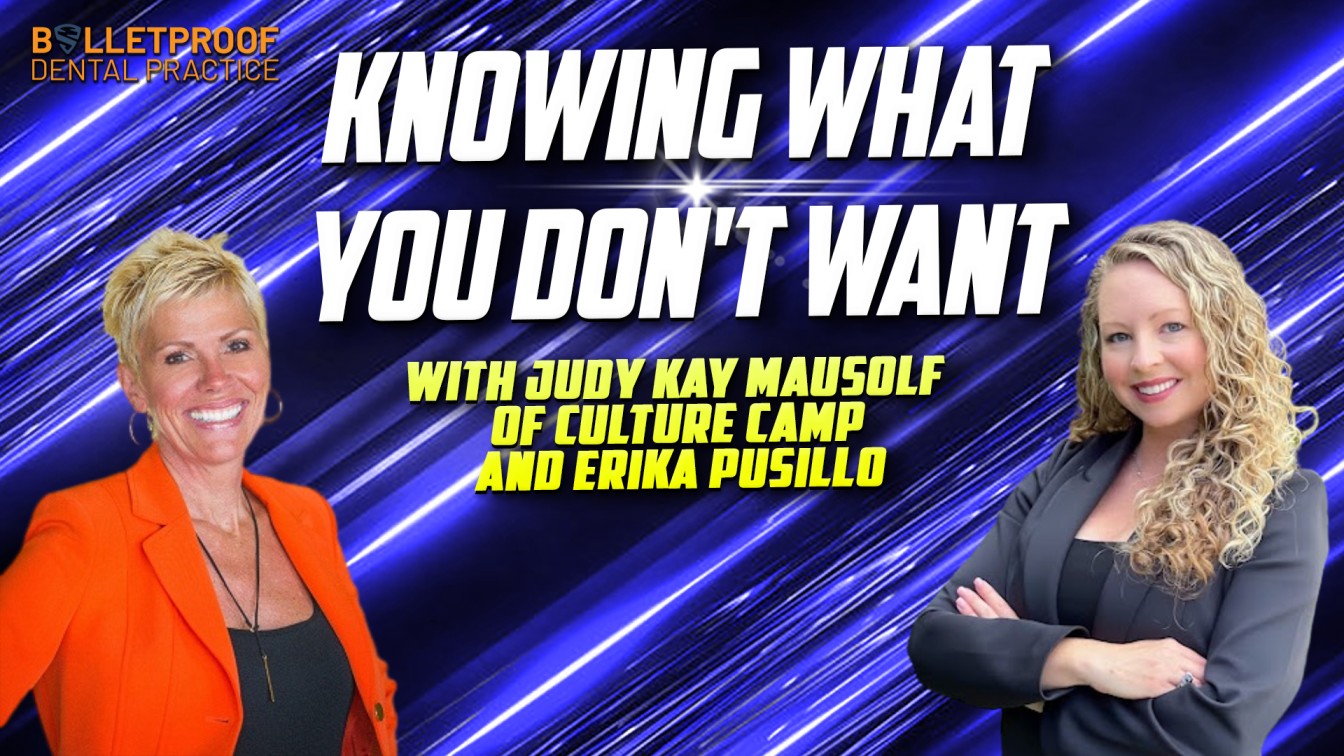
Knowing What You Don’t Want with Judy Kay Mausolf of Culture Camp and Erika Pusillo
, November 30, 2022



Cabo This Week, Immersion Learning, Biggest Breakthroughs, Your Personal KPI is Net Worth
, November 2, 2022
, October 19, 2022

















Business is not Productivity, Productivity is not Profitability with Chris Salierno
, September 22, 2021
































3 Biggest Bottlenecks of an Entrepreneurial Dentist: PART 2 with Perrin DesPortes of TUSK Partners