ASSOCIATES: WHEN? WHO? HOW? AND MORE – PART 2

Join our network at www.Bulletproof.Dental to stay in the know on all things Bulletproof!

Bulletproof Dental Practice Podcast Episode 231

Hosts: Dr. Peter Boulden & Dr. Craig Spodak

Key Takeaways:
Introduction
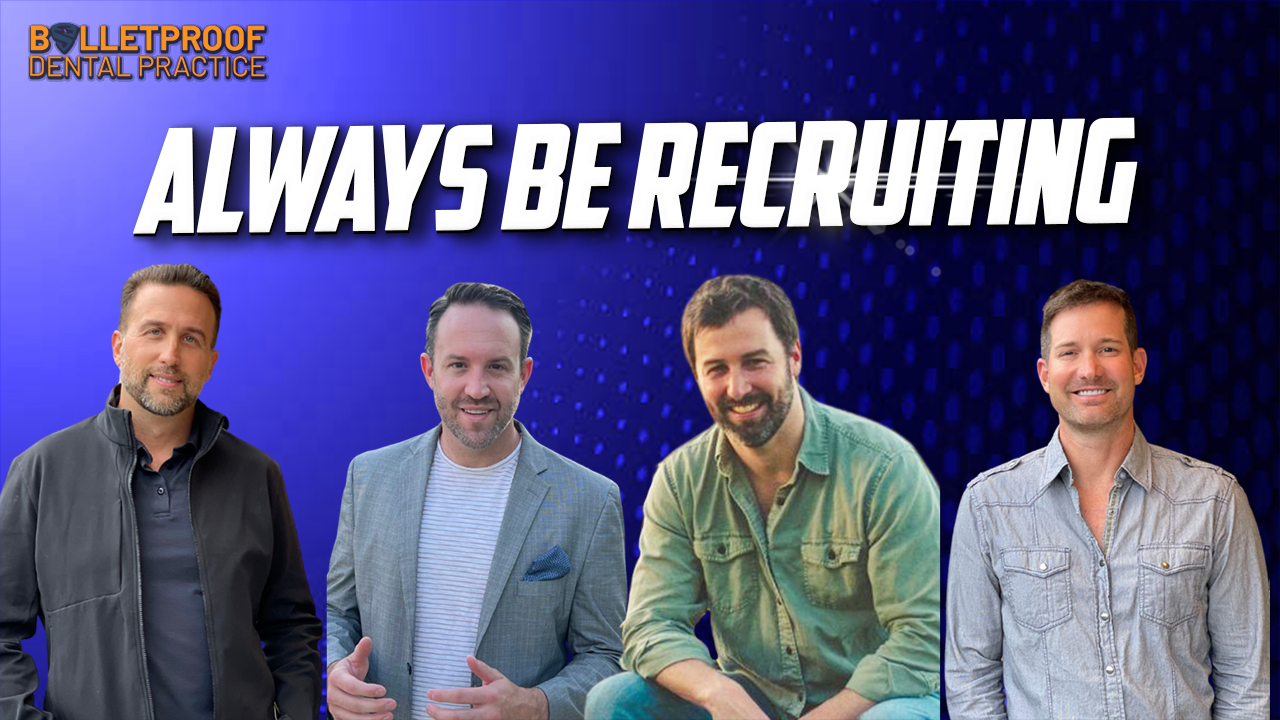
ABR: Always Be Recruiting
Outputs Are Equals To Inputs
Creative Advertising
Training Process

References:

Bulletproof Summit 2022

Mighty Networks: Bulletproof Dental Practice

Who: The A Method for Hiring

Careers Atlanta Dental Spa

Tweetables:

Culture [is the] most iconic advertisement you could make. Dr. Craig Spodak

Consistently appreciate what you have. Dr. Craig Spodak

A great associate should lead to a potential partner. Dr. Peter Boulden


Full Episode Transcript

Below is the complete transcript of this episode of the Bulletproof Dental Practice podcast. Prefer to listen? Find us on Apple Podcasts, Spotify, and YouTube.

Read the full transcript

The following transcription was from the Bulletproof Youtube channel. Here is the https://www.youtube.com/watch?v=cnG2_nEBeOk

The following transcription was from the Bulletproof Youtube channel. Here is the https://www.youtube.com/watch?v=uwkauKc3QCY

Peter Boulden
0:00:00
Hey everybody, welcome back to another episode of Bulletproof Dental Practice Podcast. Craig, you're yawning in my intro.

Craig Spodak
0:00:23
I'm your host, Craig Spodek, and I've got my co-host, Dr. Peter Bouldin, today.

Peter Boulden
0:00:27
But you're yawning in my intro, brother.

Craig Spodak
0:00:29
Sorry, bro, I was stretching. I was stretching, I got a big nitro here. You ever drink these things, Peter?

Peter Boulden
0:00:34
No.

Craig Spodak
0:00:35
Ooh, boy, those are good, bro.

Peter Boulden
0:00:38
Lots, the cold brew.

Craig Spodak
0:00:39
It's nitro.

Craig Spodak
0:00:40
I don't know what that is, but it sounds good. Yeah, it sounds fast. Sounds like you'd go really fast.

Peter Boulden
0:00:46
Yeah, I'm ready to go fast. Remember when you had nitrous in your Trans Am

Peter Boulden
0:00:53
in high school?

Craig Spodak
0:00:55
I did not.

Craig Spodak
0:00:56
You must be getting me confused with your Italian friend from New Jersey. I didn't have a Trans Am. I wanted a Trans Am.

Peter Boulden
0:01:02
Did you really?

Craig Spodak
0:01:03
I wanted a Mustang 5.0, man.

Craig Spodak
0:01:05
I like those Mustangs.

Craig Spodak
0:01:06
We could talk about cars for a long time.

Peter Boulden
0:01:08
But that's not what we're talking about today.

Craig Spodak
0:01:09
We're talking about something more relevant. I remember when I met you, though, and you had a little sports car

Peter Boulden
0:01:12
you had to like peel yourself into. And I was like, what are you doing? You look like Big Bird driving that thing.

Craig Spodak
0:01:20
And then that same week I was in that car, I went to go to a continuous education event. I went to a hotel in Fort Lauderdale. I don't know if I told you the story, but the valets, I got out of my little Porsche, and the valet started laughing. And I'm like, what's so funny? He's like, no sir, I'm so sorry. I'm like, well just tell me. I'm going into a meeting and do I have a tomato on my face or something? He's like, no, no, no. Yeah, I was like, what do I have? Just tell me, I'm not upset. He's like, no, I just didn't expect someone like your height to get out of that little car. I'm like, god damn, I'm selling this thing right now.

Peter Boulden
0:01:52
That's the other time you met me and then it was like, now you're only truck, truck only.

Craig Spodak
0:01:57
Truck only.

Peter Boulden
0:01:58
Well, we're not here to talk about sports cars and trucks. What I've been getting a lot, Craig, from people, and I think we get this a lot in Mastermind and our mining networks a lot, is talking about associates. And here are the concepts around them. When do I hire my first?

Craig Spodak
0:02:15
When's the right time?

Peter Boulden
0:02:16
How do I train them?

Craig Spodak
0:02:17
How do I find them?

Peter Boulden
0:02:19
How do I retain them long-term? How do I make them happy? And there's a lot, and this potentially could be, as you and I kind of unwrapped even those four topics I just discussed, it could be a multi-pod. Because there's a lot to unwrap there. So, yeah, any opening kind of comments on that? Don't jump into the questions yet, but any comments on some of your intel or your dialogue that you have with dentists that are in that land of wanting an associate or maybe even associates wanting to find the right dentist? That's another bullet point. Yeah.

Craig Spodak
0:03:01
I think it's, we tend to, those in the industry tend to look at it a little bit siloed and not holistically because all associates and all practices are not the same. So I think one thing globally, I just think, no, it's not just a duh. I think it's if you're an associate and you have spent a good deal of time educating yourself and learning different types of procedures and going through courses like COIS or Dawson or Speer and stuff like that, by virtue of the way you're gonna practice, you need to find a practice that is in an affluent area, you need to partner with a practice that can actually source the patients that are eligible for the types of treatment you wish to provide. And I don't think that goes into consideration as much as it should. So an associate will be like, oh, I can get 38% at this practice. And then, you know, but the practice is in a rural area, maybe in a non-affluent area, and they get like five new patients per month, and the highest producing associate in that practice is doing 400 grand, versus I can get 30% and work in a metro area, and the doctors are doing $2 million in collections there. So I think there's a lot that goes into the fit between, because dentistry, for those that don't see it at our level and have the insight into the profession, we tend to think it's all the same. Like every practice is Atlanta Dental Spa or like Fort Bend Dental or whatever. They're all very different and I think that those that are not as into the industry as we are tend to oversimplify it.

Peter Boulden
0:04:54
That's all I have to say. You have good experience there with someone who actually left you thinking it would be greener pastures because they were looking at the traction of, oh, at the higher percent or it wasn't even a higher percent,

Peter Boulden
0:05:07
it was just.

Craig Spodak
0:05:08
It was a higher percentage. Okay. It was like three or four points higher.

Peter Boulden
0:05:12
And so that's what you're saying is that, look, all things are not just binary in terms of, oh, I get 35% here and 33% here. You have to look at the context of what you're being hired at, right? So look at the fee schedule, the amount of work available, all those things.

Craig Spodak
0:05:24
That is very important. Do you have a treatment coordinator?

Peter Boulden
0:05:26
Yeah, that is huge.

Craig Spodak
0:05:28
Because like, yeah, do you have two assistants? Do you have fiber optic hand pieces? Do you have the materials? Do you have a scanner? What's the Invisalign fee? So imagine a doctor shopping your product.

Peter Boulden
0:05:39
What's the new patient load like, right?

Craig Spodak
0:05:41
Right, but imagine.

Craig Spodak
0:05:42
What's the culture, what's the.

Craig Spodak
0:05:43
Imagine if they work in your practice, and yours or my practice, our Invisalign fee is $1,100. But at the practice down the road, it's $1,900. So what's your percentage of your 32 versus 35 versus 40% if your Invisalign lab bill is $1,100 to $2,000.

Craig Spodak
0:06:03
Right.

Peter Boulden
0:06:04
I mean, these are questions.

Craig Spodak
0:06:05
Same with fees too, correct?

Craig Spodak
0:06:06
All of it, yeah. Right. Your crown fee, $800.

Craig Spodak
0:06:09
Right, right, right.

Craig Spodak
0:06:10
So yeah, I'll pay you 45% but the crown fees are all insurance. It's all $900 or $800. You won't have a treatment coordinator. These are really, and I just, I see.

Peter Boulden
0:06:21
So we jumped into it as an associate looking for a practice, right? Meaning, we're looking at it from the associate side. I'm also wanting to address it from, and I think we can put a pin in that and maybe circle back to that. I'm also wanting to address it mainly from the dentist who is an owner looking to expand. Maybe let's talk about the solopreneur dentist who is looking to, who's become too busy, who has capacity to expand the practice, whether in their own, I'm sorry, with their own footprint, and they're either too busy or they'd like to expand. So when is the right time for you? Let's say you were in that scenario, let's rewind the clock on Craig Spodak. When did you know or feel it was the right time to hire? And probably, let's also pause here, Craig. You've probably hired, just so we have some chops to be able to talk about. Oh, jeez. Right?

Craig Spodak
0:07:18
So how many associates have you? Oh, my God.

Craig Spodak
0:07:20
Oh, my God.

Craig Spodak
0:07:21
I guess…

Peter Boulden
0:07:22
Well, it can't be too many or else that won't have been successful.

Craig Spodak
0:07:26
Well, no.

Craig Spodak
0:07:27
You got to kiss a lot of frogs and life changes. One got married. No, I mean, listen, I had two associates leave on the same month of the same year. One moved to Austin and one got married and moved to Chicago. So I mean that's just life happens too.

Peter Boulden
0:07:43
So probably what? More than 10?

Craig Spodak
0:07:48
Oh my God, are you kidding me?

Craig Spodak
0:07:50
Okay.

Craig Spodak
0:07:51
Oh my God, Peter.

Peter Boulden
0:07:52
I'm being bombastic on the Bulletproof Podcast.

Craig Spodak
0:07:55
Okay, so give me another number. Give me another number.

Peter Boulden
0:07:57
I just want to see how…

Craig Spodak
0:07:58
20, Craig? No, no, no.

Craig Spodak
0:08:00
I'm thinking 30, 40.

Craig Spodak
0:08:02
Jeez.

Craig Spodak
0:08:03
Hey, but I have a scientific approach, so I don't have to actually have experience hiring people because I figured out the math behind hiring people.

Craig Spodak
0:08:12
Okay.

Peter Boulden
0:08:13
All right.

Craig Spodak
0:08:14
Well, you know what? I'm kidding. I'm kidding with you.

Craig Spodak
0:08:17
That was a joke.

Craig Spodak
0:08:18
I was trying to be funny.

Peter Boulden
0:08:19
This is a group where you have me beat. I know you're kidding. I know you're…

Craig Spodak
0:08:31
Yeah, I'd say 20. 20 feels good. I'm just trying to do the mental math.

Peter Boulden
0:08:34
And we're in the neighborhood of all of hiring probably over our career, probably 35 plus associates. Let's just call it that.

Craig Spodak
0:08:40
Sure.

Peter Boulden
0:08:41
Yeah, let's call it that. So all that conversation was just to establish that we have the jobs to be able to… because jobs are a big thing.

Craig Spodak
0:08:51
For you they are, maybe for other people they're not.

Peter Boulden
0:08:54
They are for me, because like how do you do if you haven't done, how do you tell if you haven't done?

Craig Spodak
0:09:00
How, how?

Craig Spodak
0:09:02
Well, you can do it, you just do it.

Peter Boulden
0:09:04
I mean, I guess you can, I mean, look, the adage is like, well, Tiger Woods coach coaches him, and Tiger Woods coach never won the Masters.

Craig Spodak
0:09:12
Yeah, but he's coached several people to win the Masters. I get it, I know where you're going.

Peter Boulden
0:09:15
Let's move. I'm just saying, okay, move on, right?

Craig Spodak
0:09:17
Yep.

Peter Boulden
0:09:18
So Craig, of all those times, when did you decide, you know what, we need it, we need the first associate, and then we need another associate? What was your, was it a gut feeling, was it numbers-based, was it Erica coming to you

Craig Spodak
0:09:35
saying we needed more help, Doc, what was it so um let me just kind of describe how I work and it's similar to you Peter you know we're very similar people we are the types of people that we're not we value speed of execution and we don't mind making mistakes I had a very clear concise idea of what I wanted to accomplish so I was in dental school doodling like during lab about a multi-doctor practice. I was dreaming, daydreaming about it. It's what I really wanted.

Craig Spodak
0:10:10
And I wanted that.

Peter Boulden
0:10:10
Here comes the vision folks, here comes the vision.

Craig Spodak
0:10:11
I'm sorry, but it's true, it's true. So I had this whole thing, the center for this and that. I would like just kind of fantasize about what it would be because I love being around people. I love being around people. So a day for me being around three or four people is not as exciting as a day for me being around 20, 30, 40 people. So I hired the associate the minute I possibly could and the idea that I had was I was going to have this person be busy and I was not going to be busy. So I was going to take the work out of my schedule and give it to this person, which if you ask many people, that's a crazy thing to do. Most people would say, no, you got to wait until you're booked X numbers of days or weeks or this or that. I wanted to get to this vision. I wanted to get to this place in my head.

Peter Boulden
0:10:58
At your own self, your vision was so important that you were sacrificing the day to day

Craig Spodak
0:11:03
in order to achieve it. Right, I'm willing to make less money to get to where I wanna go than make more money and not be where I wanna go.

Peter Boulden
0:11:11
And that is honestly why I see so many associateships fail, is because the lead doc, the solopreneur, is not willing to give up some of those cherry cases, you know, the eight-unit and year case that just came in before. I'll take that. No, you're gonna do-

Craig Spodak
0:11:26
I'll take that one. I know that's your aunt, but I'll take it. You brought your own aunt into the practice.

Peter Boulden
0:11:30
Yeah, right?

Peter Boulden
0:11:31
You're gonna do composites, night guard adjustments, maybe some Invisalign, but you know, the heavy-duty crown and bridge, yeah, that's mine.

Craig Spodak
0:11:39
And so you can't- That's what I hear, by the way, when associates come in,

Craig Spodak
0:11:42
they'll ask the other doctors,

Craig Spodak
0:11:43
like, hey, does Dr. Craig like take some of the bigger cases for me? Like, they're like, never, never. That was like the big fear of one that was, you know, cause she had worked for some,

Craig Spodak
0:11:52
like iconic doctor.

Peter Boulden
0:11:53
All right, so yours is more,

Peter Boulden
0:11:54
yours was more of a, you wanted it to create a bigger ecosystem. Yeah. And you're willing to sacrifice to get there. Meaning sacrifice your own hand, your own dentistry with your own hands to get there.

Craig Spodak
0:12:09
Yes, I'm curious about you. When did you grab your, when did you decide it was your first associate?

Peter Boulden
0:12:14
So I contend, you know, and Marvin Berlin has been on our podcast a couple times, spoken on Mastermind. You know, he opened my eyes up to kind of when, and it was, I contend that if you're solidly booked out as a doctor between two to four weeks out, that you have the ability to bring on an associate. Now here's where I'm gonna throw in the caveat. A, you're gonna have to give a little bit of help, just like you talked about, Craig, kind of giving up some to help share some busyness so that that associate is not just getting the per diem in perpetuity that you're gonna have to hire them on. Right, you're gonna have to get them busy. You may have to give, you may have to triage, you may have to help, you have to set them up. Right. And that's fine.

Craig Spodak
0:12:58
Usually it's at a time when the doctor

Peter Boulden
0:12:59
doesn't wanna do restorative anymore or may not wanna do as much restorative. They wanna do some more implants and crown and bridge and stuff like that. So it's fine. But I think it's two to four weeks. Also, when you're that busy at two to four weeks and you're slam jam, your team has nowhere to put people, you miss a lot of at-bats. You miss a lot of opportunities from the same day dentistry thing. And that's where I'm talking about Marvin Berlini, he opened my eyes, he said, look, you may think you're not busy enough right now to bring on an associate, but I assure you, think about all the opportunities that could be harvested from hygiene if you only had the time. Also, think about the fact that you think you're so busy in your head and you get overwhelmed. Think about all the diagnosis that you're just not mentioning

Craig Spodak
0:13:48
because you're not. Right, we talked about that as a mastermind.

Peter Boulden
0:13:50
A mastermind, because it's almost an injustice. It's almost an injustice to you, the patient's practice, when you're like, I'm too busy, I can't recommend treatment. So I'm gonna say everything looks good, let's watch it.

Craig Spodak
0:14:01
We're watching this. You know you need to fix that too. Hell yeah. But you know if you tell them you need to fix it, you can't fit them in for two, three weeks and they're gonna be upset. So you're like, we'll watch it. So you're actually, I love that. You're doing a disservice to those patients.

Peter Boulden
0:14:12
Yeah, so it's an injustice to a whole lot of people. You, the patients, the practice at scale. So I think whenever you feel solidly busy between two and four weeks, I think it's time to look at that if that's what you want to do. If you never want to bring on an associate, at two to four weeks, it may be time to look at increasing fees.

Craig Spodak
0:14:34
Or dropping the PPO.

Peter Boulden
0:14:36
Dropping that PPO, right? So there are titrations that you can do in your practice beyond just hiring an associate. But anyway, so sometimes I have hired associates, Greg, and I've said, look, you may not be busy now, but you can do a lot of hygiene checks. And if you can take an at-bat, and you can harvest from that, and you can make a hit, and you can enroll and talk to patients, then I promise you, you will not be getting that per diem for long. But it's gonna be a little bit of eat what you kill. And I think that is very healthy. I think that is super healthy, because fear is a good motivator. When you are scared that you may not be able to do, you find the way, meaning you're like, oh my gosh, I don't want to stay in a per diem situation. If you're fearful that you're not gonna perform, then you're going to be very, very motivated to learn what are some good enrollment techniques, what are some good conversations, what's the right verbiage, you're gonna be very motivated to be a better dentist because fear is a good motivator. You know, there's two motivators in life, it's fear and the avoidance of loss.

Peter Boulden
0:15:37
Yeah.

Peter Boulden
0:15:37
Right?

Craig Spodak
0:15:39
I think it was you that said this, Peter. I can't remember. I credit you with it or maybe I just adopted it as my own. You know, the per diem thing, let's just say it's $600 per day and I'm totally cool. You got to belly up. Everything is an investment. You buy the Cone Beam, you buy the CEREC, you buy the Atero. It's a major outlay of capital. It's the same thing with human capital, you got to give that per diem away just to let them know I'm investing in you as something new in this practice. This per diem that we're going, because what is $600 a day is how many thousand dollars per year? What is it?

Peter Boulden
0:16:16
$4, so it's $2,400 a week, right? $2,400 is $10,000, about $120,000 a year.

Craig Spodak
0:16:23
Yeah, $124,000. Okay, so the first question, because I've had this problem, do you want to make $124,000 per year? To which an associate might say to you, and I've had this happen, like, holy shit, that's a ton of money. Oh my God, that's incredible. That's not the right person for me in a practice like this, just because the opportunities are so large that if you want to make $124,000, there's probably better places for you. This is a very high-performing machine, and everybody around here, like hygienists, will be diagnosing, not diagnosing, but recommending treatment, and the doctor would be the brakes on it. So I like to tell associates, and I think it was you that said this, it's like, look, the per diem thing can go on for three, six months. Three months. Three months, because if it's six months from now, and you're just making your per diem, both of us have a problem. There's a big problem here.

Peter Boulden
0:17:15
Exactly.

Craig Spodak
0:17:15
Because if the other doctors are here, they're the litmus test for what can be

Peter Boulden
0:17:19
accomplished. I've got doctors doing $2 million of collections. Right. That's actually written in my associate contract when it happens.

Craig Spodak
0:17:26
Yeah. So I use that now. If you're still…

Peter Boulden
0:17:28
Three months.

Craig Spodak
0:17:29
Right.

Craig Spodak
0:17:29
Three months.

Craig Spodak
0:17:30
But why? You have to explain it. But it's to protect everybody. Right. But that's the fact that you say why is the most important part. It's not, hey, you have a per diem for three months and after that you're off. It's because if it's three months, you haven't started to kick it in gear. I mean, what do you need to produce to get to 600?

Craig Spodak
0:17:49
30,000.

Peter Boulden
0:17:51
Wait, to get to 600?

Peter Boulden
0:17:53
A day.

Craig Spodak
0:17:54
Yeah, so let's just use the 32. You need to produce 18.75. Peter, some of our hygienists do that.

Craig Spodak
0:18:00
Yeah.

Craig Spodak
0:18:01
Yeah.

Peter Boulden
0:18:02
So, and I've made that mistake.

Craig Spodak
0:18:04
I agree with you.

Peter Boulden
0:18:05
And I think that's written in. But it's also, it's not this draconian like thing in our contract to say like, well, if you don't do it, you're off this squad. It's more to say like, to your point, this is probably not a fit for you. Right. And I don't want to be going in perpetuity when you could be finding happiness in another practice and I could be happier finding it on another associate.

Craig Spodak
0:18:25
I just want to make sure that the listener is hearing that it's the conversation and not the draconian, you better do this or else. It's just like, hey, if this is really what's going on, we've got a problem. It's like having a conversation with your spouse. We should

Peter Boulden
0:18:40
really sit down and talk once per year. This is an art form. This is probably a skill. This podcast is probably a skill and we're going to go through a lot of the things and we keep opening more avenues. But if you master this, let me actually back up. The biggest impediment to your growth is going to be finding the right people, the right team members, the right associates. Associates will drive the bus forward faster than probably some most team members because they are producers at a large scale. DSOs, the biggest bottleneck to growth we see corporately too is, and I talked to some of these guys and gals, is that they cannot find and retain good talent. Some of our masterminders, the same way. It's like we actually had a discussion in Salt Lake about like what are some of the tips and tactics that you use to go outside the box other than just posting an ad on Zipwhip, I mean not Zipwhip.

Craig Spodak
0:19:43
Yeah, ZipRecruiter and whatever.

Peter Boulden
0:19:45
Yeah.

Peter Boulden
0:19:46
Right, going beyond that, what are you doing? And some of the ideas came up were pretty awesome. Which, you know, I was like, wow, I'm gonna write some of these down. It was like eight good ideas. But my point is that this whole concept, right, the finding, the when to hire, the how to hire, how to train, how to keep them busy. Like this is an art form, I think. And if you can get it right, you can very easily grow your organization. And a lot of those associates, hopefully, will turn into partners, or minority partners like they have in my instance. And so I've gotten stronger by hiring Thoroughbred as associates that then turned into be my partners. So there's a whole concept here that I think is worth some time. And like I said, we may break this up into two parts because I don't want to hurry this topic along because it comes up a lot. And I think, Craig, if we can be very comprehensive with some of this, I think it'll help a lot of listeners.

Craig Spodak
0:20:49
Agreed?

Peter Boulden
0:20:50
100%

Craig Spodak
0:20:51
Okay.

Peter Boulden
0:20:52
100% So, I'll just kind of go on to the next thing. So we've established when to hire and yours is more of a gut that aligns with your vision. Mine is more of a be at least this busy and have the capacity in your practice from a seats or operatories to be able to do it.

Craig Spodak
0:21:13
Yes, so Peter, let me just kind of clarify, you asked the question very surgically, you said, when did you know the first associate? Subsequent hires have been a little bit more calculated. For example, there's a metric I was talking with Patrick, because Patrick is in my office today, and Patrick was saying, you know what, $50,000 per op per month, statistics show that you can add more team, more ops, more team. So there's certain metrics. I don't subscribe to those as much, but I'm going to… Wait, wait, wait. Unpack that, I didn't understand. So he was talking about like at per operatory per month. I like to think of per operatory per year, but he had it in per month. Yeah, I do per year, but he was doing per month. So he's basically, let me translate, $600,000 per year, per operatory, you can actually add, that's a healthy practice

Peter Boulden
0:22:10
that he said his data. Yeah, think about that. That's a six operatory practice doing $3 million a year. Right.

Craig Spodak
0:22:18
Uh-oh.

Craig Spodak
0:22:19
Yeah, three, six, yeah. I mean, I would love to have every operatory I own to be doing that, but sometimes I'm not. With my expansion, because I'm doing expansion, I'm adding five ops. Those five ops, I've calculated at $500,000 per year as a proposition to the bank. Just the five additional ops. So in my mind, I'm like, I could do 500 more per year. So I am going to, my building needs a facelift. There's some more chairs that could be added. I'm looking at how booked up we are, some good providers that are coming down the

Peter Boulden
0:22:51
pipe for us. You're telling the bank, if you allow me to add five more operatories, that has to be in the neighborhood of 2.5 to $3 million additional per year. I think that's rich, quite honestly. I think that's a big ask of an operatory.

Craig Spodak
0:23:14
That's all I will say. You do. I've historically always been in that range, by the way.

Peter Boulden
0:23:18
Okay. Well, see, I've always been of the adage like- I thought you were too, by the way, Peter. No, it was at some point, but I had to wait for all of those, if that to be the metric of wanting to expand. To your point, you wanted more people, I wanted more real estate. I wanted more distribution. More coverage. Exactly. Because in my city, we and my partner, we needed to be able to divide and conquer, so to speak, because Atlanta is so disparate in terms of where you go. So I was willing to sacrifice maybe the efficiency of the operatory, in terms of saying, that location over there looks pretty juicy.

Craig Spodak
0:23:59
Which is funny because in Atlanta, people won't go. So if you live in Sandy Springs, you won't go to Buckhead. If you live in Buckhead, you won't go to Highlands. I noticed that. So imagine all the dialogue you had with friends early on. Oh, Peter, I'd love to go to you, but Buckhead, bro? Oh my God. So you're like, okay, well, where are you? But in Florida, I pull from Miami. Miami is 50 miles away, but we'll pull from there. So it was like, okay, let me build a mega center because people would be willing to

Peter Boulden
0:24:24
– I think it's because the traffic is just so bad here. And the congestion on even the surface streets is so yeah

Craig Spodak
0:24:29
Well, I think sitting for an hour in Metro Atlanta and only going 10 mile, but only going four miles is really upsetting versus going and 60 miles in an hour So it's just funny how these individual decisions that you and I faced were very relevant to us And the way we always say don't hijack someone else's vision Peter crafted it because he probably had those conversations with good friends like, oh man, I wish you were in Virginia Highlands. He's like, okay, well, geez, I've had 30 of my friends.

Craig Spodak
0:24:57
Yeah, say that.

Craig Spodak
0:24:58
So guess what?

Peter Boulden
0:24:59
Guess where our next location is probably going to be. Success leaves clues. Right. And that was a good tell. Right. So yeah, we got off topic there a little bit. But I mean, on topic.

Craig Spodak
0:25:13
Distribution was your driver because of the unique facets of living in Atlanta. It's crazy traffic.

Peter Boulden
0:25:20
But imagine- Yeah, the 500,000, I think that, I guess my, in closing of this one topic where Patrick gave you that, and I shouldn't have said duh because that sounded like I was saying it to Patrick. Patrick, I was not saying it to you. I'm just saying that is a great, god dang it, all of my operatories could have five hundred thousand dollars production like my geez, you know I'd be curious though in unlike your locations. I think you're probably there in certain locations Yeah, but well established locations. That's what I'm talking about. I'm gonna establish location. So pick out your you know, you're

Craig Spodak
0:25:55
Yeah, well, we'll take this one offline, but I'm gonna challenge I bet you Buckhead's north of that.

Peter Boulden
0:26:01
Okay.

Peter Boulden
0:26:02
All right.

Craig Spodak
0:26:03
Just saying.

Craig Spodak
0:26:04
So that, so I want to do a model refresh. You know, it's about nine years. Everything's kind of getting for me a little stale. And the way I anticipated using this building has never, it was, there's a lot of inefficiencies that really bother me. Like we never anticipated having this many doctors. So this is a chance for me to make it a more livable experience. And that matters to me because I believe that when people are in a better environment, it's more productive and efficient.

Peter Boulden
0:26:32
When you designed your building, let me interrupt you. I remember asking you how big is your office and how much is it? 13,000 square feet?

Peter Boulden
0:26:39
13,000.

Peter Boulden
0:26:40
Yeah. I was like, well, geez, how many operatories did you squeeze in there? You're like, 18.

Craig Spodak
0:26:45
You wanted to choke me.

Peter Boulden
0:26:48
I was like, dude, you could have gotten like 45 in there. I know. Or I forget what I said, but it's highly inefficient. But then when I saw it, I was like, okay, you wanted it to feel really good, right? And so it feels, 45-foot hallways and like it's just giant, right? And it feels great and that's what you wanted. And could you have been more efficient? A hundred thousand percent. And probably in this next annex, you will be because guess what? You don't have to be because you already created that first impression as you come in the office. So you can jam them in now, so to speak. You can be highly efficient. But I remember thinking, my God dang, did he not know that that's not very efficient?

Craig Spodak
0:27:27
Again, Peter, I was living in aid opportunities and I couldn't – it's hard to believe. In hindsight, of course, you're right. I would have. But when I was going through it, there was sleepless nights. I'm like, what the hell am I doing? What am I thinking? You know, I think that there's um, you know about what you know We're both entrepreneurial and part of being an entrepreneur is being super confident and really Underestimating the odds are stacked that are stacked against you if we knew all the things that could have happened We would have never done what we did We were we were we were fool. We're foolish in certain ways.

Craig Spodak
0:28:01
Naivety.

Craig Spodak
0:28:02
It's naive. What was I thinking? Three banks rejected me. They probably had to know something. I had a legal pad by my bed and I'm sure you've had similar experiences where there was like, here's my five rich friends and I'm going to borrow like $100 or $200 each. It was like literally a legal pad.

Peter Boulden
0:28:21
It's like the seed money for the down payment.

Peter Boulden
0:28:24
Exactly. So I mean, it all worked out, but I mean, it was very much of like, I'm going

Craig Spodak
0:28:25
to go way out on the limb to get this fruit. And I was at an age that like, you know, right before 40 or at 40, like, okay, if I totally fuck this up, I could still recover. Do I have that same risk tolerance now as a 50 year old? Not as much. But you know, we underestimate We underestimate all the scars we've had. It's easy. Oh, and by the way, when I was 40, I thought I could do no wrong. If you would have sat me down and be like, hey, bro, this is $5 million. What are you doing? You were God's gift to dentistry? I was God's gift to everything then. I was so smart, Peter. Punched you in the nose. Yeah, you would have. You were the same, by the way. We just didn't know. There's a humbling. So that's why I love when people come on like, yeah, you know, zero to one million dollar startup, you've been a dentist for like nine months. You know, I understand. It just, it takes time to realize what you know and what you don't know.

Peter Boulden
0:29:25
That's all I'm saying. I would just like to go back to something you said in there and you said a curse word and as we've shared a podcast with the Shared Practice Podcast guys, I actually looked at at their profile and they have this clean lyrics badge on their book.

Craig Spodak
0:29:41
Oh, no way.

Peter Boulden
0:29:42
Yeah, and we don't get it because you drop F-bombs.

Craig Spodak
0:29:46
Oh, I didn't mean to say that one. I didn't mean to say that one.

Peter Boulden
0:29:50
If you would like us to go clean, didn't we get a bad review about the book for curse

Craig Spodak
0:29:56
words?

Peter Boulden
0:29:57
So if you like curse words, go to Amazon.

Craig Spodak
0:29:59
No, no, no, no, no. Do you, Peter, when you talk to me on the phone, when there's real Peter and not podcast

Peter Boulden
0:30:07
Peter, you say, do you drop F-bombs? 100%.

Craig Spodak
0:30:11
Yeah, so I want real Peter and you want real Craig. If you want real Peter and real Craig, comment below for real Peter and real Craig. If you want a clean version, I guess we could do frickin'. You want frickin'?

Peter Boulden
0:30:25
No, I can't do frickin'. I think Dwight owns that one. Okay, fricken. Dwight owns that one completely.

Craig Spodak
0:30:30
Yeah.

Peter Boulden
0:30:31
So, I'm kidding, I'm kidding. I was just kind of like,

Craig Spodak
0:30:32
Oh my God, I gotta tell you something. I woke up last weekend and my 12 year old daughter comes downstairs and my wife and I is on a Saturday morning having coffee. She just killed it. She goes, good morning, mother fathers. Good morning, mother father, not fathers. And if it is, she said it, where I was like, oh my God, what did she just say? She just was smiling and so funny. Good morning, mother, father.

Craig Spodak
0:30:58
She's funny.

Peter Boulden
0:31:00
Yeah, she's funny.

Peter Boulden
0:31:00
All right, let's not, so I just wanted to make it a little java, a cleaner, clean there.

Craig Spodak
0:31:04
Okay, well, I won't curse you.

Peter Boulden
0:31:05
No, shoot, I'm kidding, I'm kidding. It's not us, it's not us, but I was proud of them to have that badge, because obviously you can never have a slip up, it looks like. Okay, so we've gone to when to hire. Let's talk about how to hire or how to find. Yeah, how to find, how to train.

Craig Spodak
0:31:26
And this is, look, we're gonna be,

Peter Boulden
0:31:28
Craig, I'm gonna have to text my next appointment because we were supposed to have a hard stop, but this is so good. I think we're in flow right now and I'm just gonna cancel the next meeting that I have because this is important stuff. So let's go right into it, but I do think it will have to be two parts because we're only through about one question now.

Craig Spodak
0:31:48
Yeah, how to find them.

Craig Spodak
0:31:49
But Lacy will know when to chop it.

Peter Boulden
0:31:51
Yeah, how to find them. So go ahead.

Craig Spodak
0:31:54
So one of the things that's been the greatest hack for me, and I think it's your fault again, I'm gonna be giving you a lot of compliments. I think the interesting thing about you, Peter, is even if it wasn't you, like me, you'll accept credit for it. I did the same thing. Did you tell me about the book Who?

Craig Spodak
0:32:14
Yes, I did.

Craig Spodak
0:32:15
Okay, you did. It doesn't matter if you did or not. I'm going to credit you with it.

Peter Boulden
0:32:21
I did, actually.

Craig Spodak
0:32:22
Did you really?

Craig Spodak
0:32:23
It doesn't matter. I'm going to give you credit for it. So there's a chapter in it, and it was like you should always be recruiting. And you should have your team always be recruiting. So one of the things that's been super successful for me, and perhaps it's a quality problem because I have a larger team, so this may not be applicable for everyone, but asking your team, asking your doctors, asking your team about finding good people. Because your assistant used to work somewhere else, your hygienist worked somewhere else before you likely, and they have a network. They have a friend that's a hygienist and they might be working in corporate and the doctor may not be as happy. So reaching out to your local network is the first step in my opinion. It's been, I didn't start doing that till really recently and it's been tremendously helpful for us. In fact, our last four hygiene hires, you can combine all that, four GNS, four hygiene, four GNS? You can't combine it. You can't combine that. Okay. So the last four of them.

Peter Boulden
0:33:26
Mother fuckers. Yeah. That's what we're going to do. We're going to go to the next page of that. But anyway, they all came from Brittany and her leadership and reaching out in the community. In actuality, one of our new doctors is going to be joining us in several months, who remains nameless, he was kind of in part sourced by one of my doctors. Because listen, when we go out and reach out to people, of course, it's all roses and sunshine, but your team of doctors can tell them how it really is. You got to be careful with that though, bud. I'm going to play devil's advocate because I actually do agree with you. But there's a fine line about poaching with that, right? Meaning you're saying, hey, well, I, you know, for your hygienist, you can say, well, I didn't hire them. Brittany got to know them and hire them. But like by proxy, like she was your assassin, so to speak.

Craig Spodak
0:34:14
Yeah, but we're very careful. So here's what I always do. So whenever we have somebody that comes on board, I ask them the same question. Are you happy where you're at? And if they say yes, I never want to disrupt that ever. I'm always saying that. I'm like, then good. Then stay there. If they're not happy and they're leaving, I'm like, look, let's stop off here. I would never want to take someone because, listen, as great of a work environment I think we have, it is not for everyone. I wouldn't have gotten to 20 associate hires over 20 years if it was flawless. There's obviously, it has to work for everyone. But what I do tell people is if you're leaving anyway and you're not wanting to be there, come here for a little while because there's no downside.

Peter Boulden
0:35:01
Or have discussions, right?

Peter Boulden
0:35:03
Right.

Peter Boulden
0:35:04
I agree with you.

Craig Spodak
0:35:05
But it's a lot of pressure. It's a lot of pressure for me. I would never take someone that was happy.

Peter Boulden
0:35:09
See, I didn't know you had that as a qualifying question.

Craig Spodak
0:35:11
We always do that, Peter. Always, always. That's good. That's good. Okay. Yeah, so we were interviewing, so one of our reps sent over someone right now, and the rep had said, hey, this person's really unhappy. So Erica met with this person and said, so what are you unhappy about? And she actually said, well, I'm actually not that unhappy. And it changed the trajectory. It changed the trajectory. Well, what do you, well, what, you know, I just haven't been reviewed in a while. Okay, great. Why don't you go back to this person and do this and this and this. So we always start with that. If you're happy where you are, stay. You never want to break up a marriage because then you'll be the person that's, you know, if it doesn't work out perfectly, you've hurt this person and the other organization. So we always start with that.

Craig Spodak
0:35:53
Thank you for the call.

Peter Boulden
0:35:54
I think that is, look, like attracts like. And so a lot of the best hires, you know, you always say this is the best hire you've ever had. And same with my practice, it's been people we already knew through an association, right? It was almost like a thoroughbred hygienist hiring their thoroughbred friend, so to speak.

Craig Spodak
0:36:12
Or like your residency program that you have.

Peter Boulden
0:36:15
Residency, yeah. And so that's, you know, we have established, we've done several residencies where we took someone who was going into their second year GPR and said, why don't you, instead of doing the school one, why don't you do it at our practice, right? And going back to your question about the per diems, like, Craig, we didn't mention this, but the per diem would be $120,000 a year in salary. But there were times, I bet you, we didn't create that from the associate or GPR resident that we brought in our, so it actually cost the practice money. It was an investment, meaning it was not an immediate ROI for the practice to have that hire, but it was a long-term play. It was a long-term investment in those people. And now, you know, both of them are either partners or long-term. So, one's up in rural Georgia. But anyway, so associates aren't always immediate ROIs, right, you're not gonna pay someone $1 and immediately get back $2.

Craig Spodak
0:37:18
Yeah, but what investment is? It's an investment in people.

Peter Boulden
0:37:21
Right, but people think this, Craig. They get very myopic with, well shit, this isn't working for me. You're not making me money day one, therefore you suck and I don't. Right? And so that's what all I'm trying to do is emphasize be the one who benefits for three to six months minimum. Minimum. Yeah, and I find that everybody that comes

Craig Spodak
0:37:43
into your organization needs some level of grace and refinement. Everybody, there's a training up. Every practice is so unique. I think it's just that you have to just accept the fact that there's gonna be that minimum time where you're just doing, you're just kind of getting people ready to perform.

Peter Boulden
0:38:05
Well, you're learning, learning the culture, learning how you're watching treatment coordinators talk to how they talk to the patient. You're watching some of the OGs in the practice, whether that's dentists, hygienists, treatment coordinators, business team. You're absorbing like a sponge, and sometimes you don't have time to be spinning the burr eight hours a day. You have to learn the big stuff, because the dentistry, you know, sometimes I always say that the dentistry is the easy part. No, it's not. Dentistry is not easy, but it sure is. There's a lot more art to verbiage and enrollment.

Craig Spodak
0:38:36
Yeah. By the way, let me ask you a question. This is not too tangential. I just want your input on this. Would you rather, there's two associates, would you rather have the one that can close like crazy and needs remedial help on their dentistry. Would you rather have one? That's an amazing dentist, but needs remedial help on their enrollment

Craig Spodak
0:38:56
Rather have a

Peter Boulden
0:38:58
Me too. I'd rather have the dentist who is a people person, right? That may need some tips and pointers on how to do better dentistry than I would

Craig Spodak
0:39:05
It's always easier to take someone who is a people person or an extrovert Yeah, it's not even an extrovert. This person that I was thinking of, it's just a person who closes. You're an introvert. This person's an introvert too, by the way, according to her index. I was just curious, you'd rather have that.

Craig Spodak
0:39:24
Yeah.

Craig Spodak
0:39:25
You'd rather be teaching dentistry than teaching enrollment, is what I'm saying.

Peter Boulden
0:39:27
Yeah, honestly, because look at the guys in my, the guys, and I'm just saying guys because it was guys I'm thinking of in my dental school class, that smoked me in clinical. Smoked me, had perfect hands. And I look back now and it's like, super mediocre careers, super mediocre.

Craig Spodak
0:39:46
Right?

Peter Boulden
0:39:47
That's unfortunate. Well, it's just because that is the X factor. It's like, because people, you know, joke in dentistry, people don't know that you just have a perfect margin. So really what we're looking for is that trifecta we always talk about, good hands, good diagnosis, and good rapport.

Craig Spodak
0:40:03
And if you're missing one, you don't do well.

Peter Boulden
0:40:06
That is the ingredients to the thoroughbred. That is the thoroughbred right there. Yeah. Just like you said, we should write that down. That should be formulaic in its nature.

Craig Spodak
0:40:16
Yeah, because you could have perfect hands, perfect diagnosis, no rapport. You could literally be like God's gift.

Peter Boulden
0:40:24
It's a three-legged stool though.

Craig Spodak
0:40:25
I know, you don't get anywhere. Or you could have great rapport, great communication, terrible hands, and you're kicking butt for a while until your shit starts breaking.

Peter Boulden
0:40:35
Until you're, you know.

Craig Spodak
0:40:36
Until you're not.

Peter Boulden
0:40:37
The board, the board several times. Yeah. All right, so let's go back to that. See how this, I knew this pod was gonna be two parts. So if we wanna cut here, we can do it, place, and then we'll go into part two.

Craig Spodak
0:40:50
Are you asking me?

Craig Spodak
0:40:51
No, no, now we're going into part two.

Peter Boulden
0:40:53
Oh, that was a little pause for you,

Peter Boulden
0:40:55
I like that you did that. Well, of course, a little break. Yeah, I like that. It's almost like we know what we're doing all of a sudden. Well, you do, so I'm just here talking. Are we recording this? So, before the last break, Greg, you spoke about always be recruiting, right? So, I can tell my kids, ABCs, you know how to know your ABCs, kids. I said, what does that mean? I said, always be cool, always be cool.

Craig Spodak
0:41:18
Oh, God.

Peter Boulden
0:41:19
Well, that comes in like, don't be a tattletale. Right, just ABCs, be cool. I just tell the kids, snitches get stitches. I think that's more. Do get stitches, that's for sure. Speaking of stitches, what'd you do to your face there? I got some, I fell on my dirt bike tour. I know, but weren't you wearing a full face helmet? Yeah, yeah, but my visor was up and it slid past and I got, it, it, uh,

Craig Spodak
0:41:41
Oh, that was your visor that did it?

Peter Boulden
0:41:41
I think it was a cactus, or it could have been the buckle, me taking it off so many times. But anyway, I did have a little wreck on my Baja motocross tour.

Peter Boulden
0:41:50
Yeah.

Peter Boulden
0:41:50
But it was all good.

Craig Spodak
0:41:51
It's nothing for you.

Craig Spodak
0:41:52
It's all good.

Peter Boulden
0:41:53
Um, I'm bulletproof, baby. You are.

Craig Spodak
0:41:56
So, always be recruiting.

Peter Boulden
0:41:58
So, the AB, so it's ABR. And I agree with that. You mentioned that some of the best, we mentioned in the last pod that some of the best talent comes from people that exist in our individual ecosystems of our lives, right? Our friends and family, your team members, et cetera. A good thing you mentioned is lean on, and you mentioned this about the reps, lean on, if you are looking for people who are potentially unhappy, but good dentists, a lot of times your Invisalign rep will know.

Peter Boulden
0:42:28
Yep.

Peter Boulden
0:42:29
Your supplies.

Craig Spodak
0:42:29
Patterson rep.

Peter Boulden
0:42:30
Patterson rep, your Shine reps, whoever is your broker.

Craig Spodak
0:42:34
Your dental attorney, your accountant.

Peter Boulden
0:42:36
Your attorney, exactly. If you're friendly with practice brokers that are in the market, they will a lot of times know. And then there's also headhunters who actually go and— Have you ever done that by the way, Peter? I have. I have. I've used it not for a dentist standpoint, but I've used it looking for a COO.

Craig Spodak
0:42:53
No, I know, I know.

Craig Spodak
0:42:54
I was talking about have you used a headhunter for a dentist.

Peter Boulden
0:42:57
Oh, you know what, Craig? I did use it for the rural practice up in Blairsville.

Peter Boulden
0:43:00
No way.

Peter Boulden
0:43:01
It didn't yield anything. Yeah, I'd be so curious to know how they would know. I think this is important as well. Well, look, they don't mind poaching is the point. They don't mind poaching.

Craig Spodak
0:43:17
I know, but they don't understand.

Peter Boulden
0:43:18
They're poaching by proxy, meaning that's not for me. That's a hired gun doing it, and that's the business model. They're saying you are out of the woods.

Craig Spodak
0:43:24
In defense, we don't poach either, but we're always looking for people that are unhappy where they are.

Peter Boulden
0:43:29
Right, you asked that qualifying question. I'm not saying that you're poaching. I'm saying that, I said don't poach, but that's a whole different scenario when someone's business model predicated on that. Like, it's not your issue at that point.

Craig Spodak
0:43:41
You know what, while we're talking about, we were picking up from, I don't wanna cut you.

Craig Spodak
0:43:45
Do you wanna keep going?

Craig Spodak
0:43:46
No, I'm done with that one. Okay, so we were just talking about training, right? Just before the end of the last podcast. Or if you're still listening on, the continuation of this one. And one of the things that was the biggest no-brainer, aha moment, I wanna credit Tiffany in my office. You know, Tiffany and you are like the same type of people, high level executor, Tiffany Dudley, Dr. Tiffany, yeah. Been with me for what, 13 years? And she came up with this idea like seven years ago, like let's get a diagnostic test that when we bring these doctors on, that they see the same things we do because what we find is that, oh, you're a dentist, of course, you're gonna see the decay, and the person with the collapsed bite, you're gonna see it's a collapsed bite, but dentistry is not as standardized as it ought to be. So we created, or she created, rather, four patients. They're pictures, photos, chief complaint, FMX, and Pano, and we made a series of complaints. Like, there's this one, it's a trick question, it's like a person that's really, really collapsed. I can't believe I'm saying this on the podcast because anybody that will listen to this will know it now. But if a person that's really, really collapsed and their chief complaint is, I'm going to a high school reunion in two months, I want four new veneers. Teeth are worn to shit, like totally gone, like nothing, like stubs for teeth.

Peter Boulden
0:45:04
Overbites like six, seven millimeters?

Craig Spodak
0:45:07
Yeah, literally touching her mental nerve, like a 300% overbite. And the teeth are worn out. And then the chief complaint is I'd love to get my forefront teeth fixed for my high school reunion in two weeks, or a month. You'd be shocked to see how many dentists are like, yeah, what are you gonna do? I would do the four veneers. And then it's like, well, did you see anything that would bother you about that? No, I'm ready to go. She has a month, so I think the lab turned around. And it's like, okay, at least you know what you're getting into.

Peter Boulden
0:45:36
So it's a good query to find out what… Literally flag pain on, it's like no, God.

Craig Spodak
0:45:42
Nothing, I'll show you the photo.

Peter Boulden
0:45:44
So I want to push you on this, because I think this is one of your, well, I think Dr. Tiffany, this is a great idea. It's what we need in the industry. I think you should get something ready for this for consumption so that we can have a test. Although then it could be cheated upon, right, meaning that if everyone knew this test as an associate, you'd know the answers and what the right thing to say.

Craig Spodak
0:46:09
But it's a great idea.

Craig Spodak
0:46:10
You could continually populate it.

Peter Boulden
0:46:11
It could be a random summit. So if you come to Summit, Craig may have this

Craig Spodak
0:46:15
Oh God, Peter, you know that's a really good thing, bro. How to hire an associate test ready to go for you. But Tiffany is likely coming to Summit and likely doing a track on being a solopreneur, I'm sorry, an entrepreneur. I mean, yeah, she might be doing a track, so stay tuned for that. Because the entrepreneur is a very valuable thing. It's like, how do you gamify your own career within the construct of an entrepreneur? And frankly, your partners are entrepreneurs as well, because a lot of the strategic decisions are made by you at a larger level. We're gonna do this one or that, gonna do this location or that, and they thrive within that construct of the greater vision.

Peter Boulden
0:46:52
That's a great idea, that test. I think Trey does that as well. You know, another guy in Texas, there's another mastermind, I think he does something very similar. I think that's a great idea. I never did that, and in hindsight, I thought you would have. Luckily, I dodged some, I didn't have to, I dodged bullets, I didn't get any, you know, I got.

Craig Spodak
0:47:08
Well, you got really quite a fortunate position in that, you know, with the residency program.

Peter Boulden
0:47:15
They were vetted by each other, yeah.

Craig Spodak
0:47:16
Yeah, so you get to see doctors for two years and their performance for two years. Most of us just get to meet them and the next week later they're actually working on your patients. It's not even right out of school. Some of the guys have been practicing for 15 and 20 years and they just didn't see the stuff.

Craig Spodak
0:47:33
So it's amazing.

Craig Spodak
0:47:34
Okay, so leveraging reps.

Peter Boulden
0:47:36
That was my last part on training. No, I think that's good. A leveraging reps. Also, another tip is like if you're, you know, I think where you're going with that, Craig, is that like the question, quote unquote, are you hiring? And you're always hiring for top talent.

Craig Spodak
0:47:52
You and I are looking for associate doctors. Like right now, if there's someone listening that wants to live in the Atlanta metro region, hit Peter up. If you're thinking about moving to South Florida.

Peter Boulden
0:48:05
Peter Thurberhead hit me up.

Craig Spodak
0:48:06
Hit me up too, 100%. Like we'd love to have more opportunities. And I know you and I, Peter, are the type of people that when we meet great people like you have in the past, we build opportunities around them. So like you're a Blue Ridge guy. I love to practice in Blue Ridge. It's my hometown, I love it. Okay, guess what? Boom, Practice in Blue Ridge is built.

Peter Boulden
0:48:29
Yeah, let me build you up the working operatory practice. Let's go.

Craig Spodak
0:48:31
Yeah.

Peter Boulden
0:48:32
Can you get your wife to work there too? Yeah, okay.

Craig Spodak
0:48:34
Yeah. All right.

Peter Boulden
0:48:35
Great. I'm the same way.

Craig Spodak
0:48:36
Great.

Craig Spodak
0:48:36
I'll literally build eight more operatories, 10 more, what do you need?

Peter Boulden
0:48:39
Well, it's the truth though, man. People are the great differentiator.

Craig Spodak
0:48:44
Yes, for sure.

Peter Boulden
0:48:45
And so I think that we're very-

Craig Spodak
0:48:47
For all endeavors, by the way, I'm sure there's not a baseball managers podcast, but if you think about the managers of every baseball team, they're not sitting around the table thinking like how to like get better branding. They're like, how do we get the most iconic players

Peter Boulden
0:48:59
to join our league? That's it's, it's, or how do we money ball this and find the best players that are undervalued based on statistics of where we need them in our organization, which is like, that's what I always call culture index that Dwight teaches us about. Dwight Pecora teaches about the culture index, which I think is like money ball for dentistry, finding where that superpower is for that person that you need to put on your bus. So to speak, bus being a practice. Sorry, we digress. So make sure that you're, so in the are you hiring, quote unquote, make sure you're having something on your website that allows people to know what position you're hiring for. And make sure that doesn't just stay static all the time. Make sure it's changing, update, you know, it might say, pardon me, it might say updated to 14, hiring a hygienist. And then have a cool description. And then even going further, what you might wanna do is have a video that talks about why, you know, hey, I'm Dr. Smith, you know, if you're a hygienist out there, looking to, you know, a video that talks to them. Because like video, I think, is so transformative. For patients to come on board to your practice, I think it works the same to hiring people. So if you are not getting good talent or good employee, I'm sorry, if you are advertising on ZipRecruiter and you're using copy and pasted verbiage from someone else to hire an associate or a genus and you're not getting remarkable results, it's because your inputs are equaling, or your outputs are equaling your inputs. You started with something crap that you regurgitated from something else and therefore you're going to get the same results as everybody else. But if you want to, but doing video or something or having an ad that sticks out and says we are quite different from all this sea of other people advertising for associates in here we are quite different and here's why. Click on this video and also have it on your website that says like we are different here's why. For instance, Greg, I have an infographic on my about careers page that I spent a lot of time on but it goes over the benefits like to your point of the thing we first started the episode last time was talking about that all things are not created equal. All practices are not created equal. So it talks about the benefits of having healthcare, the benefits of having vacations paid, the benefits of having team bonuses, the benefits of all the 401.

Craig Spodak
0:51:25
Yeah, we have the same infographic. I think we took it from you. We made our own after Vanessa. Well, Vanessa corresponds to Erika. So your Peter's head manager talks to my head manager and they share ideas. And every time Vanessa brings something up that has a nice graphic, Erica's on it too. Like she did a really cool one for the org chart

Peter Boulden
0:51:46
and for the benefits, it's great. Yeah, and it helps existing employees.

Craig Spodak
0:51:52
Yeah, reminding, oh we still do that, I forgot.

Peter Boulden
0:51:54
It reminds them, okay, pretty cool place to work. Because after you've been, you know.

Craig Spodak
0:51:57
Yeah, a lot of familiarity.

Peter Boulden
0:51:59
Yeah, a lot of familiarity. So anyway, that was a good thing. And honestly, I wanted to do it, right? Because I wanted to feel good. Make sure that like, because I love the people that work in our organization. I love all of them. And I want to make sure that it felt, it still felt good to me, which it did. So anyway, if you think of yourself in the shoes of, remember the days when you used to be looking for a job, what would appeal to you? If you would not respond to your own ad, then spice it up be different be different Right look at look at what happens when you do different kind of advertising and this is advertising make no bones about it Remember the the dollar shave club when they rocked the whole space and they instead of being like Gillette be the best you can be This guy comes out and is like our No, they're fucking awesome, right? Yeah You just ruined our clean reading they had a two billion dollar exit because they were so different and got such different results that they sold that company to Gillette. So we digress on this one, but my point is, make sure your inputs are exceptional if you wanna get-

Craig Spodak
0:53:01
And also your culture. At the end of the day, your most iconic advertisement you could ever make that lures people through the front door. When they get there and people are not happy in the workplace, I mean, listen, every workplace has drama. I'm not naive to think that. But when a doctor comes through the doors of your practice, if it feels as different as you speak of it, it's a no-brainer for them to be there. And even still, by the way, you'll have people that leave you just because, I think there's something, there's two things I wanna cover. One thing here is that I actually think successful environments oftentimes paint unrealistic things for people that are in them. So if you're in a really successful environment, I consider our environments to be very successful, where an associate doctor can actually do $2.5 million, $2 million of collection. It's like, well, geez, why do I have to give a percentage of that? I could just go out and do it on my own. I think that that successful environment can actually have people think it's possible to do it on their own, which is fine, and it might be possible for them to do it on their own. I can't make any decision about people's individual capacities. And then the second thing, I just forgot, actually.

Craig Spodak
0:54:13
I just forgot.

Craig Spodak
0:54:14
I wish I was in that beautiful mind. No, well, you go ahead. But you know what I'm saying about like when I think there's a lot of familiarity on everything, whether it's our spouses or our friendships, we have to just learn to consistently appreciate what we have, because if not, we'll take it for granted over time. Oh, I remember what the second thing was, sorry.

Craig Spodak
0:54:34
Okay.

Craig Spodak
0:54:35
So I know we're talking about retaining and hiring associates, but I think this is relevant. I was having a conversation with Erica this morning, and we're making a very big strategic shakeup. Don't name names, but you know who's, I'll tell you after the podcast, but there's somebody that I know, you know, needs to be replaced and moved around in an administrative role. And I decided with Erica, I'm like, you know, we've got such smart people here. I don't want to ever hire senior level positions in a practice like ours, because I have so many great people that have been with me so long. I'd rather take people and promote from within, and the only administrative slash operational people that are gonna come on are gonna be in like the auxiliary role. So like I wanna elevate all my people to like, you know, higher level executive roles because they're frankly, they're really capable of it. They really understand it at this point. And I don't wanna bring in like, I don't wanna hire from outside. Like I don't wanna hire like ops and, you know, I might get part-time CFO help and things like that, strategic like kind of contract basis help. But I don't know why I'm telling you this, but I think it's important that I just made the decision that everybody here is gonna grow from within. I just like that idea.

Peter Boulden
0:55:47
Feels good.

Craig Spodak
0:55:48
Oh, of course.

Peter Boulden
0:55:49
Yes, meaning that, you know, an assistant turned to a stereotech, turned to an assistant, assistant, and then an office manager, office manager,

Peter Boulden
0:55:55
can turn to a COO.

Peter Boulden
0:55:56
Yeah, I mean, there's, look, advancement, thoroughbreds need advancement. They need bigger pastures sometimes. And when you have a common organization, it's a bigger pasture. Yeah, we have to pave those ways.

Craig Spodak
0:56:08
A hundred percent.

Peter Boulden
0:56:09
Or maybe build a different paddock for that horse to go into, which is what I did. You created a big pasture and I created different paddocks. Oh, he go here and let's do this office now and you can run this one, so to speak. Sure.

Craig Spodak
0:56:22
But I agree with you.

Peter Boulden
0:56:23
So we've talked about when to hire, how to hire, not all associate percentages are created equal, how to find. The only two things I have left on here is how to train and how to get them busy. And you kind of alluded, you and I both kind of alluded to how to get them busy in the beginning, but I think that's after some of these per diem start wearing off, or I shouldn't say the per diem's wearing off. What I mean to say is I think it's after they've gotten good with verbiage and culture and know how the phone team works. And, you know, like I'm saying, there's, there's some learning that goes on with that. And it can't just be jump in and all of a sudden do, do eight hours of dentistry a day and clock in and clock out like, you know, Fred Flintstone. So how do you train, Craig?

Craig Spodak
0:57:11
Hmm, that's a long one. I'd love to tell you it's, so my role in the practice now is I want to be a support to everybody here. I want to pour myself into every single person here with whatever they need. If it's Invisalign training or I do these meetings called the Unlock Your Potential meetings where I sit with each person feel fulfilled and reach their their level of a career development that they wish. The actual training, let me just break that question down, like if it's a hygienist that's in the hygiene lead, I don't get involved with hiring, firing, any of that with the hygiene. If I do that, I oftentimes… Well you're not a hygienist, but it makes sense. Yeah, doctors, a lot of the training as far as processes that's out of my hands as well. I find, you know, the other providers, I'm sorry, the other leaders in the practice are better equipped at it to go through that stuff. The ones that have been onboarded by like, let's say like the Erica's of the world have a very successful integration. I'll be there to support clinically and if they have challenges with enrollment and stuff like that, I'll be there to help them. But by and large, I let those doctors, after they're kind of into the fold, express themselves in their own unique way. We do a very heavy vetting process in the beginning, and then it's really just about our ways, like learning our ways, and that doesn't really require me too much. It usually requires me to support them upon just their own personal challenges. So I've kind of, I know that's a long-winded answer, but I help people in the domains that I'm really good at, and some of the details about, here's how you write your notes, and here's how the payment, and here's how this and that.

Peter Boulden
0:59:07
And you say, you don't do this.

Craig Spodak
0:59:08
I don't do it, just because it's not my zone of expertise.

Peter Boulden
0:59:11
And that's exactly what I was gonna say honestly is like Clinically, I am an expert in a very very narrow lane of dentistry therefore like who am I to say that this implant that you placed or Whatever is not good, and I'm not I'm not equipped to train you because I just don't know right I was I had a very narrow lane, and I don't do extraction. I didn't do anything I just did really just cosmetics and that was pretty much it But there are other mentors and mentors in the practice that were my mentors for some restorative and things like that. So it's to your point, Craig, it's adopting some of the team to make sure that it's saying, hey, can you look at new Dr. Jones and make sure that, can you look at the first three, whatever, onlay preps, can you look at the models, can you look at the FIC, can you look at the x-rays and check that out, and just give me your blessing. And a lot of times it starts small, meaning that the associate may not be doing cosmetic preps right out the gate. So like some of my training didn't come along until later. But you start with like, let's see some of your feelings. All right, let's see some of your indirects. Okay, cool, let me see a couple, let me monitor a couple Invisalign cases. And that may be good for a couple of years, honestly. That may be good, meaning that that may be, that may not be too much more scope that you wanna go into. If there's bigger cases, then sometimes we would co-diagnose, we'd work together, right? Maybe I'll prep a little bit, if it was a cosmetic, I would prep a little bit, they'd prep a little bit, then we'd kind of temporize together. So it was almost like, I would tell the patient, this is like meeting two doctors for the price of one.

Craig Spodak
1:00:43
I always say that, by the way. Look at you, watching you make jokes. It is true, by the way. It is true, peer pressure makes doctors better. That's why the Cleveland Clinicus puts high success rates, because everybody's in each other's stuff.

Peter Boulden
1:00:53
But it's not, you know, I think it's the environment of it's not looking over someone's shoulder, it's just, you know, A, making someone better for the benefit of the patient and the practice so that you don't have to have a sweaty back conversation.

Craig Spodak
1:01:03
Yeah, I love what you're touching on right now, Peter, because there's a lot of shame in dentistry. There's shame for the solo practitioners, there's shame in my environment as well because we're all in each other's stuff. And I really just try to always break it down. I've made mistakes, Peter, you've made mistakes. We've done everything right and had patients not like us. These things happen. And if we can cultivate a community in our local environments and at dentistry at large, where we're all supporting each other, that's huge. Like Dr. Alfredo, I'm gonna give him a shout out by the way. He's actually a clinical genius. Like his hands are just he cuts teeth like great like looks like a machine did it you know and he has come into our practice several times to help out another provider where like they needed some remedial clinical training and he does it in such a way where it's not I'm better than you he does it with that with a way of making the provider feel good in the process it's really tricky to go through that so you know

Peter Boulden
1:02:02
That's science too. It's like training someone without being condescending.

Craig Spodak
1:02:06
Right, right.

Craig Spodak
1:02:07
Like I'm here, I got your back. Yeah, and that's what dentistry needs more of.

Craig Spodak
1:02:11
It looks great.

Peter Boulden
1:02:12
What I would have done though is maybe a little bit like this kind of thing.

Craig Spodak
1:02:14
Or hey, what are you using? What's the mentor you guys? This is be bonded. What are you using guys? What are we doing here? Hey, like Dr. Mike in my practice, every Sunday he sends an article to the entire doctor team. Like hey guys, happy Sunday article. It's like this clinical dialogue and they're creating study clubs on their own. And they're just like, it's a rising tide floats all ships. And if we all become better, we're here to help each other. And listen, we do have struggles. We have doctors that come on board and they need some remedial help. And that's just normal. You don't, you may not necessarily have a bad doctor. You just might have someone that needs to learn the prep stuff.

Peter Boulden
1:02:50
People that help you clinically. You know, you had your dad, right? But like, think of all the people, like I think back to all the mentors that I had. Like, you know, there was 20 or 30 doctors that have a heavy hand in-

Craig Spodak
1:03:01
Yeah, and digital's another kick in the nuts too, by the way, Peter, because like, you can do a good crown prep, take an impression, and that means you get a good crown. If you do a good crown prep and it's digital, it will be a substandard result. You need to be excellent in digital. Digital means excellent, because you think you got your two and a half, three and a half loops or four loops, you prep that too, if you think it's awesome, you scan it, you see it at 40 power,

Peter Boulden
1:03:26
you're like, holy shit. Like a volcano?

Craig Spodak
1:03:30
Yeah, exactly, what is that? Why is there like scratches? Is my burr like a brick?

Peter Boulden
1:03:35
What are those scratches?

Craig Spodak
1:03:36
Yeah, it's true. Is that hieroglyphics. I'm sure though

Craig Spodak
1:03:39
Okay

Peter Boulden
1:03:39
and then so the last thing would be how to get them busy and we and this is this is nice because it brings it full circle because you touched on this in the beginning of the first part about associates is is You were willing and I'm too. I was the same way willing to give up clinical work train them Triage for them in order to get them busy because it wasn't it wasn't me versus them so to speak it wasn't I'm busy and you're not. It was together we win, and divided we kind of fall. And so I think that is very, very important. And I think that's why a lot of associates we hear about fail, like I said in the last pod, is because there's just so much of like, well, I'll do the heavy, hard stuff, and I don't have time to teach you because I'm so busy. It's an investment. It's an investment on your money, and an associate is an investment on your time. And if you have someone that you believe in long term, it's a great investment. Yes, I love that, Peter. I love it.

Craig Spodak
1:04:37
Don't look at this person as the cash cow. I think the first decision of when to take on an associate is – it's almost like having – this sounds pretty – this is a terrible analogy but it's the only thing I could think of. It's like having a dog. You know, like, do you want a dog because you think it's cute for the good times, but you realize it's a responsibility. You have a responsibility to something that you take on like this. And I don't mean to say that an associate is like that.

Peter Boulden
1:05:05
I get it, I get it.

Craig Spodak
1:05:06
But it's like something you have to give love and support to, you have to provide.

Peter Boulden
1:05:11
And train, like train not to bat them in the house. You know?

Craig Spodak
1:05:15
You have to feed it.

Peter Boulden
1:05:16
You have to feed it.

Craig Spodak
1:05:17
Right, but it's not just for the good times. It's a relationship that you have to take on. You better be ready. I always look at each associate that's ever come into my life like, this person has to be great, not just for my office, but if they do move to Chicago like Dr. Kavita did or whatever. I loved her and she was great, but I have a responsibility to try to make her as great for dentistry and her future patients, even if they're not within the walls of this practice. And I think if you look at it from that, like this is an opportunity for you to mentor, develop and train somebody for the benefit of dentistry, you can't go wrong.

Peter Boulden
1:05:53
Yeah. And I will end on this, Greg, that I think that, you know, a great associate should lead to a potential partner if that's something they want. I don't think you should hire thinking that you can have an associate firm and think that you're going to keep equity forever and ever and grow to a billion-dollar organization. You may be able to, I just don't think that was right. I think that thoroughbreds and alpha players want a chip on the table, whether that's 5%, 10%, 2%, 20%, whatever it is. They want an equity position.

Craig Spodak
1:06:23
That's the way I am. I'd much rather have retained equity.

Peter Boulden
1:06:25
Yeah, and I think that would be a great pod as we end this one from an associate because it may go associate term owner. You know, an owner doesn't always, in dentistry we have this weird thing that thinking that owner means 50-50 and I think those days are gone because honestly 50-50 is very complicated. I've been in that 50-50. Well also too, Peter, the larger practices have more intrinsic value to them. So if you're going to own, I'd rather own a smaller piece of a more robust, larger practice than own a piece of your job. So the one doctor that is producing $2 million a year that tells you his practice is worth all these millions of dollars, you're actually just buying a piece of a job. Yeah. Right, so I'd rather have a business,

Craig Spodak
1:07:12
and a business means that it's larger than the sum of its parts.

Peter Boulden
1:07:14
I think that should be the next pod as we transition. I like this, man. I think this is, like I said, I think this is a lot to unpack. I'm glad we broke this up into two pods because I think there's so much here. I think it can be, I think it's an art form. And if you get good at it, it is, if you want to grow your practice large, you better get good at this, get good at hiring and getting people and training people and investing in people because if you don't, it's hard to do heavy lifting and carry these boulders on your own shoulders, right? It's nice to get help. It's nice to get help.

Craig Spodak
1:07:50
Yeah, for sure.

Peter Boulden
1:07:50
Get people aligned. Yeah, and I feel that same level of support. I have no partners, but the docs that work here,

Craig Spodak
1:07:56
they are my partner. They are the people that walk by a piece of trash on the floor and pick it up.

Peter Boulden
1:08:01
Yeah, they have an ownership mentality.

Peter Boulden
1:08:03
They do, they do.

Craig Spodak
1:08:04
And that's not for any other reason, it's just like, I think sometimes things get so big, they're like, how do I buy a, how do I partner into something so big? But like we said about before, what percentage of Amazon do you and I own, Peter?

Peter Boulden
1:08:18
Yeah,.000000, how many, how long do we have?

Craig Spodak
1:08:23
There's a lot of zeros.

Peter Boulden
1:08:24
Anyway, buddy, I love this one, I love this one. We're gonna get it up, published, and done.

Craig Spodak
1:08:27
Get your stamp of approval. Put a clean stamp on it, too, just to mess with people.

Peter Boulden
1:08:31
Oh, no, no, because you dropped the F-bomb.

Craig Spodak
1:08:33
But, uh. You dropped the, you said shit twice.

Peter Boulden
1:08:35
Nah, did I?

Peter Boulden
1:08:37
Yeah, you did.

Craig Spodak
1:08:37
No.

Craig Spodak
1:08:38
You'll see, you did.

Craig Spodak
1:08:39
All right. All right, from now on, we're going clean, unless you have a statement of clearance.

Peter Boulden
1:08:42
No, we're not. That's not authentic, Greg. I was kidding about that, because it's just not us, and I think that's the authenticity. So, um.

Craig Spodak
1:08:49
That's not me.

Peter Boulden
1:08:50
All right, everybody, thanks for tuning in. Oh, by the way, if you're going to Hinman Craig you are not going but there will be a bulletproof podcast booth. It'll just be little old me No, it's not true. It's Brittany and Sharisa to all right coming to him But I mean right but they may not know Brittany and Sharisa. So the bulletproof team will be there come by say hi Who knows maybe I'll even bring you on as a cameo in a podcast direct from Hinman, but Hinman wants us to do podcasting from Hinman to bring some energy in the group. So if you're coming, give the VP team a shout. And also, obviously, as we always end with, don't forget about the summit that's going to happen in Las Vegas in June 3rd and 4th. Tickets are selling out, rooms are selling out. Don't get in that predicament of saying there's no more rooms because they don't give you as many room blocks as we want. I think we have a couple hundred and I think we have about 200 rooms and I think they're pretty much

Craig Spodak
1:09:43
gone. Yeah, don't delay people.

Peter Boulden
1:09:45
Don't delay until May because you will be staying at not that hotel.

Craig Spodak
1:09:49
It's such a pain. Everybody's at AirBnB. It is such a pain. And also don't, we're limiting, we do have a hard room size that we cannot exceed so for those that call at the 11th hour, it is what it is. Don't delay get your tickets today. Do it do it do it for those that call at the 11th hour, it is what it is. Don't delay get your tickets today. Do it do it do it

Peter Boulden
1:10:03
Hi, brother. Happy Monday to you. We'll see you Monday back. See you soon. All right everybody. Take care. Take care

Transcribed with Cockatoo

Blog

The Outsourced Team Member

, February 26, 2026

What if Elon ran your practice?

, February 5, 2026

New Year Reflections and Goals

, January 8, 2026

Getting Out of the Chair
, December 4, 2025

EOS + BULLETPROOF PATHWAY

, October 16, 2025

Revolutionizing Dental Care

, October 9, 2025

Packard’s Law

, September 26, 2025

BECOME UNF**KWITHABLE

, April 10, 2025

Invest Like the Rich

, March 27, 2025

HOW TO BOOST CASE ACCEPTANCE

, February 6, 2025

Do These Before End of Year

, December 17, 2024

State of Dentistry

, May 2, 2024

Who’s Got the Monkey

, April 17, 2024

Enrolling More Dentistry

, April 17, 2024

Freedom of Direction

, March 8, 2023

ALWAYS BE RECRUITING

, November 23, 2022

Bulletproof Storytime

, May 18, 2022

Mastermind Announcement

, May 14, 2022

Reduce the Friction

, March 30, 2022

Heroin and a Salary

, December 22, 2021

How it Started, How it’s Going

, December 10, 2021
All things Real Estate – Part 2

, November 24, 2021
All Things Real Estate – Part 1

, November 17, 2021
How To Talk To Your Team

, November 3, 2021

Your Revenue Doesn’t Matter

, October 21, 2021

Fortune Rewards the Bold

, September 15, 2021
Summit Wrap Up 2021

, July 28, 2021

Debt Repayment Methods

, June 16, 2021

Bottlenecks to Revenue

, June 9, 2021

The Bulletproof Pathway

, March 17, 2021

Comfort Zone & Lifestyle Creep

, February 17, 2021

1 VS. 5 Locations

, February 10, 2021

Team Alignment is EVERYTHING

, February 3, 2021

Work As Hard As You Can

, December 9, 2020

Becoming a Thoroughbred

, November 27, 2020

Dealing with Upset Patients

, October 22, 2020

Team Compensation Negotiations

, September 17, 2020

The Risk of Burnout

, September 9, 2020

When to Expand

, August 27, 2020

Don’t Blow Your Ask

, July 16, 2020

Your Last Dance

, June 2, 2020

Looking for Silver Linings

, April 7, 2020

HR Answers in a Corona World

, March 19, 2020

The Summit Recap

, March 3, 2020

Dr. Baird is BAAACK!

, February 20, 2020

The Insurance Conundrum

, January 9, 2020

2020: Your BEST Decade Yet

, January 2, 2020

Leadership with Dr. Jenny Perna

, December 19, 2019

Smartest in the Room

, September 19, 2019